


The order matters
Treatment comes first, then repair. During the repair we keep the treatment barrier intact: we don't disturb treated soil around the foundation, and we keep new wood off the soil so it doesn't create a fresh path in.
 Carpenter Austin Texas(737) 415-9388
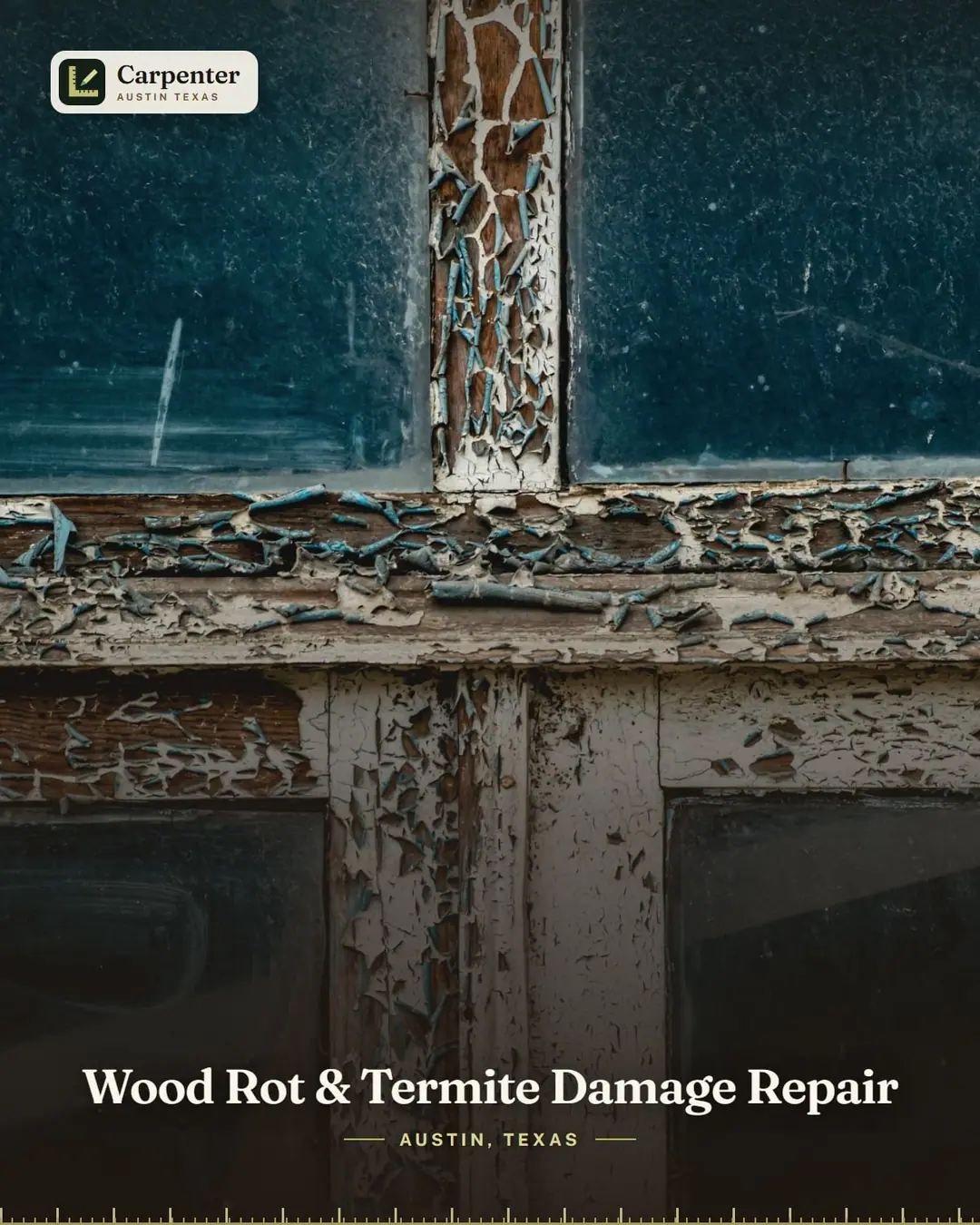
Structural, repair and remodeling · Austin, TX
It usually starts small. A screwdriver sinks into the bottom of a porch post, paint bubbles on a window sill, or the termite inspector's report comes back with two words: damage observed.
Carpenter Austin Texas cuts out rotted and termite-damaged wood, finds out why it happened and rebuilds with lumber, fasteners and finishes chosen for Central Texas heat, humidity and termites. Our jobs run from a single rotted porch post on a 1920s bungalow to sill plates and floor joists under the house. If you need termite damage repair in Austin, or you've been searching for wood rot repair near me after finding a soft spot, we start with a free written estimate. Rot and termite work is part of our home carpentry repairs.
We probe the wood, show you how far the damage goes and give you a clear written estimate. On time, with your home protected and cleaned up after.
01Warning signs
From the outside, rot and termite damage often look alike, and they often turn up in the same board. That's no coincidence: subterranean termites go after moist wood, and moist wood is where rot starts. The signs of each are below.
The surface almost never shows how far rot has gone. A sill with one soft corner can be hollow halfway along its length, and that only becomes clear once the trim or paint comes off.
Rot comes in two common forms. Brown rot leaves wood dark, dry-looking and cracked into small cubes, while white rot leaves it pale, stringy and spongy. Both destroy strength long before the wood looks gone, and both need moisture to keep spreading.
These signs come from Terminix and Texas A&M guidance on termites:
If you see live termites, call a licensed pest control company first. We repair the damage after the treatment.
Do not break open mud tubes or spray store-bought products on them before the pest control company inspects. Disturbed tubes make it harder to tell whether termites are active, and the colony usually just builds a new route nearby.
Walk the outside of the house with a screwdriver and a flashlight. Press gently into the bottom of door jambs, the ends of window sills, the base of porch posts and the lowest siding boards, which are the places water sits longest. Healthy wood pushes back. Soft wood gives way.
Inside, check under sinks, around the base of tubs and toilets, and along baseboards on outside walls. Flooring that feels soft, a toilet that rocks or baseboard paint that bubbles can all point to a slow leak feeding rot underneath.
Under a pier-and-beam house, look at the sill plates and rim joists on the side that gets the least sun and the most runoff, since rot and termite tubes usually show there first. Note what you find, and leave anything with live termites undisturbed for the pest inspector.
02What we do
Central Texas is hard on wood. Most of the rot and termite damage we repair in Austin comes from one of three local causes, and many homes have more than one.
Rot fungi need two things: moisture and warmth. Austin has a long hot season, humid spells and storms that drop heavy rain in a short time, all of which soak exposed end grain. Summer heat and sun then crack paint and caulk. Water gets into the cracks and stays there.
Lawn sprinklers make it worse. A head aimed at the siding or the porch steps keeps the same wood wet several times a week, all summer.
The Austin spots we repair most often:
Paint color plays a part. Dark paint on south and west walls runs hotter in full sun, which speeds up cracking at joints and lets water in sooner. Lighter colors and fresh caulk on those faces slow the cycle down.
Native subterranean termites are common across Central Texas. They live in the soil and build mud tubes to reach wood above ground.
Formosan subterranean termites are different. They're an invasive species and more aggressive than the native kind. Texas A&M AgriLife lists Travis County among the Texas counties where Formosan termites have been detected. KXAN in Austin has reported that Formosan termites swarm at night in May and June.
That matters for the repair. Termite damage doesn't stay in the trim. It can reach sill plates, studs and floor joists, so a proper repair checks the structure as well as the surface.
Swarmers are a warning, not the main threat. The termites that do the damage are workers that rarely leave their tunnels, so wood can be eaten from the inside for a long time before anything shows. Regular inspections catch activity the eye cannot.
The same patterns show up again and again in Austin homes. Pier-and-beam crawl spaces in older central and east Austin neighborhoods such as Hyde Park, Travis Heights and East Austin stay damp for weeks after rain. Mulch, soil or siding touching wood gives both rot and termites a direct path. Gutters dump water right at the foundation. And past repairs done with untreated lumber rot out long before the original wood around them.
Additions are a common weak spot in older houses. Where a newer room meets the original house, roof flashing, siding joints and floor framing often do not line up well, and water finds the gap. Check that seam first when an older home has rot.
Most rot starts at joints, not in the middle of boards. Water runs along a surface until it meets a seam, then wicks into end grain behind the paint where it cannot dry out. Window sill corners, the joint where trim meets siding and the bottom edge of door casing are classic examples.
Condensation causes rot too. In Austin summers, cold air conditioning ducts and pipes in attics and crawl spaces can sweat and drip onto joists and subfloor. Bathrooms without a working exhaust fan keep window trim and baseboards damp after every shower.
Rot and termites feed each other. Wood softened by fungi is easier for termites to tunnel through, and the moisture termites carry into wood helps fungi grow. That is why controlling water is the first defense against both.

Wood should be cut, fitted, and finished like it’s meant to last a lifetime.
03What we do
Rot and termite damage can show up almost anywhere wood stays damp. The sections here go spot by spot. Exterior trim and decks also have their own detailed service pages, linked below, for when the damage is part of a bigger repair on the outside of the house.
Rotted wood replacement in Austin homes most often means window sills, brick molds, door jambs and thresholds. Inside the house, it means baseboards near tubs and toilets, where slow leaks soak the wood from behind.
When rot is limited to one end of a board, we cut out the bad section and splice in a matching piece, glued and fastened to sound wood. When it runs most of the length, the whole piece gets replaced.
Window replacement and historic window restoration are separate services. Our work here is the rot.
Door jambs often rot from the bottom up, hidden by weatherstripping and the threshold. A jamb can usually be repaired by cutting off the rotted base and splicing in new wood, which keeps the door and hinges in place and avoids replacing the whole frame.
Porch posts and columns usually rot at the base, where water sits on the porch floor and wicks up into the end grain. Railings and balusters rot where they meet the posts, and porch decking rots at the board ends.
A porch post that holds up the roof is structural. Before we remove it, we set temporary support under the beam so the porch roof doesn't move. Then the rotted post comes out and a new one goes in on a base that keeps its end grain off the wet floor.
Larger porch rebuilds are handled by our porch team.
Hollow porch columns hide rot well. Water gets in at the top or through a cracked joint and rots the column from inside while the paint still looks fine. Tapping along the column and pressing at its base tell you more than looking.
Rot at the roof edge and in siding boards is common in Austin, because those boards take direct rain and sun. Our approach is the same. We find the water, then cut out the rot and rebuild. Our pages on fascia and soffit repair and siding repair cover those services in detail.
Rotted deck boards, joists and ledgers are a structural and safety issue, especially where the deck attaches to the house. The full service is on our deck repair page.
Termite damaged wood repair in Austin often goes deeper than trim. Sill plates, rim joists, floor joists, wall studs and subfloor all carry load, so the repair follows a set order.
We set temporary shoring to carry the load, then remove the damaged sections. Members that are still mostly sound get sistered. Members that are hollowed out get replaced, with treated lumber anywhere new wood meets masonry or soil.
When load-carrying members are involved, a structural engineer designs the repair and it goes through a City of Austin permit. If floors in the house already sag or bounce, our page on Austin sagging floor repair explains how we fix the framing under them.
Sill plates rot where water reaches them most: under leaking doors, below plumbing walls and along the side of the house where gutters overflow. Termites often follow the same route, so the repair and the moisture fix need to happen together.
Every repair spot has a detail that keeps water out. Window sills need a slope that sheds water outward and a drip edge underneath. Thresholds need a seal below them. Porch posts need a base that lifts end grain off the floor, and fascia needs a drip edge above it. A rebuild without that detail keeps the old weakness.
Hidden rot often sits behind the visible spot. Rot at a window sill can extend into the framing below the window, and rot at a fascia board can reach the rafter tails behind it. Opening the area is the only way to know, and it is better to find out before new wood goes in.
04Side by side
Not every rotted board has to come out. The right repair depends on how much rot there is, where it is and whether the board carries load.
| Epoxy consolidant and filler | Partial replacement (Dutchman or splice) | Full replacement | |
|---|---|---|---|
| Best for | Small, shallow, non-structural rot in trim, sills or moldings worth saving, such as original millwork | Rot limited to one section of a long board | Widespread rot, or any structural member |
| How it works | Rotted fibers are removed, a liquid consolidant hardens what's left and an epoxy filler rebuilds the shape | The rotted section is cut out and a new piece of matching wood is glued and fastened in | The whole piece is removed and a new one installed |
| Durability | Good, when the moisture source is fixed | Good, when joints are sealed | The longest, when the moisture source is fixed |
| Cost level | Lowest for small spots | Moderate | Highest |
| Limits | Not for structural wood or deep rot | Needs a profile that can be matched | More material and labor, and more finish work |
Start by finding the edge of sound wood. Probe outward from the soft spot until the tool stops sinking in. If the soft area is small and the wood around it is solid, epoxy can work. If the probe finds soft wood in several places or along the length, replacement is the safer call.
Weigh what the board is worth to the house. Original millwork with a profile that is no longer made is worth saving with epoxy, even when it takes longer. A plain modern board is often faster and cheaper to replace than to rebuild.
Epoxy needs dry wood to bond, so it goes on only after the wood has dried out. It also needs paint over it, because sunlight breaks down most epoxy fillers when they are left bare.
This Old House's guidance puts a number on it: epoxy works when rot is confined to a small area, and if more than about 10 percent of a sill is rotten, the sill should be replaced. For rotted wood replacement in Austin homes, we use the same rule of thumb and tell you which side of it your board falls on.
No repair lasts if the water keeps coming. Every option in the table depends on fixing the leak, the drainage problem or the soil contact that caused the rot.
05How it works
Probe the damage, find the cause, treat any active termites first, protect and shore, cut back to sound wood, rebuild with the right material and finish ready for paint.
We probe the wood around the visible damage to map how far it actually goes.
Probing starts at the visible damage and works outward in every direction until the tool meets firm wood. An awl or screwdriver shows softness, a tap with a handle shows hollowness, and a moisture meter shows how wet the wood still is. Each soft area is marked so the full extent is clear before anything is priced.
The check also covers places you may not have looked: the framing behind a rotted sill, the rim joist below a rotted threshold and the rafter tails behind a soft fascia. Your part is pointing out every spot you have noticed and any history you know, such as an old leak or a past termite treatment.
What to expect You show us every soft spot you know about and share any history of leaks or termite treatment.
That could be a leak, poor drainage, wood touching soil, failed caulk or active termites.
Every rot repair needs an answer to one question: where does the water come from? The search works up and back from the damage, looking for a gutter that overflows, a missing drip edge, a sprinkler head, a window with failed flashing, soil touching the siding or a plumbing leak inside the wall. For termite damage, the question is how they reached the wood.
Sometimes the cause is something you can fix yourself, like turning a sprinkler head or pulling mulch back. Other times it needs a roofer, a plumber or a pest control company. Either way, the estimate names it, so you can decide how to deal with it before the new wood goes in.
What to expect You hear what caused the damage and decide how the source will be fixed before any new wood goes in.
A licensed pest control company treats before we start repairs, so new wood isn't attacked.
If live termites, fresh mud tubes or damp tunnels turn up, repairs wait until a pest control company has treated the house. New wood put into an active infestation gives the colony fresh food. Treatment also has to reach the soil and the routes the termites use, and repair work done first could disturb them.
You hire the pest control company, or use the one you already have under contract. Ask what treatment they will use and whether any areas should stay undisturbed afterward. That answer shapes how the repair is planned around the foundation and the crawl space. Keep the treatment paperwork with your house records as well.
What to expect Your pest control company treats the house, and you pass on what they did and any areas to leave alone.
We protect the area around the repair and set temporary shoring if the damaged wood is structural.
Indoor repairs start with drop cloths, floor protection and plastic barriers, because cutting rotted wood and old paint makes dust and debris. Outside, plants near the work are covered or tied back and the ground below is protected, so paint chips and rotten wood can be gathered up.
When the damaged wood carries load, such as a porch post, sill plate or joist, temporary support goes in before anything is removed. Posts or short shoring walls pick up the load nearby so the structure above stays put. Skip that and a porch roof or a floor can drop while the old wood is out. Your part is clearing furniture, plants and stored items from around the repair.
What to expect You clear the area, then see floors and plants covered and, for structural repairs, temporary supports go in.
All damaged wood comes out, back to sound material, not just the soft surface.
Rotted wood is cut back past the soft area into wood that is firm and dry, since fungus can live in wood that still looks sound at its edge. For trim, that can mean cutting a sill back to a clean joint. For framing, it means removing whole sections of a stud, joist or plate and checking the members on either side.
This is when hidden damage usually appears. A sill plate that looked soft at one corner may be hollow along a longer run, and rot behind trim can reach sheathing and studs. Covering soft wood instead of removing it only buries the problem, so the full extent gets dealt with now.
What to expect You see how far the damage really went and approve any added work in writing before it continues.
New wood goes in using rot-resistant or treated material where it fits the job. Cut ends are primed and sealed, and fasteners are corrosion-resistant.
New wood is cut to fit the opening and matched to the profile and size of what was removed. Splices on trim are made with angled joints that shed water, rather than square butt joints that trap it, then glued and fastened to sound wood. Structural members are sistered or replaced as the plan calls for, with treated lumber where new wood meets masonry or soil.
Every cut end is primed and sealed before the piece goes in, because end grain is where water enters first. Fasteners resist corrosion, since treated lumber and damp spots eat through plain steel. It is also the moment to improve on the original detail, with a drip edge, a gap above the porch floor or flashing behind trim.
What to expect You see new wood fitted to match the old and can check the joints and profile before finish goes on.
Joints are caulked and the repair is left primed and ready for paint, and the site is cleaned.
Joints between new and old wood, and between trim and siding, are caulked with an exterior sealant that stays flexible in heat. Nail holes are filled and the new wood is primed so it is protected and ready for paint. Paint it soon after priming, because primer alone is not meant to face Austin sun for long.
Clean-up removes rotted wood, offcuts, fasteners and paint chips from the site. After the next heavy rain, take another look at the repair. Water should run off the new wood rather than sit on it, and the source found earlier should stay dry.
What to expect You see the repair caulked, primed and ready for paint, with the work area cleaned.
Hidden damage found partway through a job doesn't get repaired on the spot. We show it to you and price it in writing first.
06Rules & permits
Pest control companies and carpenters do different jobs. Pest control companies, licensed through the Texas Department of Agriculture's structural pest control program, inspect for termites and treat them. We repair the wood they damaged.
Treatment comes first, then repair. During the repair we keep the treatment barrier intact: we don't disturb treated soil around the foundation, and we keep new wood off the soil so it doesn't create a fresh path in.
Some termite bonds and service plans include coverage for repairs to new damage, and some don't.
If you're buying or selling, the wood-destroying insect report from the inspection may list damage that needs repair. Send it to us and we'll price the repairs it lists. We don't treat termites ourselves.
Give the carpenter the pest inspector's report and diagram, and give the pest company a note of what was repaired. Each one sees damage the other may miss, and both records together show the full history of the house.
New landscaping, a plumbing repair under the slab or a patio poured against the house can disturb treated soil. Ask your pest company whether the barrier needs checking after any digging near the foundation.
Unlike subterranean termites, drywood termites live inside the wood and do not need soil contact. Small pellets near trim or furniture mean a pest company should inspect, since treatment often targets the wood itself rather than the soil.
07Pricing
Cost depends on how far the damage goes and whether it's structural. A probe inspection gives you the real number. For third-party benchmarks, a Mr. Handyman cost guide puts epoxy repair of trim, casing or a sill at about $218 to $400, based on Tampa-area pricing. Insurify gives $1,000 to $10,000 as a normal range for termite damage repair, with about $3,000 as the average. Better Termite's 2025 guide tiers the work: $300 to $2,000 for minor or cosmetic damage, $2,000 to $5,000 for moderate and $5,000 to $15,000 or more for major structural damage. Those are the sources' figures, mostly national, not our prices.
NerdWallet, Policygenius and Insurify all describe most standard homeowners policies as excluding termite damage and gradual rot, which insurers treat as preventable with maintenance. There are exceptions. Hidden damage that causes a sudden collapse may be covered under some policies. Rot caused by a sudden covered event, such as a burst pipe, may be treated differently from rot that built up over years. Read your policy and talk to your agent. We can provide a written estimate and a description of what we found for your claim, but we can't promise what your insurer will pay.
Rot and termite damage grow every wet season that the source stays in place. A soft corner of a sill caught early can be a quick splice or epoxy fix, while the same spot left alone can reach the framing below it.
Once damage reaches sill plates, joists or studs, shoring, engineering and a permit can become part of the job. Those steps add cost, but they make sure the repair is designed for the load it carries.
Fixing grading, a leaking shower pan or a run of gutter sometimes costs more than the carpentry itself. Budget for it, because without it the repair is only temporary.
08Why us
We chase the moisture source, rebuild structure and match trim on the same job, choose materials for Austin conditions, price extra work in writing and keep your home protected and clean.
Ask how far past the soft spot the wood will be cut, and what happens if the damage goes further. A clear answer shows the repair is aimed at sound wood rather than just the visible surface.
Ask what caused the rot and how the source will be stopped. If nobody can answer that clearly, the repair is likely to fail in the same place.
Ask how cut ends, joints and fasteners will be protected on the new wood. Those small details decide how long a repair lasts in Austin sun and rain.
Wood should be cut, fitted, and finished like it’s meant to last a lifetime.
09Checklist
Keep water moving away from the house, keep wood off the soil, keep paint and caulk sound, keep the crawl space dry and have termites inspected every year.
In spring, when termites begin to swarm, walk the foundation looking for mud tubes and discarded wings, and check that sprinklers still point away from the house after any yard work.
In summer, check the south and west sides for cracked paint and open caulk joints, since the sun breaks them down there first. Close small openings right away, while a tube of caulk is all they need.
In fall, clean the gutters and confirm downspout extensions still carry water well away from the foundation. In winter, when plants die back, it is easier to see where soil and mulch have crept up against siding.
10DIY or pro
A small, shallow epoxy patch on trim is fair DIY work, but load-bearing wood, unknown leaks, termites, work at height and repairs that need documentation call for a professional.
The short version
A confident DIYer can handle a small, shallow epoxy patch on a piece of trim.
Dig out all the soft wood first, down to firm fibers, then let the area dry out fully. Epoxy over wet or soft wood fails from underneath, often without showing it until the damage has spread.
Brush a consolidant into the remaining fibers to harden them before filling. Shape the filler slightly proud of the surface and sand it flush once it cures. Then prime and paint the patch, because epoxy and wood both need protection from the sun.
If you find more rot than expected while digging out, stop there. A soft spot that keeps growing as you work is usually bigger than a patch can fix.
Call a professional when
11Service area
We repair rot and termite damage across Austin: Central, North, North Central, Northeast, Northwest, Far North, East, West, South, South Central, Southeast Central / Riverside, Southeast and Southwest Austin.
People looking for wood rot repair near me in any of those areas are in our service area. Older homes in central and east Austin, with pier-and-beam crawl spaces underneath, see the most structural rot: sill plates, rim joists and floor joists that have sat in damp air for decades.
older bungalows and cottages, historic districts like Hyde Park, and renovations on tight lots.
(737) 415-9388Central Austin, TX
mid-century ranch homes in established neighborhoods.
(737) 415-9388North Austin, TX
mid-century houses, many due for new trim or decks.
(737) 415-9388North Central Austin, TX
newer subdivisions sitting on the clay east of I-35.
(737) 415-9388Northeast Austin, TX
Hill Country lots on sloped limestone, with decks built for the view.
(737) 415-9388Northwest Austin, TX
newer subdivisions where builder-grade trim and fences often need upgrades.
(737) 415-9388Far North Austin, TX
older homes east of I-35 on clay soil, with plenty of infill and renovation.
(737) 415-9388East Austin, TX
hillside homes on limestone, where decks and stairs follow the slope.
(737) 415-9388West Austin, TX
established neighborhoods with a mix of older and newer homes.
(737) 415-9388South Austin, TX
older houses around neighborhoods like Travis Heights, many with porches and original trim.
(737) 415-9388South Central Austin, TX
older homes, rentals and newer infill south of Lady Bird Lake.
(737) 415-9388Riverside, Austin, TX
growing neighborhoods on clay soils, where doors and trim feel the ground move.
(737) 415-9388Southeast Austin, TX
hillside lots with decks and views toward the Hill Country.
(737) 415-9388Southwest Austin, TX
Homes on the clay east of I-35 often have crawl spaces and slab edges that stay damp after storms, which keeps sill plates and rim joists wet. Better drainage around the house is often part of the lasting fix there.
On wooded lots in west and southwest Austin, shade and leaf litter slow drying, gutters clog quickly and branches rub fascia and roof edges. Those homes tend to see more rot high on the house than near the ground.
Newer subdivisions are not immune. Finger-jointed trim, landscaping packed against walls and sprinklers set close to the house can bring rot to homes that have only seen a few summers.
12Questions
It depends on how far the rot goes, whether the wood is structural and how hard it is to reach. For small trim repairs, a Mr. Handyman guide puts epoxy repair of trim or a sill at about $218 to $400, based on Tampa-area pricing. We'll inspect yours and give you a free written estimate.
Insurify gives a national range of $1,000 to $10,000, with about $3,000 as the average. Cosmetic damage to trim sits at the low end. Structural damage to sill plates and joists, especially when an engineer and permit are needed, sits at the high end.
Usually, for small spots. Epoxy saves the board and avoids matching a profile. It isn't the right repair for structural wood or for rot that runs deep, and in those cases replacement costs more because it's the only repair that holds.
Sometimes. Some termite bonds and service plans include repair coverage for new damage that happens while the plan is active. Others only cover re-treatment. Read your contract or ask your pest control company what yours includes.
It depends on whether the leak was sudden and covered, or slow and long-term. Rot from a leak that started with a storm may be treated differently from rot that built up over years of missed maintenance. Ask your insurer before you assume either way.
No. Our estimates are free, and they're in writing.
A buyer's inspector will usually flag it, so it's often worth fixing or at least pricing ahead of time. A repair done before listing takes it off the buyer's list. A written quote, even unused, helps both sides negotiate with real numbers.
Yes. Get active termites treated by a licensed pest control company, then repair the damage. New wood put in while termites are still active can be attacked within the same season.
No. Licensed pest control companies treat termites. We repair the wood they damaged and coordinate the timing with your pest control company.
Yes. Texas A&M AgriLife lists Travis County among the Texas counties where Formosan subterranean termites have been detected. Native subterranean termites are still the more common termite in Austin homes.
Usually in spring. Subterranean termites commonly swarm then, and KXAN has reported that Formosan termites in Austin swarm at night in May and June. Wings on a windowsill in spring are worth a call to a pest control company.
Lightly damaged wood can sometimes be reinforced, by sistering a new member alongside it or adding a consolidant to trim. Structural wood that termites have hollowed out has lost its strength and gets replaced or sistered.
Live termites, fresh mud tubes and moist soil inside the tunnels all point to an active infestation. Dry, crumbling tubes and empty galleries suggest old damage. A pest inspector confirms either way.
It's an inspection report, often part of a Texas real estate sale, that notes termite activity and damage at the house. A licensed pest control inspector fills it out. If yours lists damage, send it to us and we'll price the repairs.
Small trim repairs are quick. Structural repairs take longer, mostly because engineering and permits come before the carpentry, and termite treatment has to happen first when termites are active. Your estimate includes a schedule.
It depends on where the wood goes. Treated lumber fits structural members and anything near the ground, while cedar and PVC trim are common choices for exterior trim. The estimate names the material for each part of the job.
Usually. Many older profiles still exist as stock moldings, and others can be built up from two stock pieces. We look at your trim before quoting and tell you how we'd match it.
Trim repairs usually don't. The City of Austin's list of work exempt from building permits includes repairing or replacing exterior trim, wood fascia and soffits. Replacing structural members like joists or sill plates may need a permit, so confirm with the City of Austin Development Services Department.
For small spots, sometimes. Most of the time some siding or trim has to come off, because the only way to see how far rot has spread is to look at the wood behind the surface.
Yes. Rot fungi spread through wet wood that touches other wet wood. That's why we remove all of the affected material, not just the soft part, and fix the moisture source.
Stop the water. Fix the leak or drainage problem that started it. Then keep exterior wood sealed and painted, and keep it off the soil.
There's no fixed number that fits every house. Inspect your trim once a year, and re-caulk and repaint when paint starts to crack, peel or chalk. South- and west-facing trim takes the most Austin sun and usually wears out first.
Pressure-treated wood resists rot and termites, but it can still decay. Cut ends that weren't sealed are the weak spot, and so is wood that sits in standing water.
It's a strong option for trim that stays wet, because PVC doesn't rot. The trade-offs: it looks different from painted wood up close, it expands and contracts with Austin heat, and homes in historic districts may need approval before swapping wood for PVC.
Mulch holds moisture against the house, and moist soil next to wood suits subterranean termites. Keep mulch pulled back several inches from siding and the foundation.
Once a year is the common advice from pest control companies, including Stride Pest Control. Follow the schedule your own provider recommends.
Look at the gutters and for water pooling at the foundation. Check the crawl space for standing water or damp soil, and press on the trim at window sills and porch post bases. Soft wood after a storm is worth a look.
13Keep exploring
Wood rot & termite damage repair is one part of what we do. The same crew handles the services below, so one call covers the whole job.

Carpentry repair in Austin for loose trim, rotted posts, stairs, and water, storm or fire damage. Small jobs welcome, with a free written estimate.
See the service
Sagging floor repair in Austin for joists, subfloors and squeaks, with an honest call on framing vs foundation. Costs, process and a free estimate.
See the service
Rough carpentry in Austin: wall and roof framing, beams, attic conversions and pier-and-beam repair, built to engineer plans. Free written estimates.
See the service
Kitchens, baths, open layouts, garage conversions and aging-in-place work from Austin carpenters who frame and finish it. Free, clear written estimates.
See the service
Historic home restoration carpentry in Austin: millwork matching, porch restoration and in-kind repairs that suit historic review. Free written estimates.
See the service
Commercial carpentry in Austin for tenant finish-outs, office build-outs, retail fixtures, millwork and property repairs. Clear written bids, on time.
See the serviceFree written estimate
We find the damage, fix the cause and rebuild it to last, anywhere in Austin.
From a single rotted porch post in a 1920s bungalow to a custom cedar deck overlooking the Hill Country.
Original trim, porches and windows repaired with lumber, fasteners and finishes chosen for Central Texas.
Tenant improvements, commercial millwork and ongoing repairs for rental homes.