


Those figures don't line up neatly
The HomeBlue data is older, and per-foot figures may not include railings, stairs and permits. The 2026 range is all-in pricing for full projects. Both are the sources' figures, not our prices.
 Carpenter Austin Texas(737) 415-9388
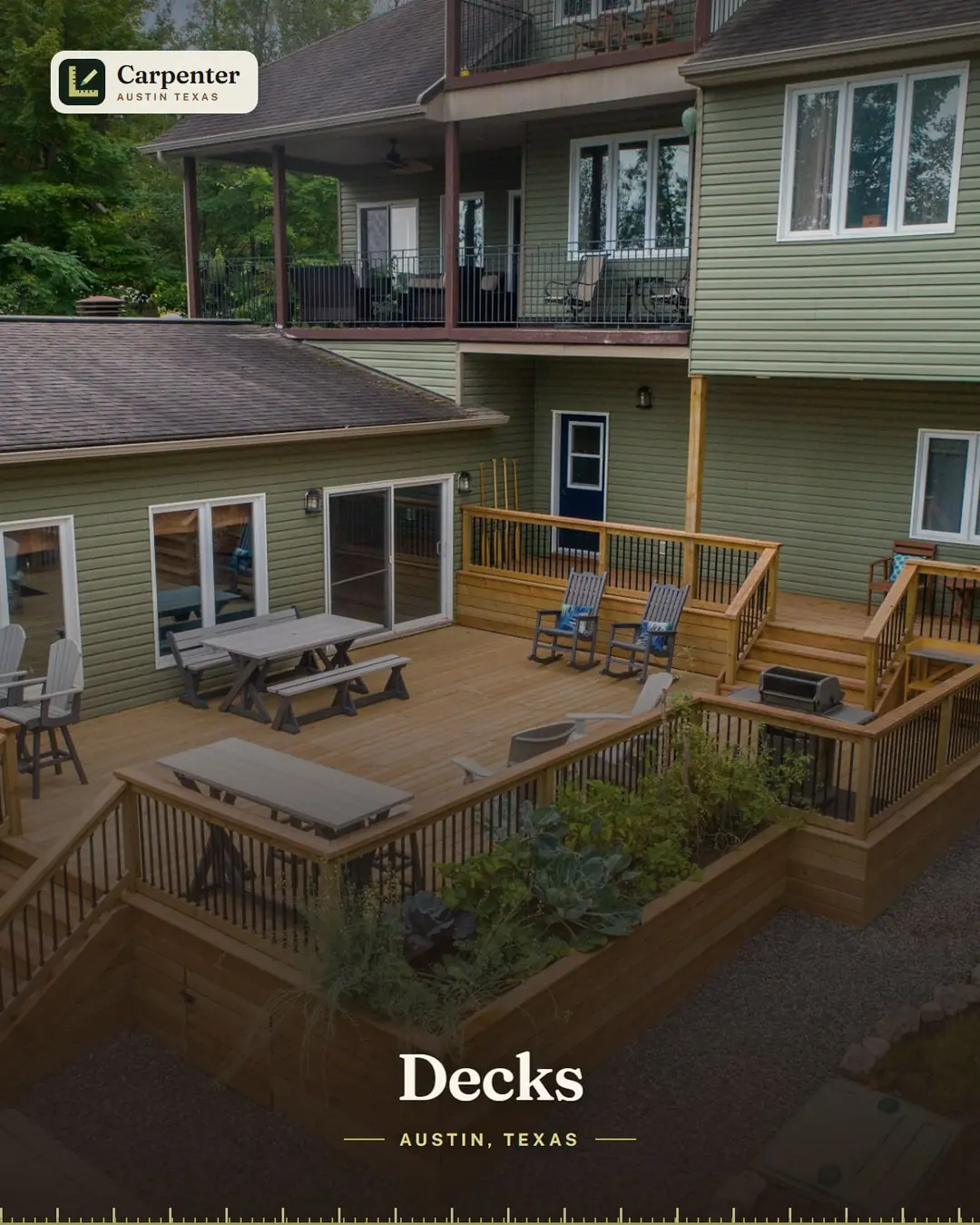
Outdoor and exterior · Austin, TX
In Austin a good deck gets used for most of the year. It should feel like an extra room off the kitchen in April and still look right twenty years from now. Carpenter Austin Texas designs and builds custom decks: ground-level platforms, raised and second-storey decks, multi-level decks, pool decks and rooftop decks. We also replace worn-out decks and build the railings and stairs that go with them.
If you're comparing deck builders Austin homeowners recommend, start with how the builder thinks about wood. Ours is simple: it should be cut, fitted, and finished like it's meant to last a lifetime. As a custom deck builder, Austin jobs for us run the full range: we've framed everything from a low backyard platform to a cedar deck overlooking the Hill Country. We're a full-service carpenter in Austin, not just a deck contractor. Austin homeowners who hire us for a deck get the same crew that handles trim, stairs and framing.
Central Texas is hard on decks. Summer heat, sudden storms, shifting clay soil and termites all work on the frame, so we pick lumber, fasteners and finishes that hold up here. You get a free written estimate. We show up when we say we will, protect the yard while we work and clean up at the end of each day.
Tell us about your yard and how you want to use it. We'll visit, measure, talk materials and give you a clear written estimate, free. On-time arrival, yard protected, clean job site.
01What we do
Everything below is work we do on and around a deck, from the footings up to the last stair tread. Each section stands on its own, so jump to the one that matches your project. Whichever deck builders Austin homeowners end up calling, the frame is the part to ask about, because it decides how long the deck lasts. Repair-only work has its own page, linked in the replacement section.
A custom deck is designed around your house, the slope of the lot, where the sun lands and which trees you want to keep. A kit can't do that. Hiring a custom deck builder? Austin lots run from flat central yards to steep West Austin slopes, so we sketch the deck to the yard first and pick the material second.
Some jobs get split between a framing crew and a finish crew. We frame, deck, rail and trim the whole job ourselves, which keeps the details consistent from the posts to the fascia.
Deck replacement in Austin makes sense when the problems are in the structure, not the surface. A new board won't fix a rotten beam.
Signs it's time to replace:
Replacement starts with demolition and haul-off. We check the old footings and reuse them only if they're sound and sized correctly; otherwise they come out too. Then we frame to current code, lay new decking, build new railings and stairs, and pull the permit the job needs.
It's also a chance to redesign. You can go bigger, add a better stair, or switch from pine to cedar or composite while the old deck is gone.
If the frame is still sound and only the surface or a few boards are bad, you probably don't need a new deck. Our deck repair in Austin team handles that work.
Deck railings in Austin take full sun all summer, so the style you pick changes how much upkeep you sign up for.
Raised decks need guards. Building code sets both the guard height and the largest opening allowed between balusters, and we build to the version the City of Austin has adopted when your permit is issued. We can also replace the railings alone on an existing deck if the frame below is sound.
Pool decks in Austin can be wood or composite, built around above-ground pools or alongside in-ground ones. The surface you pick matters more here than anywhere else in the yard, because people walk on it barefoot in August.
Lighter colours, capped composite and cedar run cooler underfoot than dark boards. Ask to see a sample in the sun before you choose. Boards also need some grip when wet, and the frame needs drainage so splash water doesn't sit on the joists.
Chlorine and salt water are hard on hardware. Around a pool we use stainless or coated fasteners and connectors made for that exposure. We also keep the gaps between boards clear so water runs through.
Pools come with their own barrier and gate rules in Austin. Those rules affect where the deck stairs land and how the railing ties into the fence. We check the City's current requirements during design, before anything is drawn in final, and plan the deck so the barrier works with it.
Think about where wet feet go. A path from the pool to the house across boards with good grip and no raised fasteners prevents slips, and a spot for towels and loungers out of the main walkway keeps the deck easy to cross.
Rooftop decks in Austin sit over flat roofs, garages or the low roofs on some central Austin townhomes. They almost always need a structural engineer and a building permit, so we don't treat them as a weekend add-on.
The questions start with load. Can the existing roof framing carry the deck, the furniture and a crowd? Next is the membrane. The deck has to sit on sleepers or pedestals that don't puncture the roof, and the membrane needs protecting during the build. Every open edge gets a guard.
Wind and sun hit harder up there. There's no tree shade on a roof, so it's worth planning a pergola or shade structure from the start.
We work alongside a roofer for the membrane and flashing. We don't do the roofing ourselves. A rooftop deck is never permit-free, and we'll walk you through what the City asks for before design is final.
Deck staining in Austin is about fighting UV. Bare wood turns grey and starts to check quickly under our sun, and the cracks hold water.
Good staining is mostly prep. We wash the deck, use a brightener to even out the colour, let the wood dry, and lightly sand rough spots. Then the stain goes on.
Expect to redo any of them more often than you would in a milder climate. On walking surfaces we usually suggest a penetrating semi-transparent stain. Film-forming products sit on top of the wood, and once foot traffic and sun crack that film, it peels. Penetrating stain fades instead, which is easier to recoat.
New cedar and pressure-treated pine both need to dry out before stain will soak in. We test the wood before we stain it. Composite decks don't need stain at all, only cleaning.
A quick water test tells you whether wood will take stain. Sprinkle a little water on the boards. If it soaks in quickly, the wood can usually take stain. If it beads and sits, the wood is still too wet or sealed, and stain will not penetrate.
Boat docks in Austin take water, sun and wakes all year. We do the carpentry on docks: decking, walkways, re-decking a tired dock surface and repairs to wood framing.
Materials have to suit the water. That means lumber treated for marine or ground contact, composite decking where you want less upkeep, and stainless or hot-dip galvanized hardware that won't rust out in a few seasons.
Permits depend on the lake. Lake Austin shoreline inside the city limits goes through City of Austin review, while docks on Lake Travis are generally regulated by the Lower Colorado River Authority (LCRA). We'll help you confirm the right permit path for your lot before any work is priced in final.
Size the deck for the furniture, not the yard. A dining table needs room for chairs to pull out and people to walk behind them, and a grill needs space away from the house wall and the railings. Lay the furniture out on the lawn, with a garden hose as the border, to test the shape.
Plan the stairs early. Where they land decides how people cross the yard, so aim them toward the path, the gate or the pool, not into a planting bed. Wide stairs take more space but work as seating and feel safer for children.
Think about what you may add later. Shade, lighting, a hot tub or a privacy screen are all easier when the frame and footings are planned for them from the start.
02What we do
Most Austin decks sit on a pressure-treated pine frame no matter what goes on top. The frame is out of sight and treated pine is strong, rated for ground contact and fairly cheap. So the real choice is the surface board, and that comes down to three things: budget, how much upkeep you want, and how the deck feels underfoot in July. The table compares four common choices. The sections after it go deeper on composite and cedar, the two usual upgrades over pine.
| Board | Look | Upfront cost | Upkeep | Heat underfoot | Lifespan in Austin | Best for |
|---|---|---|---|---|---|---|
| Pressure-treated pine | Plain, greenish at first, greys if left bare | Lowest | Highest: regular sealing | Moderate | Shorter | Tight budgets, painted or solid-stained decks |
| Cedar | Warm natural wood | Middle | Stain every few years | Cooler than dark boards | Longer than pine with care | Natural look, shaded or partly shaded decks |
| Capped composite | Wood-grain plastic shell, many colours | Higher | Low: wash only | Dark colours get hot | Long | Owners who won't re-stain |
| Tropical hardwood (ipe) | Dense, dark, fine grain | Highest | Oil to keep colour | Moderate | Longest of the wood options | Premium decks and pool surrounds |
Composite decks in Austin use boards made from wood fibre and plastic with a hard plastic cap, or from solid PVC. Neither one rots, and termites don't eat them. You never stain them, and capped boards hold their colour well.
The trade-offs are real. Composite costs more upfront than pine or cedar. Darker colours get hot in direct Austin sun, so we steer west-facing decks and pool decks toward lighter boards. Composite also expands and contracts with heat. Each manufacturer sets its own joist spacing and gap rules, and we follow them, because the boards will sag or buckle if you don't.
Hidden fasteners clip into the board edges, so the surface stays clean with no screw heads. Composite boards come with the manufacturer's warranty. That warranty is the manufacturer's, separate from our work, and it usually depends on the boards being installed to their instructions.
Which brands fit your deck depends on colour, heat and budget, and we'll talk through the options at the estimate.
Cedar decks in Austin are chosen mostly for the wood itself. It is warm to look at, and on a July afternoon it stays cooler underfoot than dark composite, which matters if you walk out barefoot. The heartwood resists rot naturally. Cedar is also light and stable, so boards stay flatter than pine.
Grade changes both price and look: knotty cedar has a rustic, busy grain and costs less, while clear cedar has few or no knots and costs more.
Cedar still needs stain or sealer every few years in Austin sun, or it greys and checks like any other wood. It also belongs on a pressure-treated pine frame with good clearance above the ground. Cedar heartwood resists rot, but it isn't rated for soil contact the way treated posts are.
Cedar costs more than treated pine. It's the board to pick when you want real wood that still looks like wood in ten years, and you're willing to stain it. A cedar deck on a West Austin lot facing the Hill Country is the kind of job it suits.
Pressure-treated pine has the lowest upfront cost. It needs regular sealing, and it can check and twist as it dries in our heat. Posts and anything near soil should be lumber rated for ground contact.
Tropical hardwoods like ipe are very dense and last a long time. They cost the most, and because the wood is so hard to cut and fasten, labour runs higher too. Oil keeps the colour. Left alone, ipe turns silver.
Which material fits which homeowner:
Compare boards by total upkeep, not just the purchase. A wood deck needs cleaning and fresh stain on a regular cycle, while capped composite needs washing. Count what that upkeep will take from you, in money or weekends, over the life of the deck.
Look at edges and ends. Wood boards show their grain on cut ends, and those ends need sealing to slow checking. Capped composite has a protected face and edges, but a cut end shows the core, which matters on stair treads and border boards.
Remember the frame under any surface. Whatever boards you choose, the frame is usually treated pine, and the tops of joists hold water under every board. Protecting those top edges helps the hidden wood last as long as the surface.

Wood should be cut, fitted, and finished like it’s meant to last a lifetime.
03What we do
Austin is hard on decks, and the parts that fail first are usually the ones you can't see. A board can look fine while the footing under it has dropped or the ledger behind it has been wet for years. Here's what we do differently.
Much of East, Northeast and Southeast Austin sits on Blackland Prairie clay. It swells when it's wet and shrinks in drought, and that movement can lift or drop a shallow footing. Much of West, Northwest and Southwest Austin is the opposite: thin soil over limestone or caliche. The ground is stable, but drilling piers through rock is slower and costs more.
For a deck, that means footings aren't one-size-fits-all. We set the depth and size for the site you have. The posts sit on concrete with standoff bases, so the wood never sits buried in soil. We also direct roof and yard drainage away from the footings, because water pooling around a footing on clay is how heave starts.
On a raised deck, a tall deck or a site with unusual soil, an engineer may need to design the footings. We'll tell you at the estimate if your deck is one of those.
Austin summer sun bleaches wood, opens checks in the surface and can cup boards. The daily heat cycle also works smooth nails loose over a few seasons, which is why so many old decks have nail heads standing proud of the boards.
What we do about it:
A deck pairs well with a pergola or patio cover. If shade is part of the plan, see our outdoor living construction page and we'll design the two together.
Spring storms in Austin bring sudden wind and heavy rain. Wind tries to lift and rack a deck, so we tie joists, beams and posts together with metal connectors and hurricane-style ties. The ledger is bolted to the house framing and flashed so water can't get behind it.
Heavy rain soaks posts at grade. That's why posts sit on concrete, above the soil.
Central Texas has subterranean termites, including Formosan termites. We use treated lumber for the structure and keep every piece of wood out of contact with soil. Keep mulch, planters and soil pushed back from the framing, too.
Moisture also gets trapped where the deck meets the house. Flashing and a small gap at the ledger let that area dry. These are the same details our carpenters check when they're deciding whether an old deck needs repair or replacement.
Watch the yard during a heavy rain before the deck is built. Water that sheets toward the house or pools where footings will go tells you drainage needs fixing first. A deck built over a wet spot keeps its frame damp and its footings moving.
Look at the trees around the deck. Large limbs over the deck drop leaves that hold moisture on the boards, and roots near footing locations limit where posts can go. Trimming and placing footings early avoids surprises during digging.
Note how much afternoon sun the deck will take. A west-facing deck in full sun is the place for lighter boards, gaps set carefully for heat movement and a plan for shade.
04What we do
Most decks in Austin need a City of Austin building permit. Only small, low, freestanding decks are exempt. The rules for those are narrow, and even an exempt deck still has to meet zoning rules, tree rules and, on many lots, HOA rules. We check these before your design is final, so you don't build something you'll have to change. Fees and review times vary by project and change over time, so we don't quote them here.
The City of Austin Development Services Department lists the work that doesn't need a building permit on its "Work Exempt from Building Permits" page. We checked that page in October 2026. Under it, your deck is permit-exempt only if all five of these are true:
Miss any one and the deck needs a building permit, which covers attached decks, raised decks, bigger decks and anything in a floodplain. Lighting and outlets need their own electrical permit. A licensed electrician pulls that one.
Exempt doesn't mean anything goes. The same City page says exempt work must still comply with building codes, City codes and all other applicable ordinances.
On a permitted deck, the City inspects the work at set stages before signing off. We plan the build around those inspections so framing isn't covered before it's checked.
Zoning setbacks still apply to decks, permit or not. A deck can't go wherever it fits.
Decks can also count toward your lot's impervious cover limit, which caps how much of the lot can be covered by hard surfaces. On a small central lot that's already close to the limit, this can shape the deck's size. We check it during design.
Austin protects larger trees, and the rules can affect where footings go near big live oaks. We plan footings around the root zone and check with the City when a protected tree is close.
Wildfire rules are newer. The City's Wildland-Urban Interface (WUI) Code page says more than half of Austin falls into one of three WUI zones. In Zone A, decks must be built with ignition-resistant or other approved materials; Zones B and C apply the rule within 30 ft and 10 ft of a building. The amended 2024 code took effect July 10, 2025. We look up your lot on the City's WUI map before choosing materials.
Many Austin subdivisions, including Circle C, Avery Ranch and Steiner Ranch, have an architectural review step before you build a deck. HOA rules can be stricter than the City's on colour, height and placement. A deck the City would approve can still be turned down by the HOA.
Read your CC&Rs early. Approval can add weeks before any digging starts, so it's worth knowing the rules before you fall in love with a design. Your submission usually needs drawings, a site plan and material and colour samples, and we'll go over what your HOA asks for at the estimate.
Have a current survey of your lot ready. It shows property lines, easements and existing structures, which are the starting points for setbacks and impervious cover. Without one, it is hard to confirm where the deck can go.
Count all the hard surfaces, not just the deck. Driveways, patios, sheds and walks already use part of your lot's impervious cover limit, so a small lot can run short of room before the deck is even drawn.
Keep the approvals together. The HOA approval letter, the building permit and the inspection records belong with the house papers, since a buyer or insurer may ask for them later.
05How it works
Every deck we build runs through the same seven steps.
We measure, check slope, soil, drainage, trees and sun, and ask how you'll use the deck.
Measuring starts at the house: the door the deck will serve, the height of its threshold above the ground, and what sits on that wall, such as windows, dryer vents, hose bibs, meters and AC lines. The deck surface usually sits a step below the door threshold so rain cannot run inside, so that height sets much of the frame.
Out in the yard, the check covers how far the ground falls away from the house, where rainwater runs and pools, the soil type and the trees the deck has to work around. Watching where the afternoon sun lands helps decide board color and whether shade belongs in the plan.
Think about how you will use the deck: a grill, a table for six, a hot tub later, a place for children to play. Each one changes size, layout and load.
What to expect You walk the yard with us, show where the deck should go and where stairs should land, and describe how you will use it.
You get a layout, material, railing and stair options, and an itemized price.
The layout shows the deck's footprint, any levels, where stairs land and how the deck meets the house. Check it against real use: room to pull chairs out from a table, a clear path from the door to the stairs, and space for the grill away from the house wall and the railings.
Options let you trade cost against upkeep and look. Material, railing and stair choices are priced separately, so you can see what a cedar surface or a cable railing adds compared with a simpler choice, and decide where the money matters most to you.
Read the itemized lines for what is included and what is not, such as removing an old deck, lighting work or footings for future shade. Ask about anything unclear before you sign.
What to expect You compare material and railing options line by line, adjust the layout, and pick the version you want built.
We confirm which permits and HOA approvals your deck needs before any work starts.
Most decks in Austin need a building permit. A deck that is attached to the house, more than 30 inches above grade, larger than 200 square feet, used as an exit or sitting in a flood hazard area falls outside the exemption. Confirming this first means the design and the paperwork match.
Zoning and site rules come into this step too: setbacks, impervious cover, nearby protected trees and, on many lots, wildfire zone material rules. Any of them can change the deck's size, position or board choice, so they get checked before the design is final.
If you have an HOA, read its guidelines and allow for its review before work is scheduled. City approval and HOA approval are separate, and you need both.
What to expect You read your HOA guidelines, start any approval it needs, and know which permits apply before any digging is scheduled.
Utility locates are called in before anyone digs.
Before anyone digs, buried utility lines get marked through the free locate service, so footing holes stay clear of gas, electric, water and communication lines. Private lines the locate service does not mark, such as irrigation, landscape lighting or a cable to a shed, are worth pointing out yourself.
Footing locations are laid out with string lines and stakes, squared to the house. The holes are dug or drilled to the depth and size the design and the site call for, and the concrete is set with post bases that keep the wood above the soil.
On clay, wet ground after rain can hold up digging. On rock, drilling is slower and louder. Either way, keep pets inside while holes are open.
What to expect You point out sprinkler lines and private cables, see the layout staked in the yard, and keep pets away from open holes.
Framing starts at the house with the ledger, the board that carries one side of an attached deck. The siding behind it is opened, the ledger is bolted into the house framing, and flashing laps over it so rain runs out instead of behind. Posts, beams and joists follow, tied together with metal connectors.
Joist spacing is set for the decking chosen, since some boards need closer support than others. Blocking goes in where railing posts will attach, because a railing is only as solid as the framing it bolts into.
Where the permit calls for an inspection, the framing stays uncovered until it passes. This is a good time to look at the frame yourself, since you will not see it this clearly again.
What to expect You see the bare frame before decking goes on, and you can look at the connectors and the ledger flashing up close.
Decking goes on with the gap the material calls for, which lets water drain and boards move with heat. Board ends are planned to land over joists, and on longer decks the end joints are staggered or broken with a divider board so the surface reads cleanly.
Railing posts bolt through the frame and its blocking rather than hanging off the rim board alone. Stairs are laid out so every riser and tread matches, because an uneven step is the one people trip on, and they land on a firm pad rather than bare soil.
Trim and skirting finish the deck. Skirting with gaps or a lattice pattern keeps air moving under a low deck so the frame can dry.
What to expect You see the deck take its final shape and can check how the stairs, rails and board pattern look before trim goes on.
We go over the deck with you and leave the yard clean.
On the walkthrough, push on every railing post and the top rail, walk each stair, and look along the boards for raised screw heads or uneven gaps. Look under the deck for loose offcuts, and check that the ground still slopes away from the footings.
Clean-up covers offcuts, screws, packaging and the soil dug from footing holes. Check the lawn edges near the stairs for a stray screw before you mow.
Ask how to clean your decking, what to avoid on its surface and when to plan its first finish if it is wood. Keep the permit records and any manufacturer paperwork with your house documents, since a buyer or insurer may ask for them.
What to expect You walk the deck with us, test the rails and stairs yourself, and keep the permit records and care notes.
We show up when promised, protect your yard and the house while we work, and clean the site at the end of every day. How long the build takes depends on size, height and inspections, and we'll give you a schedule with your estimate.
06Pricing
Deck prices depend on size, height, material, the site, the railings and the stairs. Two decks with the same square footage can differ by thousands of dollars.
Published numbers give a starting point. HomeBlue's Austin deck cost guide, from December 2021, lists installed costs of roughly $16 to $19 per sq ft for pressure-treated pine, $27 to $31 for cedar, and $32 to $33 for composite. A 2026 page from All Seasons Decks, an Austin builder, puts most Austin decks at $15,000 to $45,000 installed.
The HomeBlue data is older, and per-foot figures may not include railings, stairs and permits. The 2026 range is all-in pricing for full projects. Both are the sources' figures, not our prices.
Our estimate is written and itemized, so you can see where the money goes and decide what to keep. It's free.
A raised deck needs taller posts, bigger footings, more bracing, guards around every open edge and longer stairs. Two decks with the same footprint can differ widely in cost once one of them stands high off a slope.
Railing runs around every open edge, and stairs add stringers, treads, landings and railings of their own. A compact shape with fewer open edges can cut railing cost noticeably.
A lower-priced wood deck that needs regular staining can catch up with a composite deck over the years. Compare both the build price and what keeping the deck sound will cost you.
07Why us
We're deck builders, Austin craftsmen who work as carpenters, not installers who only screw down boards. Most of what we care about is under the boards, in the footings, the ledger flashing and the connectors.
If repairing your old deck makes more sense than replacing it, we'll say so.
Ask how the ledger is attached and flashed. A clear answer names bolts or structural screws into the house framing and flashing that laps over the ledger. Nails alone, or no flashing, are among the most common reasons older decks fail at the house.
Ask how footings are chosen for your soil and whether an engineer will be involved on a tall deck. On clay, you want to hear about movement and drainage, not just depth.
Ask how railing posts are fastened. Posts bolted through framing with blocking behind them stay solid. Posts screwed only to the outside of a rim board work loose over time, and that is the part of a deck people lean on.
Wood should be cut, fitted, and finished like it’s meant to last a lifetime.
08Good to know
A new deck often looks best with a fence or gate that matches it, such as cedar pickets that echo the deck boards so the yard reads as one project. Our wood fences and gates page covers styles and options.
Fascia, skirting and the trim where the deck meets the house tie it into the building so it doesn't look added on. See our exterior trim and carpentry page for that work.
If a pergola or patio cover might follow in a year or two, we can set the footings or post locations while the deck is being built.
A fence or gate built from the same species as the deck boards weathers the same way, so the two still look related years later instead of drifting apart in color.
Solid skirting on a low deck traps moisture and invites animals. Spaced boards or lattice hide the space under the deck while letting air move through so the frame can dry.
A pergola or patio cover carries more weight and wind uplift than a deck railing, so its posts are planned to land on footings built for that job, not on deck boards.
09Care & upkeep
Clean boards, clear gaps, dry posts and solid rails keep a deck sound, and a short check each spring catches what slips through.

Each spring, push hard on every railing post and the top of each stair rail. Any movement means a loose bolt or soft wood at the post base, and both get worse once they start.
Look under the deck with a flashlight. Check the ledger for stains or rust streaks, the connectors for rust, and the posts at their bases. Clear out leaves and debris that collect under a low deck and hold moisture.
Check the surface for raised fastener heads, split board ends and spots where water sits after rain. Reset fasteners before they snag bare feet, and clear any gaps that have filled with debris.
Catching a loose rail post or a soft board early keeps it a small fix instead of a major repair.
10Service area
Deck work changes across Austin with the soil, the slope and the size of the lot more than with the neighborhood name.
older bungalows and cottages, historic districts like Hyde Park, and renovations on tight lots.
(737) 415-9388Central Austin, TX
mid-century ranch homes in established neighborhoods.
(737) 415-9388North Austin, TX
mid-century houses, many due for new trim or decks.
(737) 415-9388North Central Austin, TX
newer subdivisions sitting on the clay east of I-35.
(737) 415-9388Northeast Austin, TX
Hill Country lots on sloped limestone, with decks built for the view.
(737) 415-9388Northwest Austin, TX
newer subdivisions where builder-grade trim and fences often need upgrades.
(737) 415-9388Far North Austin, TX
older homes east of I-35 on clay soil, with plenty of infill and renovation.
(737) 415-9388East Austin, TX
hillside homes on limestone, where decks and stairs follow the slope.
(737) 415-9388West Austin, TX
established neighborhoods with a mix of older and newer homes.
(737) 415-9388South Austin, TX
older houses around neighborhoods like Travis Heights, many with porches and original trim.
(737) 415-9388South Central Austin, TX
older homes, rentals and newer infill south of Lady Bird Lake.
(737) 415-9388Riverside, Austin, TX
growing neighborhoods on clay soils, where doors and trim feel the ground move.
(737) 415-9388Southeast Austin, TX
hillside lots with decks and views toward the Hill Country.
(737) 415-9388Southwest Austin, TX
On flat lots with clay soil, decks are often low and wide. The work focuses on footings that tolerate soil movement, drainage away from the posts, and enough space under the frame for air to move.
On sloped lots with rock close to the surface, decks often step down in levels or stand tall off the hillside. Drilling footings into rock, guards on open edges and engineering for taller sections become part of the plan.
On small older lots near the center of the city, impervious cover limits, setbacks and large protected trees often shape the deck's size and position more than the yard itself.
Sites differ a lot from one side of town to the other. East-side lots tend to sit on clay that moves with the seasons, while West Austin lots are often sloped with limestone close to the surface.
11Questions
A 12x16 deck is 192 sq ft. At HomeBlue's 2021 Austin per-foot figures, that's roughly $3,000 to $3,650 for treated pine before railings and stairs. Height, stairs, railing style and material change it, and current all-in prices run higher. Our written estimate prices your actual deck.
Often, yes, if you don't want to re-stain every few years. Composite skips staining costs and resists rot and termites. The catch in Austin is heat: dark composite gets hot in direct sun, so pick a lighter colour for decks that face west or surround a pool.
A solid, well-built deck adds usable outdoor space, and buyers notice that in a city where people spend so much time outside. How much it adds to a sale price depends on the house and the market. A deck with a soft rail or rotten boards can count against you.
Repair is cheaper when the frame is sound and only boards, a railing or a stair have failed. Once the joists, ledger or footings are going, replacement wins, because patches on a bad frame keep coming back. We'll inspect it first.
Common extras are demolition and haul-off of an old deck, stairs, upgraded railings, lighting by an electrician, permits and engineering, drilling through rock and built-in benches or planters. Our written estimate lists each one on its own line, so you can see what each choice adds.
We give clear written estimates, and a project can be phased to fit a budget: build the deck now, for example, and add shade or lighting later. Ask about payment terms at the estimate visit.
No. Deck estimates are free and written. At the visit we measure the space, check the site and talk through materials and layout with you.
No single board wins everywhere. Cedar and light-coloured capped composite stay more comfortable in direct sun. Treated pine is the cheapest but needs the most upkeep in our heat. For a deck in full afternoon sun, the board's colour matters about as much as the material.
Dark composite can get very hot in direct Austin sun, hot enough that bare feet notice fast. Lighter colours help, and so do shade and the heat-reflective lines some manufacturers now sell. Bring a sample home and leave it in the sun for an afternoon before you choose.
How long cedar lasts depends on care. Regular staining, good clearance above the ground and drainage under the deck all matter. Well-kept cedar on a sound treated frame lasts many years. Cedar left bare, or built tight to wet soil, wears out much sooner.
Yes. We leave an opening sized for the trunk to grow and place footings outside the tree's critical root zone. Austin protects larger trees, so if the tree is big we check the City's rules before the design is final.
Yes. Slopes common in West and Southwest Austin suit tiered decks well. Taller sections need guards, may need engineering, and will need a permit.
Lighting, yes. A licensed electrician wires it under a separate electrical permit, and we leave space and blocking for it during framing. A hot tub is heavy when full, so the frame has to be designed for that load from the start. Adding one to an existing deck usually means reinforcing it.
Cable rail and horizontal designs keep sight lines most open. Every option still has to meet code for guard height and openings.
Usually, yes. Under the City of Austin's "Work Exempt from Building Permits" page, a deck is exempt only if it's 200 sq ft or less, no more than 30 in. above grade, not attached to the house, not an exit from the house and not in a flood hazard area.
Ask us at the estimate. We'll explain who handles the permit on your project, and any permit costs will be listed on your written estimate.
That depends on your lot's zoning district, because setbacks differ from district to district and lot to lot. Easements can limit placement too. We check your lot's setbacks during design so the deck lands where it's allowed.
In most Austin HOA neighbourhoods, yes. Get approval before building starts. Your HOA will usually want drawings and samples, and we'll go over the requirements with you.
An unpermitted deck often surfaces when you sell the house or at an inspection. The usual options are to permit it after the fact, which may mean opening up parts for inspection, or to rebuild it to code. We'll inspect it and give you a straight answer about what's there.
Usually, yes. Rebuilding the structure is treated like new construction and follows the same rules. The City's exemption for deck repair covers only non-structural work limited to the existing deck boards, and it excludes guardrails and handrails.
That depends on the deck's size, height and the permit. Permit review and HOA approval come first, and those timelines are set by the City and your HOA, not by us. Once building starts, we'll give you a schedule for your deck with the estimate.
Any season works here. Booking in winter means the deck is usually ready by spring. Summer heat and spring storms can shift a schedule by a few days, and we'll keep you posted when they do.
Not usually, after the first walk-through. We need access to the yard, pets kept inside or away from the work area, and a way to reach you with questions.
We lay ground protection where we stage materials and walk equipment, keep lumber stacked in one place and protect the house where we work near it. The site gets cleaned at the end of each day.
Yes. Demolition and haul-off are part of a deck replacement, and they appear as their own line on the estimate.
Footing and framing work pause in heavy rain, and wet clay can delay digging for a day or two. We'll update you on the schedule as soon as the weather changes it.
Re-stain when water stops beading on the boards and the colour has faded. In Austin's strong sun that comes around more often than it would in a milder climate, and the sunniest parts of the deck wear first. Composite decks don't need stain.
Use treated lumber for the frame and keep wood from touching soil. Keep mulch and soil pulled back from the posts, and fix leaks or drainage that keep the area damp. Composite boards resist termites, but the frame under them is still wood, so the same rules apply.
Boards cup when the top and bottom dry at different rates. In our heat the top dries fast while the underside stays damp, especially on low decks with poor airflow. Proper board spacing, open space underneath and a sealed surface reduce it.
Use soap, water and a soft brush. Check your manufacturer's guidance before using a pressure washer, because the wrong pressure or nozzle can mark the cap and may affect the warranty.
A well-connected frame handles normal wind. Hail mostly marks finishes and can dent soft wood, but it rarely hurts the structure. After a big storm, check for loose rails, fallen limbs and debris damage, and call us if anything moves.
Composite boards carry the manufacturer's own warranty, which is separate from any warranty on the labour. Ask us about workmanship terms at the estimate visit. Whoever builds your deck, get those terms in writing before work starts.
12Keep exploring
Decks is one part of what we do. The same crew handles the services below, so one call covers the whole job.

Deck repair in Austin by Carpenter Austin Texas: rotted boards and joists, loose railings, ledgers and resurfacing. We inspect first. Free estimates.
See the service
Exterior trim, siding, fascia and porch carpentry in Austin. We fix the wood behind the trim and flash it right. Free written estimates across Austin.
See the service
Carpenter Austin Texas designs and builds outdoor living spaces in Austin: pergolas, patio covers, gazebos, screened porches and catios. Free estimates.
See the service
Cedar privacy, horizontal, picket and split rail fences built by Austin carpenters, with posts set for clay or limestone. Free written fence estimate.
See the service
Carpenter Austin Texas builds custom sheds in Austin on site: storage sheds, workshops, backyard offices, pool houses and garages. Free written estimates.
See the serviceFree written estimate
Free on-site visit, clear written estimate, and a crew that shows up when promised and cleans up before leaving.
From a single rotted porch post in a 1920s bungalow to a custom cedar deck overlooking the Hill Country.
Original trim, porches and windows repaired with lumber, fasteners and finishes chosen for Central Texas.
Tenant improvements, commercial millwork and ongoing repairs for rental homes.
