


Angi's Austin data puts a typical window replacement project at around $5,990 on average, with a range of roughly $3,344 to $9,128. That figure is for a project, not for one window.
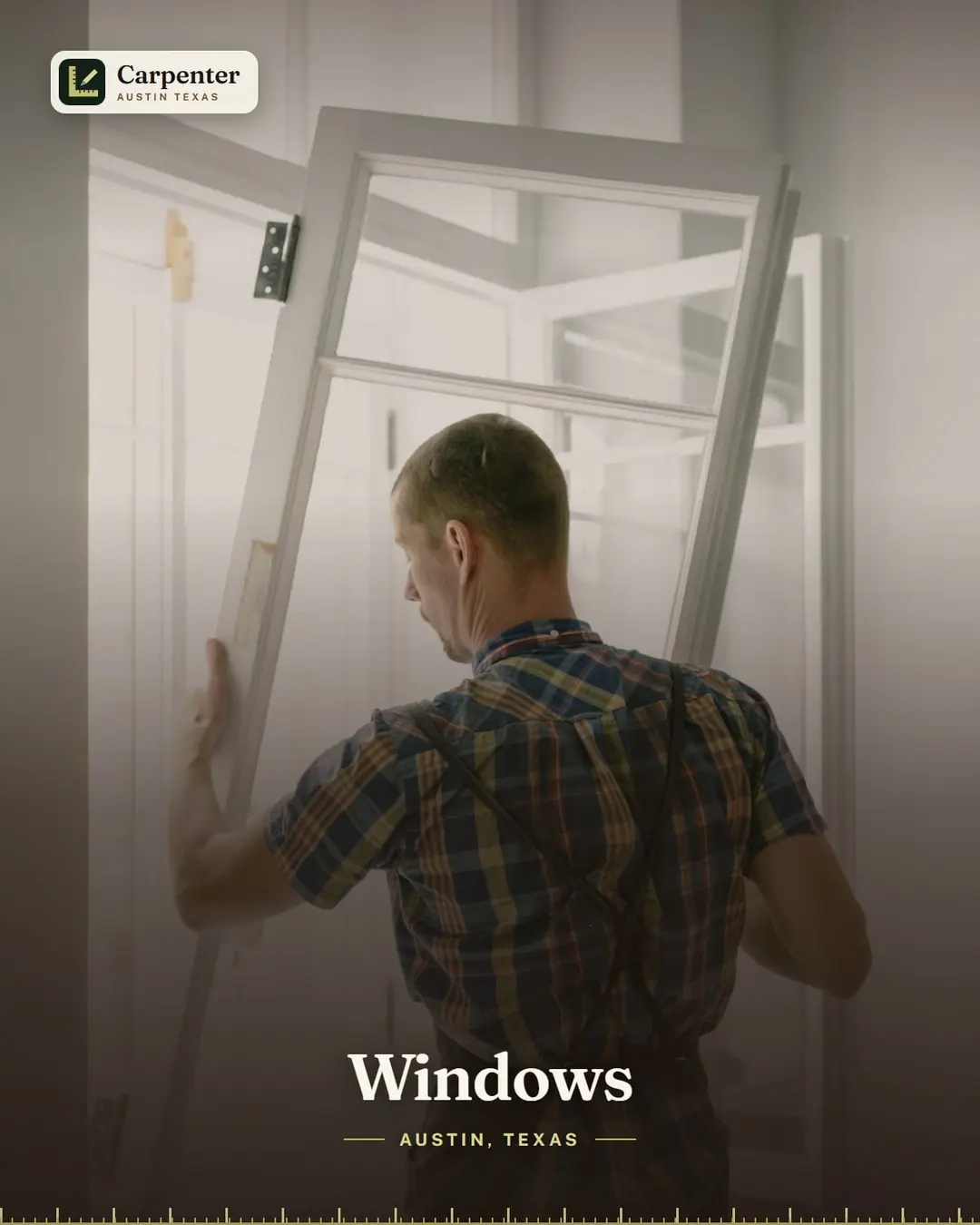
Interior carpentry · Austin, TX
Window installation, replacement & framing in Austin, TX
The west bedroom is the hottest room in the house by late afternoon. The glass in the living room has fogged between the panes. One window won't stay open, another won't lock, and the paint on a sill has gone soft under your thumb. Or you're remodeling and want a window where there's only wall, or a bigger one where the old one was too small.
Read more
Carpenter Austin Texas handles window installation in Austin, along with the carpentry around each window. We frame new and enlarged openings, rebuild rotted sills and finish the trim inside and out. Window replacement in Austin is only as good as the opening the window sits in, and Austin's heat, sudden storms and shifting clay soil are hard on both. Window framing in Austin homes, from new headers to rebuilt sills, is carpentry work, and we do it ourselves.
Every job starts with a free written estimate from your local carpenter in Austin.
We'll measure your openings, check the frames and sills for rot, explain your options and put the price in writing. We arrive on time, protect your furniture and floors, and clean up before we leave each day.
- Free written estimateYou know the scope and the price before anyone picks up a saw.
- On time, as promisedWe show up on the day and at the time we agreed.
- Your home protectedFloors, furniture and the yard are covered while the work goes on.
- Clean job siteThe work area is swept and cleared before we leave.
- Built for Texas weatherLumber, fasteners and finishes chosen to hold up to Austin heat, storms and clay.
- Jobs of every sizeOne rotted porch post gets the same care as a custom build.
The numbers behind this work
- 85.8rainy days a yearAustin averages 85.8 days a year with measurable rain, so wood outdoors is wetted roughly one day in four and has to dry out in between.NOAA climate normals · 1991-2020
- 36.25 inaverage yearly rainfallAustin's official climate station averages 36.25 inches of rain a year, much of it in a few hard storms, which is why end grain, fascia and sills need sealing and drainage.NOAA climate normals · 1991-2020
- 902Texas hail events in 2025Texas led the nation with 902 major hail events in 2025, and Austin's severe weather season runs March through May, mostly as large hail and strong wind.Insurance Information Institute · 2025
- 45 yrsbuilding age that brings historic reviewDemolishing or relocating any Austin building 45 years or older that could qualify as a landmark goes to the Historic Landmark Commission first.City of Austin Historic Preservation · 2026
01Warning signs
Signs you need new windows
In short
Fogged glass, hot rooms, drafts, sticking or unlockable sashes, rotted sills, single-pane or hot aluminum frames, storm damage or a mismatched look all point toward new windows.
- Sign 01
Fog or moisture between the panes, which means the seal has failed
- Sign 02
Rooms that overheat on the sunny sides of the house
- Sign 03
Drafts and dust coming in around the sash
- Sign 04
Windows that stick, won't stay open or won't lock
- Sign 05
Soft, cracked or rotted sills and frames
- Sign 06
Single-pane glass, or aluminum frames that are hot to the touch in summer
- Sign 07
Hail or storm damage
- Sign 08
A look that doesn't fit a remodel
Checks to make before the estimate
Feel the frame on a sunny summer afternoon. A frame that is hot to the touch is passing heat into the room, which is common with older aluminum windows that have no thermal break.
Look closely at any fogging. Haze you can wipe off is condensation on the surface. Haze between the panes that never wipes away means the seal between them has failed, and the glass has lost much of its insulating value.
Press on the sill and the bottom corners of the frame outside, and look for peeling paint or dark stains below the window. Those spots help show whether a sill repair, an insert or a full-frame replacement is the likely route.
Good to know
Some of these can be repaired without a new window. A rotted sill on its own, for example, is covered in the sill repair section below.
02What we do
Window replacement in Austin
In short
Window replacement means three decisions: how the window goes in, what the frame is made of and which glass suits Austin sun. The sections below take them in that order. Restoring original wood sashes is a different job, covered in the older-homes section further down.
Method What stays Best when Trade-offs Insert (pocket) replacement The existing frame, trim, siding and drywall The old frame is sound, square and dry Less disruption; slightly smaller glass area Full-frame replacement Nothing; the old window comes out to the rough opening Rot, missing flashing, a size change or an out-of-square opening More trim work and higher cost An insert fits a new window inside the old frame. It's faster and leaves the siding, drywall and trim alone, but it only works when the frame is in good shape, and you lose a little glass area to the new frame.
Full-frame replacement takes the old window out down to the framing. That lets us repair rot, re-flash the opening, change the size and correct an opening that has gone out of square.
In Austin, full-frame is often the honest choice. Seasonal clay-soil movement racks openings, and sills on walls exposed to sun and rain often rot. We check every opening at the estimate before recommending a method.
Check the old frame before settling on an insert. Push on the bottom corners, look for water stains on the inside stool and see whether the sashes bind. Any of those signs suggests the frame is no longer a sound base for a new window.
- Single-hung: the bottom sash slides up, the top stays fixed. Common and affordable.
- Double-hung: both sashes move, and many tilt in for cleaning from inside.
- Casement: hinged at the side and cranked open. It seals tightly, opens fully for airflow and suits the spot over a kitchen counter where reaching up to lift a sash is awkward.
- Sliding: the sash slides sideways. It suits wide, short openings.
- Picture or fixed: no moving parts, the most glass for the opening. Common for Hill Country views.
- Awning: hinged at the top, so it can stay open in light rain.
- Specialty shapes: arches, circles and trapezoids, usually fixed.
Bay and bow windows have their own section below.
Think about how you reach each window. Over a sink or behind furniture, a crank casement or awning is easier to open than a sash you have to lift, and on upper floors, tilt-in sashes let you clean the outside glass from inside.
Material Heat performance Upkeep Look Relative cost Vinyl Insulates well; quality varies and some move in extreme heat Low Smooth, limited colors Lowest Fiberglass Stable in heat, strong Low; can be painted Slim, paintable Higher Wood and clad-wood Insulates well Wood needs regular finish care; cladding cuts the outside upkeep Classic Highest Aluminum Conducts heat unless thermally broken Low Slim frames Low to middle Angi's Austin cost guide says vinyl, wood and aluminum all hold up in Austin heat. In practice, how well a specific product is made, and where it goes on the house, matters more than the material name. Wood does best under deep eaves. Aluminum, common in older Austin homes, needs a thermal break to stop it from carrying heat inside. We'll explain which lines we'd install for your house and why.
Most new windows have double-pane insulated glass. A Low-E coating on the glass cuts the heat and UV that come through it.
In Austin, the number to watch is SHGC, the solar heat gain coefficient. It measures how much of the sun's heat gets through the glass, and lower means less heat in. Austin Energy's multifamily window rebate, for example, requires a maximum SHGC of 0.25 and an ENERGY STAR rating. That's a program rule for rental properties, not a requirement for your house, but it shows the range the utility treats as efficient.
Austin Energy also offers a residential rebate of $1 per square foot for solar screens with an SHGC of 0.40 or lower, installed by a participating contractor. Program terms change, so check the current offer before you count on it.
U-factor measures how well the whole window holds heat in or out. In Austin's climate, SHGC usually matters more.
Look for the rating label on any window you are considering. It lists the SHGC and U-factor for the whole unit, so you can compare products on the same terms rather than on brochure claims.
Questions to ask about each opening
Ask how each window will be installed, not just which window it is. The same product can perform very differently set as an insert in a tired frame than set full-frame in a rebuilt, flashed opening.
Ask about glass side by side around the house. North-facing windows take little direct sun, while west and south walls take the most, so the glass package doesn't have to be identical on every side to make sense.
Ask which openings need safety glass. Some locations call for tempered glass under the code, and knowing which windows those are before the order goes in avoids a costly reorder.

Wood should be cut, fitted, and finished like it’s meant to last a lifetime.
03What we do
New windows, enlarged openings and window framing
In short
This is where a carpenter-led installer differs from a window-only installer. New windows in a solid wall, bigger openings and window-to-door conversions all involve structural framing. Window framing in Austin means getting the header, studs and sill right, then keeping water out of the opening and finishing the trim. The sections below cover window openings only.
Cutting a new opening or enlarging one means installing a properly sized header over the opening, with king and jack studs on each side and a framed sill below. In a load-bearing wall, the floor or roof above needs temporary support while the old studs come out. Before cutting, we check the wall for wiring, plumbing and ducts.
Bedroom windows have extra rules. A bedroom needs an emergency escape window with a minimum opening size and a maximum sill height, and we confirm the current values with Development Services before framing one.
Window replacement isn't on the City of Austin's list of work exempt from building permits, and new or enlarged openings are structural work. We confirm the permit requirements for your project with Development Services.
Turning a window into a door is a job for our interior and prehung doors team.
A window opening is a hole in the wall, and water will find it. The layers that stop it go on in order:
- A sloped sill or a sill pan at the bottom of the opening
- Flashing tape, lapped shingle-style so each layer sheds water over the one below
- Head flashing or a drip cap over the top of the window
- Sealant, as the last line of defense rather than the first
Skip the flashing and the leak doesn't show at first. Water gets behind the trim during one of Austin's sudden heavy storms and rots the sill and the wall framing from the inside.
Water usually gets in at the bottom corners of a window, where the sill meets the side jambs. That is why those corners get extra attention in the flashing sequence, and why caulk alone at the corners is never a real fix.
Window trim installation in Austin finishes the job on both sides of the wall.
Inside, the options include picture-frame casing, craftsman head-and-sill trim, a stool and apron at the bottom, or drywall returns with no casing at all. Outside, there's brickmould, wide flat trim, and PVC or fiber-cement trim that resists rot and termites better than painted wood.
In older homes, we match the existing trim profiles so new windows don't stand out. For exterior trim, siding and fascia repair beyond the window, see our Austin exterior carpenters.
Size the stool and apron to the casing. A stool that projects evenly past the casing on both sides, with an apron below that matches the casing width, is a small detail that makes interior window trim look finished.
Planning a new or bigger window
Check both faces of the wall before you settle on a size. Inside, look at furniture, outlets and switches; outside, look at the siding pattern, the roofline and what the window will face. A window that lines up with the heads and sills already on that wall looks planned rather than added.
Think about the view and the sun together. A large west-facing opening gives you the evening view and the afternoon heat, so glass and shading belong in the same conversation as size.
Expect wall finishes to be part of the work. Drywall inside and siding or brick outside are cut back and patched around the new framing, and matching an older siding profile can take some searching.
04What we do
Specialty window projects
In short
Beyond standard replacement, Carpenter Austin Texas builds and installs the projects below. Each section stands on its own.
Bay windows in Austin homes project out from the wall to add light and floor space. A bay window uses three units set at angles, usually a large center window with two narrower ones. A bow window curves gently across four to six units.
Both make room for a window seat, and a built-in seat can be part of the project.
The structure matters. A projecting unit needs support underneath, from a cable system, knee braces or a framed foundation for a full bump-out. It also needs a small roof or head board above it and an insulated seat board inside, because the seat board is where heat and cold get in.
West-facing bays turn into heat traps in an Austin summer. Choose Low-E glass, and consider an overhang above the bay.
Adding a bay where there wasn't one means enlarging the opening and framing the projection, which usually needs a permit. We check with Development Services for your project.
On cost, Thumbtack's Austin data notes that bay or bow windows with specialty glass and framing can reach around $5,000 each. Your written estimate gives the price for your wall.
Skylight installation in Austin brings daylight into rooms that don't have an outside wall. Fixed skylights don't open. Venting skylights open for air. Tubular skylights, also called sun tunnels, run a reflective tube from the roof to a ceiling diffuser and fit where a full skylight won't.
Skylights work well over interior bathrooms, kitchens and hallways.
The carpentry is in the framing. We cut the roof opening between rafters, or across them with headers when the skylight is wider than the rafter spacing. Then we build the light shaft through the attic to the ceiling. Flashing kits are matched to the roofing type, whether that's shingles or metal.
Austin sun adds a caution. A skylight lets summer heat straight into a room, so choose Low-E or solar-control glazing, and consider a shade. Hail is the other concern; ask about impact-resistant glazing options.
HomeAdvisor's 2025 national data shows an average skylight installation of around $1,915, with most projects between about $1,000 and $2,800. Your written estimate gives the Austin price for your roof.
Think about the light shaft as well as the skylight. A shaft that flares wider toward the ceiling spreads light across more of the room, while a straight shaft gives a tighter pool of light directly below.
Window sill repair in Austin starts with spotting the damage. Signs include soft or spongy wood, paint that peels again no matter how often it's redone, dark staining, and gaps opening at the joint between the sill and the frame. Inside, the stool below the window may show water damage. Termite mud tubes near the sill mean termites are working in the wood.
The causes are usually water. It sits on flat or badly sloped sills, gets in through failed caulk and paint, or runs behind the trim where flashing is missing. Sprinklers soak sills on low windows. Termites follow the damp wood.
Repair options depend on how far the rot goes:
- Small soft spots: consolidate the wood with epoxy and fill it.
- A damaged section: cut it out and splice in new wood.
- A failed sill: replace the whole sill with rot-resistant wood or PVC.
- Any of the above: re-flash the opening so the water stops getting in.
When rot has spread from the sill into the frame or the wall below, the window should be replaced full-frame so the opening can be rebuilt. If termites are active, pest treatment comes first, before any wood is replaced.
Check the slope of the sill. A sill should fall away from the window so water runs off. One that has flattened or tipped back toward the house holds water against the joint and will rot again however often it is painted.
Plantation shutters in Austin homes are interior louvered shutters set in a frame, usually with wide louvers. They control light and heat on sunny sides of the house, give privacy with the louvers closed, and look like part of the house rather than a window covering.
Material is the main choice. Real wood, paint-grade or stain-grade, is lighter, but it can warp in very humid rooms. Composite or MDF-core shutters and vinyl or poly shutters resist moisture and heat, so they suit bathrooms and kitchens.
Shutters are mounted either inside the window opening or outside it on a frame. An outside mount needs a frame that matches the surrounding trim, and every window is measured on its own, which matters most for arched or out-of-square openings. Prices vary a great deal by material, so you'll get a written figure for your windows.
Check clearance before choosing a louver size. Wide louvers need depth to tilt open without hitting the glass, window cranks or handles, which matters most when shutters are mounted inside the window opening.
Exterior shutters in Austin homes are either decorative, fixed to the wall, or functional, hinged so they can close over the window.
Styles include louvered, raised panel, board-and-batten, and Bahama or Bermuda shutters, which hinge at the top and shade the window from the sun.
Size them so they look like they could close. Each shutter should be half the width of the window and its full height.
Material choices include cedar and other woods, composite, vinyl and PVC. Austin sun and humidity are hard on paint and on wood, so wood shutters need more upkeep than the others.
Operable shutters need real hardware: hinges and shutter dogs, the small holdbacks that keep a shutter open against the wall. All shutters should be mounted into the wall framing, not just the siding. HOA and historic-district rules may apply to visible exterior changes.
Choosing the right specialty project
Start with the problem you want solved. If a room is dark, a skylight or a larger window adds light. If it is too hot, shutters, solar screens or better glass address the heat. If you want space, a bay or bow window adds a little floor area.
Then look at the structure involved. A bay needs support below and a roof above, a skylight needs a roof opening and a light shaft, and working exterior shutters need solid framing behind their hinges.
Weigh upkeep before you choose. Wood shutters, wood sills and painted trim on a sunny wall need regular care in Austin, while composite, PVC and fiber-cement options trade some of the look of wood for less maintenance.
05How it works
Our window installation process
In short
Each window moves from measuring and choosing to ordering, protecting the house, removal, opening repair and flashing, setting, trim, testing and clean-up.
- Step 01
Consultation and measure
We check frames, sills and openings for rot and square.
Each window is measured for width and height at several points, because an opening that has racked out of square measures differently at the top, middle and bottom. For an insert, the smallest measurement sets the size.
Frames and sills are checked for rot by pressing at the bottom corners, inside and out. Diagonal cracks from the corners of the window, stains on the inside stool and sashes that bind all hint at movement or water behind the trim.
This is when you describe what bothers you about each window: heat, drafts, noise, sticking or the look. Saying which rooms overheat helps match the glass to each side of the house.
What to expect You walk us through the house, point out problem windows and hot rooms, and watch us measure and probe each opening.
- Step 02
Choices
You pick the method, style, frame and glass, and get a written estimate.
Four choices shape each window: the installation method, the style, the frame material and the glass. The method comes from the condition of the opening, and the others come from how you use the room and which way it faces.
Glass can vary by side of the house. Low-SHGC glass where the sun is strongest and a standard Low-E package elsewhere is a common way to spend the budget where it counts.
The written estimate lists each opening on its own line, with the method, any expected sill or framing repair, trim and finish. Read how it handles rot found after removal, since the full extent only shows once the old window is out.
What to expect You decide the method, style, frame and glass for each opening, and get a written estimate listing every window.
- Step 03
Order
Your windows are ordered to the measured sizes.
Windows are made to size, so each measurement is checked against the order before it is placed. A window that is too big won't fit, and one that is too small leaves gaps that trim and sealant have to cover.
The order also records details that are easy to miss: which way casements hinge, the grille pattern, the color inside and out, any tempered glass and the screen type. Those choices are fixed once the windows are built.
While the windows are on order, check HOA rules if your community regulates window color, grilles or style. For a historic landmark or contributing property, check whether review applies before any visible change.
What to expect You confirm sizes, hinge directions, grilles, colors and screens, and your windows are ordered to exactly those details.
- Step 04
Protection
We cover floors and furniture inside and protect plants and beds outside.
Inside, drop cloths cover the floor under each window and the path to the door, and furniture near the windows is moved or covered. Blinds, curtains and other window coverings come down first.
Outside, plants and beds below the windows are protected, since old sashes, trim and debris come out over them. Covers go down where ladders stand to protect the lawn and catch stray sealant and nails.
You can help by clearing sills, moving fragile items and furniture away from the walls, and taking down curtains and rods ahead of time. Point out any plants you especially want protected.
What to expect You see floors and furniture covered inside, beds and plants protected outside, and window coverings taken down.
- Step 05
Removal
Old windows come out.
For an insert, the sashes, stops and balances come out and the old frame stays. For full-frame replacement, interior and exterior trim come off and the whole window is cut free down to the rough opening.
Older aluminum windows are often held by a nailing fin hidden behind the siding or stucco, so the cladding around them is cut back carefully to free the fin without damaging more of the wall than necessary.
In homes built before 1978, old window paint may contain lead, and removal disturbs it. Ask how dust will be contained, and keep children and pets away from the work area while windows come out.
What to expect You see the old sashes or whole frames come out, leaving the old frame or the bare rough opening ready to inspect.
- Step 06
Opening repair
We repair framing and sills, then install the sill pan and flashing.
With the old window out, the sill and framing are checked for rot and termite damage. Soft wood is cut out and replaced, and a sill that has lost its slope is rebuilt so water runs away from the house.
A sill pan or sloped sill goes in first, then flashing tape is lapped up the sides shingle-style. Each layer overlaps the one below it, so water running down the wall is always guided outward.
This is the part of the job you never see again once trim is on, and it decides whether the opening stays dry through Austin's heavy storms. Ask to see it before the window goes in if you want to.
What to expect You see rotted wood cut out, the sill rebuilt where needed, and the pan and flashing installed before the window goes in.
- Step 07
Setting
Each window is set level, shimmed and fastened, and the gaps are filled with low-expansion foam.
Each window is set on the sill and leveled, then shimmed at the sides so the frame is straight and square. A window forced into the shape of an out-of-square opening will bind and leak, so the frame is squared to itself even when the opening isn't.
Fasteners go through the frame or fin into the framing at the points the maker specifies. Over-driven screws can bow a frame, so each one is snugged and the sash checked for an even gap.
The space around the frame is filled with low-expansion foam made for windows. Ordinary expanding foam can swell enough to bow the frame and make the sash stick.
What to expect You see each window set level and square, shimmed and fastened, and the gap around it sealed with foam.
- Step 08
Trim
Exterior trim and sealant go on, followed by interior trim and paint touch-up.
Outside, trim and head flashing or a drip cap go on above the window, and joints are sealed with a flexible sealant that can stretch as the house moves. The bottom edge is detailed so any water that gets behind can drain out.
Inside, casing, a stool and apron, or drywall returns are fitted to match the room. In older homes, trim profiles are matched to the existing ones so the new windows blend in.
Nail holes are filled, joints caulked and paint touched up. Exterior trim on a sunny wall needs a good exterior paint, since UV breaks down finish fastest there.
What to expect You see exterior trim and sealant go on outside, and casing or returns fitted and touched up inside.
- Step 09
Testing
We check that every sash opens, closes and locks.
Every sash is opened, closed and locked. It should move smoothly without binding, stay where it is set if it is a hung window, and lock without force. Casement cranks should turn easily and pull the sash tight against its seal.
Tilt-in sashes are tested for cleaning, screens are fitted, and the weep holes at the bottom of the frame are checked to make sure sealant hasn't blocked them.
Try each window yourself. Open and lock the ones you use most, and ask how the tilt, crank or latch works on any style that is new to you. Check that every screen sits snugly in its frame.
What to expect You open, close and lock each window yourself, try the tilt or crank, and ask about anything that is new to you.
- Step 10
Clean-up
We clean the glass, clean up and haul away the old windows.
Labels and stickers come off the glass, and the glass is cleaned with a non-abrasive cleaner that won't harm its coatings. Tracks and sills are vacuumed of dust and debris.
Drop cloths come up, beds and lawns are checked for nails and debris, and the old windows are hauled away. Walk the beds once more yourself before kids or pets play there.
Keep the paperwork that came with the windows: the rating labels, the product names and the maker's care instructions. You will want them if a seal ever fails or when you sell the house. Rehang your window coverings once the trim paint has dried.
What to expect You see clean glass, vacuumed sills and tracks, tidy beds and lawn, and the old windows carried away.
06Pricing
Window installation cost in Austin
In short
Whole-house pricing depends on how many windows you replace, their size, the installation method, the frame material and the glass. It also depends on what we find behind the old frames. Your free written estimate itemizes each opening. Sill repair and shutter pricing are covered in their own sections.
Typical window replacement costs
For specialty work, Thumbtack's Austin data notes that bay or bow windows can reach around $5,000 each, and HomeAdvisor's national skylight average is about $1,915.
Your house will have its own number
A free written estimate gives it to you, opening by opening.
The opening's condition can outweigh the window
Rot, missing flashing or a racked frame turns an insert job into full-frame replacement, with framing, trim and wall repair added to the total.
Access changes the effort
Second-story windows, openings over roofs or dense plantings, and windows behind built-in furniture take more setup and care than a ground-floor window with clear access.
Glass and style choices add up per opening
Low-SHGC coatings, tempered glass where it is required, casement hardware and specialty shapes each raise the cost of a window, and that multiplies across a whole house.
07What we do
Windows built for the Central Texas climate
In short
Austin windows deal with intense sun, sudden storms and hail, clay soil that moves, and preservation rules in some older neighborhoods. Each one changes how a window should be chosen and installed.
- Solar screen rebate
- Austin Energy: screens with SHGC 0.40 or lower
- Multifamily window rebate
- Maximum SHGC 0.25, ENERGY STAR rated
- Permit-exempt list
- Window replacement is not on Austin's list


West- and south-facing windows take the most solar heat. Long runs of summer days over 100 degrees and steady UV break down seals, glazing compounds and finishes.
On those sides, choose low-SHGC Low-E glass, and add solar screens, exterior shading or an overhang where you can.
Hail and storm rain blown sideways test every opening. Sound flashing and tight sills keep the water out, and where hail is frequent, it's worth asking about stronger glass before you order.
Expansive clay, especially in east Austin's Blackland Prairie, shrinks and swells with drought and rain. Slabs move with it. You'll notice sashes that bind and diagonal cracks running from the corners of windows.
Installation is how we answer it: full-frame replacement where an opening is out of square, careful shimming, and flexible sealants that stretch as the house moves. A window can't fix a foundation, though. If many windows and doors bind at the same time, get a foundation evaluation first.
Pre-war bungalows and mid-century homes in central neighborhoods such as Hyde Park, Travis Heights, Clarksville and Bouldin Creek often still have their original wood windows.
Hyde Park is one of the City of Austin's eight local historic districts. The City's historic review covers exterior alterations to landmarks and to contributing properties in local and National Register historic districts, so replacing visible windows on those homes may need review first.
Restoring original wood windows is sometimes the better choice than replacing them. Our Austin historic restoration team handles that work.
Shading that helps any window
Exterior shading stops heat before it reaches the glass, which a coating alone cannot do. Solar screens, awnings and roof overhangs on west and south walls take much of the afternoon load off a window.
Trees help too, but plant with care. A deciduous tree on the west side shades in summer and lets winter sun through, while planting too close to the house traps moisture against sills and siding.
Inside, light-colored blinds or shutters reflect some heat back out through the glass, but by then the heat is already in the room. Treat them as a second line, not a substitute for good glass and outside shade.
08Why us
Why choose Carpenter Austin Texas for window installation
In short
Carpenters repair the opening, flash full-frame installs, finish trim inside and out, advise honestly on method and glass, and price the job in writing first.
- 01Carpenters who repair the opening, not just swap the glass
- 02Full-frame installs flashed to shed Austin storm water
- 03Trim finished inside and out
- 04Honest advice on insert or full-frame, and on the right glass for each side of the house
- 05A clear written estimate before work starts
- 06On time, with your home protected and cleaned up before we leave each day
Questions to ask any window installer
Ask who repairs the opening if the sill or framing is rotted. An installer who only sets windows may leave the damage behind new trim, where it keeps spreading.
Ask how the opening is flashed on a full-frame job: whether a sill pan goes in, how the tape is lapped, and what goes over the head of the window. Clear, specific answers are a good sign.
Ask whether the bid covers interior and exterior trim, paint touch-up and haul-away. A price that leaves those out isn't comparable with one that includes them.
Wood should be cut, fitted, and finished like it’s meant to last a lifetime.
09Care & upkeep
Caring for new windows
In short
Keep tracks and weep holes clear, check sealant and paint each spring, keep sprinklers off sills, lubricate hardware as the maker recommends and clean glass gently.

At a glance
- Clean the tracks and weep holes so water can drain out.
- Check exterior sealant and paint each spring.
- Keep sprinklers off windows and sills.
- Lubricate hardware with what the window maker recommends.
- Wash glass with non-abrasive cleaners to protect the Low-E coating.
- Watch sills for peeling paint, an early sign of rot.
- Keep the manufacturer's warranty paperwork somewhere you can find it.
Seasonal window checks
Before storm season, pour a little water into each track and watch it drain out through the weep holes. If it pools, clear the holes with a soft brush or a pipe cleaner, never a sharp tool that can damage the frame.
In late summer, look at the exterior sealant on sunny walls. Cracking, gaps or sealant pulling away from the trim are signs of UV and movement, and resealing early is far cheaper than repairing a wet sill.
When cleaning, use a soft cloth and a mild cleaner. Razor blades and abrasive pads can scratch the glass, and harsh cleaners can damage some coatings and the seals around the sash.
10Service area
Window installation across Austin
In short
We install windows in all 13 Austin areas we serve, from aluminum-framed homes of the 1970s and 1980s to vinyl-window suburbs and original wood windows in central Austin.
We install windows in all 13 areas we serve:
Central, North, North Central, Northeast, Northwest, Far North, East, West, South, South Central, Southeast Central / Riverside, Southeast and Southwest Austin.
The windows we replace change across the city. Homes from the 1970s and 1980s often have aluminum frames, suburban homes from the 1990s and 2000s mostly have vinyl, and central neighborhoods still have original wood windows.
Central Austin
Central Austin older bungalows and cottages, historic districts like Hyde Park, and renovations on tight lots.older bungalows and cottages, historic districts like Hyde Park, and renovations on tight lots.
(737) 415-9388Central Austin, TX
North Austin
North Austin mid-century ranch homes in established neighborhoods.mid-century ranch homes in established neighborhoods.
(737) 415-9388North Austin, TX
North Central Austin
North Central Austin mid-century houses, many due for new trim or decks.mid-century houses, many due for new trim or decks.
(737) 415-9388North Central Austin, TX
Northeast Austin
Northeast Austin newer subdivisions sitting on the clay east of I-35.newer subdivisions sitting on the clay east of I-35.
(737) 415-9388Northeast Austin, TX
Northwest Austin
Northwest Austin Hill Country lots on sloped limestone, with decks built for the view.Hill Country lots on sloped limestone, with decks built for the view.
(737) 415-9388Northwest Austin, TX
Far North Austin
Far North Austin newer subdivisions where builder-grade trim and fences often need upgrades.newer subdivisions where builder-grade trim and fences often need upgrades.
(737) 415-9388Far North Austin, TX
East Austin
East Austin older homes east of I-35 on clay soil, with plenty of infill and renovation.older homes east of I-35 on clay soil, with plenty of infill and renovation.
(737) 415-9388East Austin, TX
West Austin
West Austin hillside homes on limestone, where decks and stairs follow the slope.hillside homes on limestone, where decks and stairs follow the slope.
(737) 415-9388West Austin, TX
South Austin
South Austin established neighborhoods with a mix of older and newer homes.established neighborhoods with a mix of older and newer homes.
(737) 415-9388South Austin, TX
South Central Austin
South Central Austin older houses around neighborhoods like Travis Heights, many with porches and original trim.older houses around neighborhoods like Travis Heights, many with porches and original trim.
(737) 415-9388South Central Austin, TX
Southeast Central Austin / Riverside
Riverside older homes, rentals and newer infill south of Lady Bird Lake.older homes, rentals and newer infill south of Lady Bird Lake.
(737) 415-9388Riverside, Austin, TX
Southeast Austin
Southeast Austin growing neighborhoods on clay soils, where doors and trim feel the ground move.growing neighborhoods on clay soils, where doors and trim feel the ground move.
(737) 415-9388Southeast Austin, TX
Southwest Austin
Southwest Austin hillside lots with decks and views toward the Hill Country.hillside lots with decks and views toward the Hill Country.
(737) 415-9388Southwest Austin, TX
What your home's windows may need
In homes with original aluminum frames, check for condensation and heat at the frame itself. Those windows are usually strong candidates for full replacement, since the frame is what carries the heat in.
In homes from the 1990s and 2000s with vinyl windows, failed seals and worn balances are the usual complaints. If the openings are dry and square, an insert may be all you need.
In older central homes with original wood windows, look at the sash wood before deciding. Sound old wood can often be restored, while windows with rotted sashes and sills may be better replaced with units that match.
11Questions
Window installation FAQs
Cost & value
These answers cover price and savings.
01How much does window replacement cost per window in Austin?
It depends on the size, frame material, glass and installation method. Our estimates are itemized per opening, so you see the price of each window. The estimate is free.
02Is it cheaper to replace all windows at once?
Usually, per window, because measuring, ordering and setup are shared across the job. If the budget won't stretch, replacing the sunniest side first is a common way to phase it.
03Do new windows lower energy bills in Austin?
Low-SHGC, Low-E windows cut solar heat gain and drafts, which can lower the cooling load. How much you save varies by house.
04Are there rebates for windows in Austin?
Austin Energy offers a residential rebate of $1 per square foot for qualifying solar screens with an SHGC of 0.40 or lower, and a multifamily rebate for windows and solar screens. Terms change, so check the current programs before you plan around them.
05Is vinyl or fiberglass worth the extra cost?
Fiberglass costs more, but it stays stable in heat and can be painted. Quality vinyl is the value choice.
06Is full-frame replacement worth the extra cost?
Yes when frames or sills are rotted, openings are out of square, or you want a different size. Otherwise, a quality insert is fine.
Choosing windows
These answers cover window choices.
01What type of window is best for Texas heat?
The glass matters more than the frame. Choose low-SHGC, Low-E double-pane glass, then a frame that stays stable in heat, such as fiberglass or quality vinyl. Casements seal the tightest of the operable styles.
02What SHGC should I choose for Austin?
Lower is better on sunny sides of the house. As a reference point, Austin Energy's multifamily window rebate sets a maximum SHGC of 0.25.
03Double-hung or casement windows?
Double-hung windows suit traditional homes and are easy to clean when they tilt in. Casements seal tighter and open wider for airflow.
04Should I choose triple-pane windows in Austin?
Rarely. In a hot climate, a good double-pane Low-E window with a low SHGC gives most of the benefit for less money.
05Do window grilles affect performance?
Grilles between the panes are a style choice with little effect on performance. Simulated divided lites look more authentic on older homes.
06Can I change the size of my windows?
Yes, with full-frame replacement and new framing. Enlarging an opening needs a new header and usually a permit.
Installation & permits
These answers cover the install.
01How long does window installation take?
It depends on the number of windows and the method. Full-frame replacement and rot repair add time compared with inserts, and your estimate includes the schedule.
02Do I need a permit to replace windows in Austin?
Window replacement isn't on the City of Austin's list of permit-exempt work, and new or enlarged openings are structural. We confirm the requirement for your project with Development Services before work starts.
03Can windows be installed in summer?
Yes. Working one opening at a time limits how much heat gets in, and sealants are chosen for hot weather.
04Will installation damage my walls or siding?
Inserts barely touch the walls. Full-frame replacement removes trim and sometimes the edges of the siding, which are repaired and refinished as part of the job.
05What are bedroom egress window requirements?
A bedroom needs an emergency escape window with a minimum opening size and a maximum sill height under the residential code. We confirm the current values with Development Services for your window.
06Does my HOA need to approve new windows?
Many HOAs set rules on color, grilles and style. Check with yours before you order.
Specialty windows & shutters
These answers cover bays, skylights and shutters.
01Can a bay window be added to an existing wall?
Yes, usually by enlarging the opening with a new header and supporting the projection. A permit is typically needed.
02Do skylights leak?
Properly flashed modern skylights rarely do. Leaks usually come from poor flashing or aging roofing around the skylight.
03Do skylights make rooms hotter in Texas?
They can, without solar-control glazing or a shade. Tubular skylights add light with less heat.
04Are plantation shutters better than blinds?
Shutters last longer, insulate a little better and look built-in. Blinds cost less.
05Wood or composite plantation shutters for a bathroom?
Composite or vinyl handles bathroom humidity better. Real wood suits dry rooms.
06Can exterior shutters be functional?
Yes, with properly sized shutters, hinges and shutter dogs mounted into the framing. Closed, they shade and protect the window.
Repairs, problems & older windows
These answers cover problems with existing windows.
01Can you replace just the glass instead of the whole window?
Sometimes a fogged insulated glass unit can be replaced on its own. On older or failing frames, a full replacement is better value.
02Why is there condensation between my window panes?
The seal between the panes has failed and the insulating gas has leaked out. The glass unit or the whole window needs replacing.
03Can a rotted window frame be repaired?
Small areas can be repaired. Widespread rot means full-frame replacement.
04Should I replace or restore original wood windows?
If they're original old-growth wood in a historic home, restoration is often worth pricing. Our historic restoration team can advise.
05Why do my windows stick?
Paint, dirt in the tracks, swollen wood or an opening racked by soil movement. Cleaning and adjustment fix many sticking windows; out-of-square openings need full-frame work.
12Keep exploring
Related carpentry services in Austin
In short
Windows is one part of what we do. The same crew handles the services below, so one call covers the whole job.

Finish carpentry
Carpenter Austin Texas installs trim, baseboards, casing, wainscoting and wood ceilings in Austin homes, with coped joints and a free written estimate.
See the service
Custom woodwork
Custom woodwork for Austin homes: built-in bookshelves, office built-ins, window seats and Murphy beds, scribed to your walls. Free written estimates.
See the service
Cabinetry
Custom kitchen cabinets, islands, vanities and garage cabinets built for Austin homes, plus cabinet refacing and repair. Free measure and written estimate.
See the service
Stairs & railings
Custom staircases, stair railings, floating stairs and stair repair in Austin, TX. Layouts checked against code and a free written estimate for every job.
See the service
Doors
Interior, prehung, French, patio, barn, pocket, storm and hidden bookcase doors installed in Austin, TX, hung plumb by carpenters. Free written estimate.
See the service
Wood flooring
Wood flooring in Austin: solid and engineered hardwood installed over a checked, moisture-tested subfloor, plus board repairs. Free written estimates.
See the service


Free written estimate
Call an Austin carpenter today
New windows, bigger windows or a sill that can't wait, request your free written estimate. We arrive on time, protect your home and clean up after.
- Homeowners
From a single rotted porch post in a 1920s bungalow to a custom cedar deck overlooking the Hill Country.
- Older Austin homes
Original trim, porches and windows repaired with lumber, fasteners and finishes chosen for Central Texas.
- Businesses and property managers
Tenant improvements, commercial millwork and ongoing repairs for rental homes.
