


Texas species such as pecan and mesquite are specialty options when suitable stock can be found.
Interior carpentry · Austin, TX
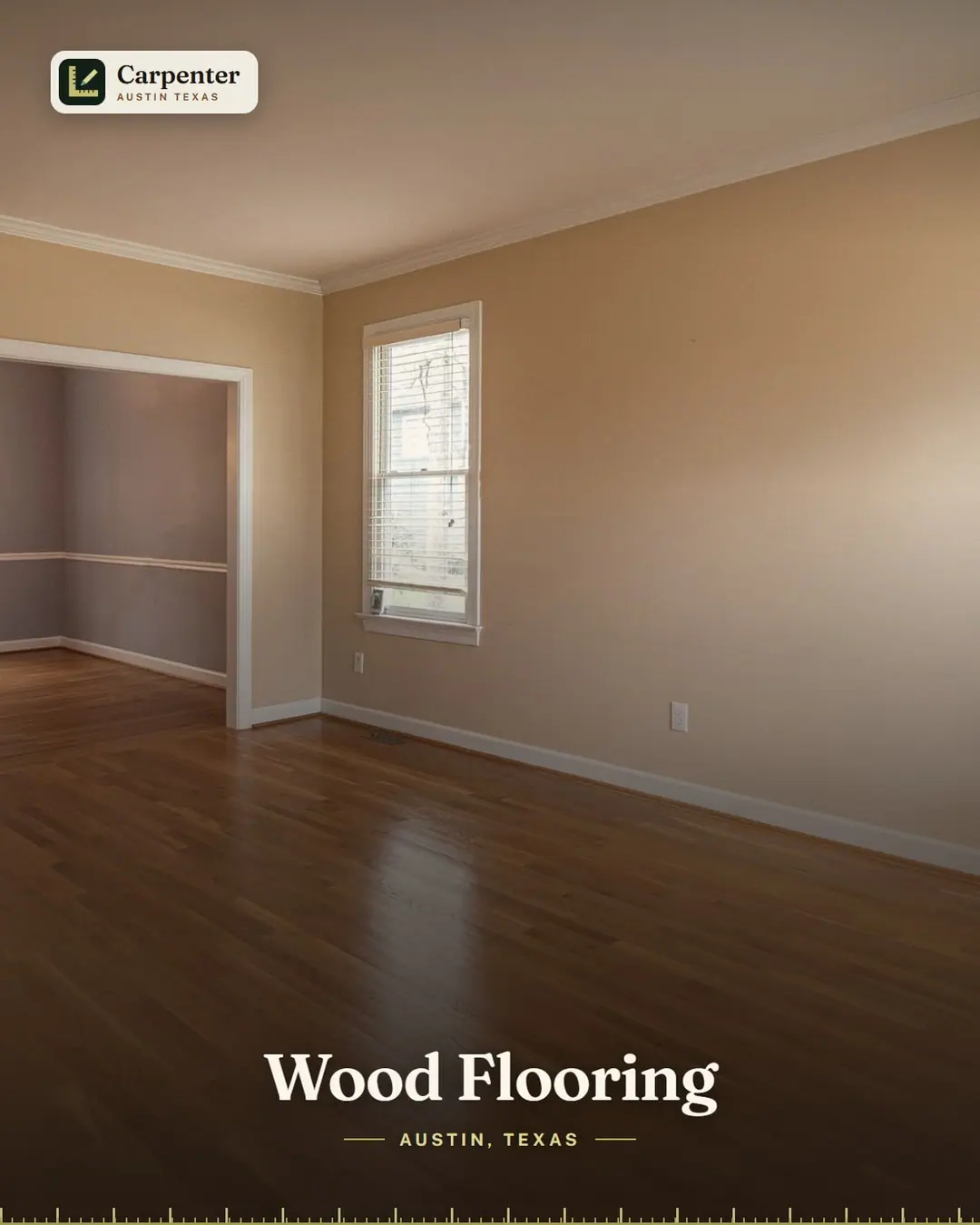
Wood flooring installation & repair in Austin, TX
Good wood flooring in Austin is flat, quiet underfoot, and built to ride out Central Texas humidity without cupping or opening gaps. Carpenter Austin Texas installs solid and engineered hardwood flooring in Austin homes and repairs damaged boards. We also fix the subfloor underneath. We're carpenters first, and a floor is only as flat as what it sits on.
Read more
That means squeaks get fixed from below and soft spots get opened up, not covered over. You get a free written estimate before work starts. We protect the rest of your home while we work and clean up before we leave. For everything else we build, visit our Austin carpentry company home page.
Tell us the rooms and square footage; we'll check the subfloor, take moisture readings and give you a written price. We arrive on time, protect your home and leave a clean site.
- Free written estimateYou know the scope and the price before anyone picks up a saw.
- On time, as promisedWe show up on the day and at the time we agreed.
- Your home protectedFloors, furniture and the yard are covered while the work goes on.
- Clean job siteThe work area is swept and cleared before we leave.
- Built for Texas weatherLumber, fasteners and finishes chosen to hold up to Austin heat, storms and clay.
- Jobs of every sizeOne rotted porch post gets the same care as a custom build.
The numbers behind this work
- 81%of home buyers want main-level hardwood81 percent of home buyers want hardwood flooring on the main level of the house.NAHB, What Home Buyers Really Want · 2024
- 2000median year Austin homes were builtThe median home in Austin was built in 2000, so half of the city's housing stock is now more than 25 years old.U.S. Census, ACS 2024 · 2024
- 128 sq ftsiding or floor-deck repair with no permitAustin exempts siding, floor-decking and roof-decking repairs of up to 128 square feet each from a building permit; larger repairs need one.City of Austin Development Services · 2026
- 90 to 150days a year the clay stays crackedThose shrink-swell cracks stay open for 90 to 150 cumulative days in most years, moving pier-and-beam floors, decks and fence posts with them.USDA soil survey · Houston Black series
01Warning signs
Signs it's time for new wood floors or repairs
In short
Moisture damage, a loose subfloor and a worn-through finish each need a different fix, so name the symptom before you decide on new floors.
- Sign 01
Worn carpet or vinyl you want gone
In older homes, it may be hiding original oak.
- Sign 02
Cupped, crowned or buckled boards
All three point to moisture.
- Sign 03
Wide gaps between boards that don't close in humid months
- Sign 04
Squeaks and soft spots where the subfloor has loosened or weakened
- Sign 05
Water, pet or furniture damage on a few boards
- Sign 06
Floors already sanded too thin to refinish again, with nail heads or tongues showing
- Sign 07
Mismatched floors after a remodel joined two rooms
Simple checks you can do yourself
Look along the floor at a low angle with light from a window behind it. Cupped boards show as ridges at every seam, crowned boards as a hump in the middle, and a worn finish as dull lanes where people walk most.
Walk the room slowly and listen. A squeak at one spot often means a loose board or subfloor, while a bounce across the whole room points to the framing. Pull a floor vent cover to see how much wood sits above the tongue.
Note when the gaps appear. Gaps that open in winter and close in summer are normal seasonal movement, while gaps that stay open all year point to something else.
Good to know
A floor that sags or feels bouncy has a framing problem below it, and that needs sagging floor and subfloor repair before new boards go down. If the boards are sound and only the surface is worn, refinishing usually fixes it without new floors (see the refinishing section below).
02What we do
Our wood flooring services
In short
We install new wood floors and repair existing ones. We also handle the transitions, stair treads and trim that make a new floor look finished at every edge.
Hardwood floor installation in Austin starts with one choice: solid or engineered. Solid hardwood is one piece of wood, usually 3/4 in. thick. Engineered hardwood is a real wood wear layer over a plywood-style core, which makes it more stable. The section after this one compares the two in detail.
There are three install methods:
- Nail-down, over a wood subfloor. This is the standard for solid hardwood on pier-and-beam homes and second floors.
- Glue-down, over a concrete slab. Most engineered floors in slab homes go down this way.
- Floating, with click-lock boards that join to each other over an underlayment and aren't fastened to the floor below.
Next comes the finish. Site-finished floors are installed raw, then sanded flat and finished in place. The result has no bevels between boards, and you can choose a custom stain color. Prefinished floors arrive with the finish already on. They go in faster, with no sanding or finish fumes on site.
Layout is the third decision. Straight lay is the most common. Random-width boards give an older, rustic look. Diagonal, herringbone and chevron patterns take more time and material. Borders and picture-frame details can outline a room or a fireplace hearth.
When floors run through several rooms, we plan the direction so it makes sense from the front door and across doorways. A board direction that changes at every room looks pieced together.
At the edges, we undercut door casings so the new floor slides under them cleanly. Baseboard and shoe molding go back on, or new trim goes up, so the floor meets the wall with a clean line instead of a gap.
Plan the floor height at every doorway. New flooring can raise the floor enough to catch the bottom of interior doors, so doors may need trimming and thresholds need a plan before the boards go down.
Hardwood floor repair in Austin covers more than patching a scratch.
Damaged boards are cut out and new ones "laced in," so the joints stagger like the rest of the floor and the repair doesn't show as a square patch.
Water damage starts at the source. We find and fix the leak or get it fixed, dry the floor, then replace boards that stayed cupped or stained.
Pet urine can soak deep into the wood and leave black stains that won't sand out. Those boards get replaced.
Squeaks are fixed from below where there's access, or from above with special screws that snap off below the surface.
Where a wall, floor vent or fireplace hearth was removed, there's a gap in the floor to patch. When rooms are opened up in a remodel, we weave new boards into the existing floor so the two read as one.
Matching is the hard part. Many older Austin homes have 2-1/4 in. red or white oak strip flooring, and new boards need to match the species and width. After repairs, the room is usually refinished so new and old boards take the same color.
Find the cause before the repair. Damage from a leak, a pet or a dropped pan each needs a different fix, and replacing boards over an active leak or a damp crawlspace only wastes new wood.
Worn, scratched or dull floors with enough wood left can usually be sanded and refinished instead of replaced. Refinishing often follows a few board repairs. It's also the time to change the stain color. See our page on hardwood floor refinishing in Austin.
Check the wood above the tongue before planning a refinish. Pulling a floor vent cover shows the board edge, and if the wood above the tongue is thin, sanding is limited or no longer an option.
New floors often lead to stairs. We match stair treads and nosings to the new flooring so the staircase doesn't look like a different house.
Transitions finish the edges. Where wood meets tile or carpet, thresholds, reducers and flush transitions each suit a different height difference. For full stair rebuilds or new railings, see our Austin stair builders.
Mind the height difference at each transition. A threshold that sits too tall becomes a trip hazard, so the flooring thickness and any underlayment should be known before the transition pieces are chosen.
Decide these before the estimate
List the rooms you want to connect. A floor that runs unbroken through the living room, hall and kitchen needs one species, one width and one board direction, and that changes where transitions fall and how much material you need.
Find out what is under the current floor if you can. Pulling up a corner of carpet in a closet, or checking the edge at a floor vent, tells you whether you have slab, plywood or old boards underneath, which shapes the install method and the prep.
Keep a sample or a photo of any floor you want the new one to match, such as the hall or the stairs.

Wood should be cut, fitted, and finished like it’s meant to last a lifetime.
03Side by side
Solid vs engineered hardwood for Austin homes
In short
Solid hardwood suits wood subfloors and can be sanded more times, while engineered hardwood is more stable and the usual choice over a slab.
| Feature | Solid hardwood | Engineered hardwood |
|---|---|---|
| Construction | One piece of wood, usually 3/4 in. thick | Real wood wear layer bonded to a layered core |
| Best subfloor | Wood subfloor: pier-and-beam homes, second floors | Concrete slab (glue-down or floating), or wood subfloor |
| Stability in humidity swings | Moves more; wide boards cup or gap more | Moves less, so wide planks are safer |
| How many times it can be sanded | Usually three or more times (Checkbook) | Depends on wear layer; often once or a few times (Checkbook) |
| Install methods | Nail-down | Glue-down, floating or nail-down |
| Typical look | Classic strip or plank; site-finished or prefinished | Wide planks common; mostly prefinished |
Questions to ask about engineered boards
Ask how thick the wear layer is, since it decides how many times the floor can be sanded. A thin wear layer looks the same as a thick one on the first day, but it may allow only a light screen and recoat later.
Ask what the core is made of. A multi-ply core is stiff and stable, while some budget cores resist moisture less well at the edges. Check the install instructions too, because some products are approved only for certain install methods or rooms.
Buy all the flooring from one production run if you can, so the colour and sheen match across the whole floor.
Our take
The sanding figures come from Checkbook's consumer guide to hardwood floors.
The house decides much of this. Most newer Austin homes sit on concrete slabs, where engineered flooring glued down or floated is the usual choice. Many pre-1950s bungalows in central Austin are pier-and-beam, with a wood subfloor that suits nail-down solid hardwood.
04Good to know
Wood species, widths and finishes
In short
Janka hardness measures how much force it takes to press a steel ball halfway into the wood. Higher numbers resist dents better. The figures below are from the Wood Database.

At a glance
- Red oak, 1,220 lbf: the classic American floor, with warm, pinkish tones and strong grain.
- White oak, 1,350 lbf: more neutral color and slightly harder than red oak. Rift and quartersawn white oak have a straight, even grain.
- Hickory (shagbark), 1,880 lbf: very hard, with big color variation from board to board.
- Hard maple, 1,450 lbf: pale and smooth, with tight grain that can stain unevenly.
- Black walnut, 1,010 lbf: dark and soft, so it dents more easily.
- Reclaimed heart pine: deep amber color and old character.
Width changes how a floor behaves
Narrow strip flooring moves less with humidity. Wide planks move more, so engineered boards are often the safer choice for wide-plank looks in Austin. Site-finished floors can take any stain and finish, while prefinished floors come with factory finishes; our refinishing page compares the finishes in detail.
Grade changes the look as much as species
Clear and select grades have few knots and an even colour, while character and rustic grades show knots, mineral streaks and colour variation. The same oak can look formal or rustic depending on its grade.
Sawing method affects stability
Rift and quartersawn boards are cut so the growth rings run steeply through the board, which makes them move less across their width than plain-sawn boards. That matters for wider boards in a humid climate.
Colour shifts with light and age
Some species darken or turn amber over time and others fade, so the floor you approve on a sample board will not look quite the same once it has lived in a sunny room.
05Austin conditions
Austin conditions that affect wood floors
In short
Humidity comes first. Wood takes on moisture in humid months and dries out through long air-conditioning seasons. We let boards acclimate in the conditioned house and check them with a moisture meter before install, following the National Wood Flooring Association's guidance and the flooring maker's instructions.

Slabs come next
Concrete holds moisture, so we test the slab before any glue-down or floating floor goes over it. A vapor retarder goes down where the flooring maker requires one.
Then the soil
Blackland Prairie clay under east and much of central Austin shrinks and swells with drought and rain. Foundations move with it, and you see it in the floor: slab cracks under a glued floor, or sagging joists under a pier-and-beam floor. Structure gets fixed first. Lots on limestone in west Austin move less.
Older homes often have floors worth saving
Houses in Hyde Park, Travis Heights, Bouldin Creek, Clarksville, Cherrywood and Holly frequently have original oak or pine under carpet.
Crawlspaces cause trouble too
Poor ventilation or a plumbing leak under a pier-and-beam house puts moisture into the underside of the boards, and they cup.
Termites are the last one
Subterranean termites, Formosan termites among them, can damage subfloors and the sill area. When floors are up, we look.
On permits
the City of Austin's "Work Exempt from Building Permits" page lists tiling, carpeting "and similar finish work" as exempt for homes. Wood flooring isn't named on that list, but it's the same kind of finish work. Changing subfloor framing is structural work, and that's a question for the City's Development Services Department.
New concrete and drywall add moisture
In a remodel or addition, a new slab, plaster or drywall mud releases water into the house, and wood delivered too early soaks it up. Moisture readings decide when the boards come in.
Big storms find the weak spots
Heavy rain can push water under a door or through a leaky window and onto the floor. Check for swelling near exterior doors after a storm, because a small leak caught early saves boards.
Window walls fade floors unevenly
Strong Texas sun through large windows changes the colour of the boards in a pattern, so rugs that never move leave an outline. Move rugs and furniture now and then, especially while the floor is new.
06How it works
Our wood floor installation process
In short
Eight steps take you from moisture readings and a written estimate to a finished floor, with the subfloor fixed before any new boards go down.
- Step 01
In-home estimate
We measure, check the subfloor and take moisture readings.
We measure each room and note how they connect, where the doorways and transitions fall and where stairs or hearths interrupt the floor. Those details set the layout, the material and the trim work.
The subfloor check matters as much as the tape measure. We walk the floor for squeaks and soft spots, look at the slab or crawlspace where we can, and check for flatness. Moisture readings of the subfloor or slab show whether wood can go down safely.
This is a good time to show us samples you like and ask whether solid or engineered suits your house.
What to expect You show us the rooms, point out squeaks, soft spots or stains and share any flooring samples you like.
- Step 02
Written estimate
It lists species, install method and prep work.
The estimate lists the species, the install method and the prep work, so you can see how the floor will go in and what happens to the subfloor first. Check that the board width, grade and finish match what you chose.
Look for the trim and transitions too: baseboard and shoe molding, door undercuts, stair treads and thresholds. These finish the job, and leaving them off an estimate is how a floor ends up looking unfinished at the edges.
Ask about anything vague, such as what counts as subfloor repair, before you approve, so the scope is clear on both sides.
What to expect You read the written estimate, check the species, method, prep and trim, and approve it when every line is clear.
- Step 03
Delivery and acclimation
Flooring sits in your home so it adjusts to indoor conditions.
The flooring is delivered into the rooms where it will be installed, not a garage or porch, so it settles to the same conditions it will live in. The house should be running its normal heating or cooling at this stage.
Boxes are opened or stacked as the flooring maker directs, with space for air to move. Moisture readings of the wood are compared with the subfloor, and installation waits until those readings say the wood is ready.
Keep the HVAC on and the windows closed, and avoid wet work such as drywall or painting in the same rooms while the wood settles.
What to expect You keep the house at its normal temperature while the flooring sits in the rooms, and avoid wet work nearby.
- Step 04
Protection and removal
We protect the rest of the house and take out the old flooring.
Floors, doorways and rooms beyond the work area are protected, and dust barriers go up where needed. Removing old flooring is dusty, especially tile and old glue, so containment matters.
Carpet, pad and tack strip come up, or old boards and vinyl are taken out down to the subfloor. Baseboards that will be reused are pulled carefully and labelled so they go back in the same places.
With the old floor out, the subfloor is open to inspection. Water stains, rot, termite damage or old patches show up now, and anything found is shown to you before it is covered.
What to expect You see the work area sealed off and the old flooring removed, and we show you anything found underneath.
- Step 05
Subfloor prep
We flatten high and low spots, re-fasten loose panels and fix squeaks. Damaged sections are replaced, and a moisture barrier goes down where it's needed.
Flatness is checked with a long straightedge across the floor. High spots are sanded or ground down and low spots are filled, because a new floor copies every hump and dip beneath it.
Loose subfloor panels are screwed down into the joists, which removes most squeaks before the boards go down. Damaged or soft sections are cut out and replaced, and over a slab or crawlspace a moisture barrier goes down where the flooring maker requires one.
Skipping this step is the most common reason a new floor squeaks, gaps or feels hollow later, however good the boards on top are.
What to expect You see the subfloor flattened, screwed down and repaired, with a moisture barrier where one is needed.
- Step 06
Layout and install
We snap a straight reference line and install from it.
A straight reference line is snapped off the main wall or sightline, because walls are rarely straight and the first rows set every row after. Board direction is planned so it runs through doorways without changing from room to room.
Boards are racked out from several boxes at once to mix colour and length, and the end joints are staggered so no pattern lines up. An expansion gap is left at every wall and fixed object, hidden later by the trim. Door casings are undercut so the boards slide beneath them.
Nail-down, glue-down or floating, each method follows the flooring maker's instructions for fasteners or adhesive.
What to expect You see the reference line marked and the boards go down, mixed from several boxes with staggered joints.
- Step 07
Trim and transitions
Baseboard and shoe molding are reinstalled or replaced, and transitions go in at doorways.
Baseboard and shoe molding go back on, or new trim goes up, covering the expansion gap at the walls. Shoe molding is nailed into the baseboard, not the floor, so the boards can still move beneath it.
Transitions are fitted at each doorway where wood meets tile, carpet or another floor. Each one is chosen for the height difference, so the step is small and nothing catches a toe or a vacuum, and each is fixed firmly so it does not rock.
Stair treads, nosings and vent covers are fitted at this stage too, so every edge of the new floor looks finished.
What to expect You see trim back on the walls and transitions fitted at each doorway, so every edge of the floor looks finished.
- Step 08
Finish and walkthrough
Site-finished floors are sanded and finished. We clean up and walk through the floor with you, with care instructions.
Site-finished floors are sanded flat with progressively finer grits, vacuumed thoroughly and stained, if you chose a stain, before the finish coats go on. Prefinished floors get a clean and a check for any boards that need touch-up.
During the walkthrough you walk the whole floor in socks, looking at the joints, the transitions and the finish under different light, from the windows and from the lamps. Point out anything you see while we are still there.
You also get care instructions for your finish, including when furniture can go back, which cleaners to use and why felt pads and steady indoor humidity matter.
What to expect You walk the finished floor with us, point out anything you notice and get care instructions for your finish.
Good to know
Install time depends on square footage, subfloor work and whether the floor is site-finished, plus the acclimation period. Your written estimate gives the schedule for your job.
07Pricing
Wood flooring cost in Austin
In short
HomeAdvisor's 2025 national cost guide puts hardwood installation at roughly $6 to $25 per square foot installed. It lists typical projects at about $2,469 to $7,032, with an average around $4,724. Those are national figures, not Austin prices and not ours.
Repairs are priced per job after we've seen the damage, since one cupped board and a room of water damage are very different jobs.
Subfloor work is the hidden variable
A flat, sound subfloor needs little prep, while a squeaky or uneven one needs fastening, sanding and patching. That is why moisture readings and a subfloor check come before a firm price.
Transitions and trim add up across rooms
Each doorway, stair and floor vent needs its own piece and fitting, so an open plan with few doorways usually costs less in trim than a house of small rooms.
Matching an existing floor takes extra care
Weaving new boards into old ones and blending the finish takes more labor than starting a new floor in an empty room.
08Why us
Why choose a carpenter for your wood floors
In short
A floor carpenter looks at what's under the boards. A flooring crew that only installs boards may lay new wood over a squeaky or uneven subfloor. We fix the subfloor and the framing squeaks first. Door casings, baseboards, stair treads and transitions are part of the same job, done by the same people.
- That matters most in remodels, where new flooring has to be woven into the old so you can't see where the wall used to be. See our page on home remodeling in Austin
- The promises are the same as on every job
We show up when we say we will and protect your home while we work. Before we leave, we clean up. Your estimate is written. You'll get an honest answer too, such as refinishing instead of replacing when your floors have enough wood left.
What to ask any flooring installer
Ask what they do when they find a problem under the old floor. A good answer covers how they show you the issue, how it gets fixed and how that changes the estimate before any new boards go down.
Ask how they check moisture and how they decide the wood is ready to install. An installer who reads both the wood and the subfloor is following the flooring maker's guidance rather than a fixed calendar.
Ask who handles the trim, stairs and transitions, since those edges decide whether the floor looks finished or looks like boards dropped into a room.
Wood should be cut, fitted, and finished like it’s meant to last a lifetime.
09DIY or pro
DIY vs professional hardwood installation
In short
A floating click-lock engineered floor in a square room over a flat slab is a realistic DIY project.
When you look for hardwood floor installers near me, hire one for nail-down solid hardwood, glue-down floors over slabs, patterns and stairs. The same goes for older homes, repairs, and weaving new boards into existing floors.
The short version
If you lay a floating floor yourself
Check flatness first. Lay a long straight board across the slab in several directions and look for gaps underneath. Floating floors flex over dips and hollows, and the click joints can break or open where the floor is not flat.
Leave the expansion gap at every wall, cabinet and door frame, and never pin a floating floor down with nails, screws or heavy built-ins. A floor that cannot move will buckle in its first humid season.
Mix boards from several boxes as you go and stagger the end joints, so the colour looks even and the joints never line up across the room.
Common DIY mistakes
- Skipping moisture testing and acclimation.
- Leaving no expansion gap at the walls.
- Installing over an uneven subfloor.
- Poor stagger, so end joints line up across the room.
- The wrong adhesive or underlayment for the floor.
10Care & upkeep
Caring for wood floors in Central Texas
In short
Steady indoor humidity, grit control and the right cleaner do more for a wood floor than any polish.

At a glance
- Keep indoor humidity steady. The National Wood Flooring Association recommends 30 to 50 percent humidity and 60 to 80 degrees year-round; check your flooring's warranty for its own range.
- Put felt pads under furniture legs.
- Use mats at exterior doors to catch grit and caliche dust.
- Sweep, or vacuum on the hard-floor setting, and clean with a product made for your finish.
- Skip steam mops and wet mopping.
- Use blinds or UV-filtering film on sunny windows to slow fading.
- Recoat or refinish before wear reaches bare wood; our refinishing page covers when.
Handling spills and small damage
Wipe up water and pet accidents right away with a dry or barely damp cloth. Standing water at the board edges is what causes swelling and dark stains, not the brief spill itself.
Small scratches in the finish can often be hidden with a touch-up marker or a light buff, while scratches through to bare wood need attention before moisture gets in. Avoid wax and oil soaps on modern film finishes, since they leave residue that blocks a later recoat.
Before using any new cleaner, test it in a closet or under a rug and check for haze or a sticky film.
11Service area
Wood flooring across Austin
In short
We install and repair wood floors in all 13 areas of Austin listed below.
Central Austin
Central Austin older bungalows and cottages, historic districts like Hyde Park, and renovations on tight lots.older bungalows and cottages, historic districts like Hyde Park, and renovations on tight lots.
(737) 415-9388Central Austin, TX
North Austin
North Austin mid-century ranch homes in established neighborhoods.mid-century ranch homes in established neighborhoods.
(737) 415-9388North Austin, TX
North Central Austin
North Central Austin mid-century houses, many due for new trim or decks.mid-century houses, many due for new trim or decks.
(737) 415-9388North Central Austin, TX
Northeast Austin
Northeast Austin newer subdivisions sitting on the clay east of I-35.newer subdivisions sitting on the clay east of I-35.
(737) 415-9388Northeast Austin, TX
Northwest Austin
Northwest Austin Hill Country lots on sloped limestone, with decks built for the view.Hill Country lots on sloped limestone, with decks built for the view.
(737) 415-9388Northwest Austin, TX
Far North Austin
Far North Austin newer subdivisions where builder-grade trim and fences often need upgrades.newer subdivisions where builder-grade trim and fences often need upgrades.
(737) 415-9388Far North Austin, TX
East Austin
East Austin older homes east of I-35 on clay soil, with plenty of infill and renovation.older homes east of I-35 on clay soil, with plenty of infill and renovation.
(737) 415-9388East Austin, TX
West Austin
West Austin hillside homes on limestone, where decks and stairs follow the slope.hillside homes on limestone, where decks and stairs follow the slope.
(737) 415-9388West Austin, TX
South Austin
South Austin established neighborhoods with a mix of older and newer homes.established neighborhoods with a mix of older and newer homes.
(737) 415-9388South Austin, TX
South Central Austin
South Central Austin older houses around neighborhoods like Travis Heights, many with porches and original trim.older houses around neighborhoods like Travis Heights, many with porches and original trim.
(737) 415-9388South Central Austin, TX
Southeast Central Austin / Riverside
Riverside older homes, rentals and newer infill south of Lady Bird Lake.older homes, rentals and newer infill south of Lady Bird Lake.
(737) 415-9388Riverside, Austin, TX
Southeast Austin
Southeast Austin growing neighborhoods on clay soils, where doors and trim feel the ground move.growing neighborhoods on clay soils, where doors and trim feel the ground move.
(737) 415-9388Southeast Austin, TX
Southwest Austin
Southwest Austin hillside lots with decks and views toward the Hill Country.hillside lots with decks and views toward the Hill Country.
(737) 415-9388Southwest Austin, TX
What we find under Austin floors
In older central neighbourhoods, it is common to find original oak strip or pine under carpet or vinyl, often worth repairing and refinishing rather than replacing. Lift a vent cover or a closet carpet corner to look.
Newer homes farther out usually sit on slabs, so engineered flooring glued down or floated is the usual choice, and moisture testing of the slab comes first, especially in east Austin where the clay moves.
In any house, the condition of the subfloor or slab decides the prep, so the estimate visit starts with a look at what is underfoot.
Good to know
Not sure if we work on your street? Ask when you request your estimate.
12Questions
Wood flooring FAQs
In short
Answers to the questions Austin homeowners ask most about new wood floors and repairs.
Cost and budget
01Is engineered hardwood cheaper than solid hardwood?
Not always. Engineered can cost the same or more than solid, depending on the wear layer and species. Over a slab it often saves money on installation, because it can go straight onto the concrete.
02Does the price include removing my old floors?
Removal and disposal are listed on the written estimate when they're part of the job, so you can see what they add.
03Why do herringbone floors cost more?
Every board is cut to an angle and laid out by hand from a center line. More cuts, more layout time and more waste all add to the price.
04How much extra flooring should I order?
It depends on the layout and the room's shape; diagonal and herringbone floors waste more. Your estimate includes the waste allowance. Keep a spare box after the job for future repairs.
05Is it cheaper to refinish or replace hardwood?
Refinishing is usually far cheaper when the boards have enough wood left. Replacement is for floors that are badly damaged or already sanded too thin.
06Do you charge to move furniture?
Ask when you request your estimate. Either way, clear small items, breakables and anything in closets that sits on the floor before the crew arrives.
Choosing your floor
01Which hardwood holds up best with dogs?
Harder species such as hickory or white oak resist dents and scratches better. A matte finish and a wire-brushed texture hide the scratches that do happen.
02Is white oak or red oak better?
White oak is slightly harder (1,350 lbf vs 1,220 lbf on the Janka scale, per the Wood Database), more water-resistant and more neutral in color. Red oak is warmer, with pink tones and a strong grain. Neither is better in general; it comes down to the look you want.
03Are wide plank floors a good idea in Austin?
They can be. Wider boards move more as humidity changes, so engineered wide plank is the more stable choice. Solid wide planks need very steady indoor humidity.
04Can hardwood go in a kitchen?
Yes. Wipe spills quickly, choose a durable finish, and put a mat in front of the sink.
05Can hardwood be installed in a bathroom?
It's not recommended in full bathrooms, where standing water from tubs and showers ruins it. Powder rooms are fine.
06Should I choose prefinished or site-finished flooring?
Prefinished goes in faster, with no finish fumes on site. Site-finished floors are sanded flat after install, have no bevels between boards and can take any stain color.
Installation and timeline
01How long does hardwood need to acclimate?
There's no fixed day count. It depends on the product and on moisture readings of the wood and the subfloor. We follow the flooring maker's instructions and NWFA guidance, and install once the readings say the wood is ready.
02Can hardwood be installed over concrete?
Engineered hardwood can be glued or floated over a slab that's been moisture-tested and flattened, with the right moisture barrier. Solid hardwood usually needs a wood subfloor over the concrete first.
03Can new hardwood go over my existing floor?
Sometimes, over flat, sound wood or vinyl. The added height causes trouble at doors, transitions and stairs, so removing the old floor is often the better choice.
04Can I stay in the house during installation?
Usually yes for prefinished floors. With site-finished floors, you'll need to stay off them while the coats dry.
05Which way should hardwood boards run?
Usually along the longest wall or the main sightline from the front door. On wood subfloors, boards should run across the floor joists.
06Do you install floors on stairs too?
We match stair treads and nosings to the new floor. Full stair rebuilds and railings go to our stair team.
Repairs and damage
01Can you replace just a few damaged boards?
Yes. We cut out the damaged boards, lace in new ones so the joints stagger, then blend the finish.
02Can water-damaged hardwood be saved?
Sometimes, if it's dried quickly and the cupping is mild enough that the boards settle back close to flat as they dry. Boards that are badly stained or buckled are replaced. The leak gets fixed first either way.
03Why are my hardwood floors cupping?
Moisture from below, often a damp crawlspace, a slab or a leak, makes the board edges rise above the centers. Find and fix the source before anyone sands the floor.
04How do you fix squeaky hardwood floors?
From below, we re-fasten the subfloor or shim gaps over the joists. From above, special screws pull the boards down and snap off below the surface. Sometimes the subfloor itself needs repair.
05Can you match old hardwood in my house?
Usually, by matching the species and board width. The finish is then blended by refinishing the area or the whole room.
06Do pet stains come out of hardwood?
Surface stains may sand out. Deep black urine stains usually go through the board, and those boards need replacing.
Austin homes and foundations
01Is there hardwood under the carpet in my older Austin home?
It's common in older central Austin homes. Lift a floor vent cover or pull back a corner of carpet inside a closet to look.
02Is hardwood a good idea on a pier-and-beam foundation?
Yes. Solid hardwood nailed to a wood subfloor suits pier-and-beam well, as long as the crawlspace is dry and the framing is sound.
03Will foundation movement crack my new floors?
Slab movement can show up as gaps or lifted boards. Floating engineered floors tolerate small movement better than glued or nailed floors, because they aren't locked to the slab. Major foundation problems should be fixed before new floors go in.
04What humidity is best for hardwood floors in Austin?
The National Wood Flooring Association recommends keeping homes between 30 and 50 percent humidity year-round. Your flooring maker's warranty may set its own range. Run the HVAC steadily. A dehumidifier helps in a damp house.
05Do I need a permit to replace flooring in Austin?
Usually not for floor coverings, which the City of Austin lists with "similar finish work" as exempt for homes. Structural subfloor or framing work is a different matter; check with the City's Development Services Department.
06Do termites eat hardwood floors?
They can, starting with the subfloor and sill area. Signs include hollow-sounding boards, blistered finish and mud tubes along the foundation. A pest professional needs to treat the colony before any repair, or the new wood gets eaten too.
13Keep exploring
Related carpentry services in Austin
In short
Wood flooring is one part of what we do. The same crew handles the services below, so one call covers the whole job.

Hardwood floor refinishing
Hardwood floor refinishing in Austin: board repairs first, then sanding, stain and finish with dust containment, or a recoat when that's enough.
See the service
Finish carpentry
Carpenter Austin Texas installs trim, baseboards, casing, wainscoting and wood ceilings in Austin homes, with coped joints and a free written estimate.
See the service
Custom woodwork
Custom woodwork for Austin homes: built-in bookshelves, office built-ins, window seats and Murphy beds, scribed to your walls. Free written estimates.
See the service
Cabinetry
Custom kitchen cabinets, islands, vanities and garage cabinets built for Austin homes, plus cabinet refacing and repair. Free measure and written estimate.
See the service
Stairs & railings
Custom staircases, stair railings, floating stairs and stair repair in Austin, TX. Layouts checked against code and a free written estimate for every job.
See the service
Doors
Interior, prehung, French, patio, barn, pocket, storm and hidden bookcase doors installed in Austin, TX, hung plumb by carpenters. Free written estimate.
See the service


Free written estimate
Call an Austin carpenter today
New hardwood or repairs: we check what's underneath first and give you a written price. We show up on time and leave a clean site.
- Homeowners
From a single rotted porch post in a 1920s bungalow to a custom cedar deck overlooking the Hill Country.
- Older Austin homes
Original trim, porches and windows repaired with lumber, fasteners and finishes chosen for Central Texas.
- Businesses and property managers
Tenant improvements, commercial millwork and ongoing repairs for rental homes.
