


The first is the soil
Much of East, Northeast and Southeast Austin sits on Blackland Prairie clay, which swells when wet and shrinks in drought. Footings move with it. Posts tilt, and the connections between posts, beams and joists slowly open up.
 Carpenter Austin Texas(737) 415-9388
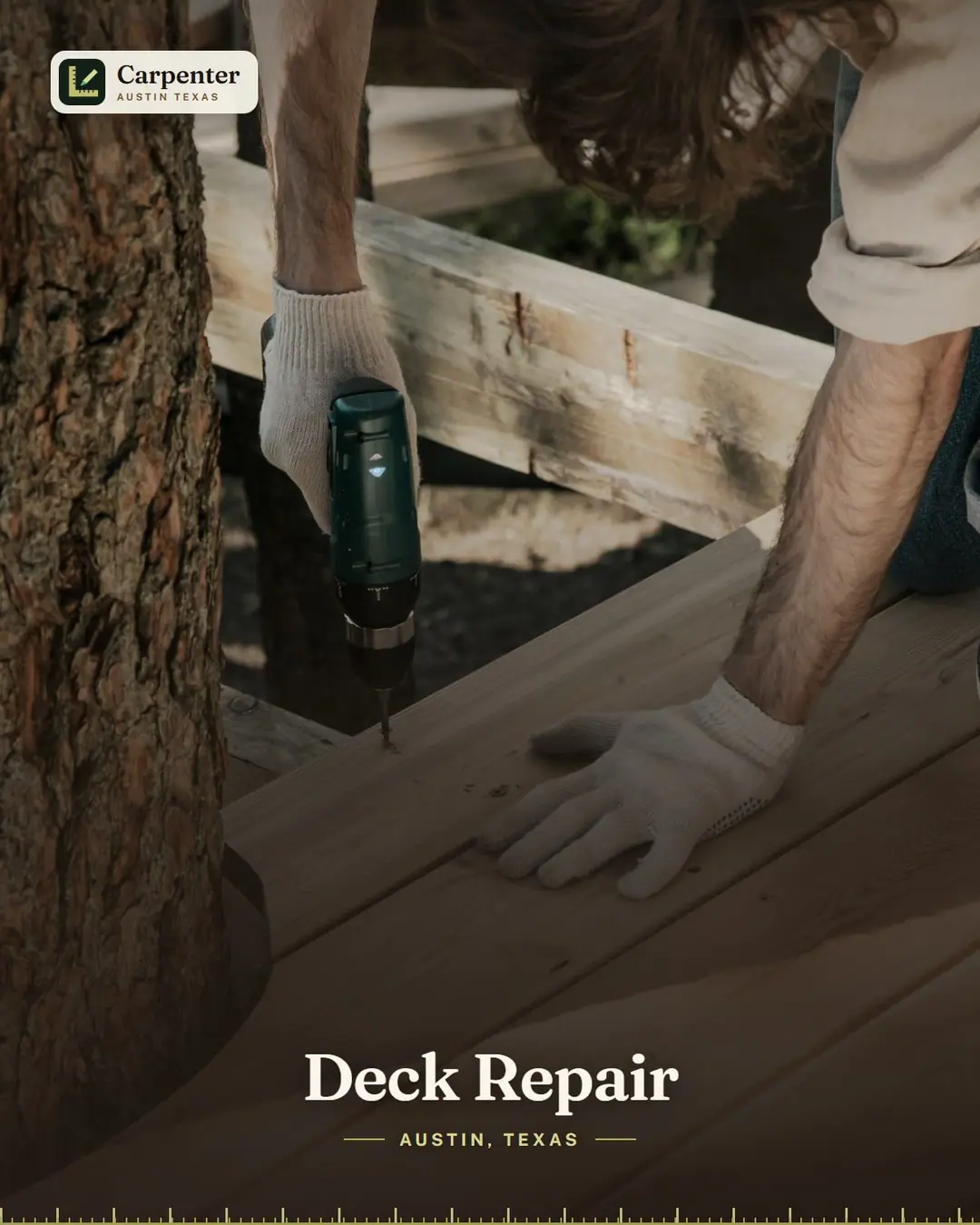
Outdoor and exterior · Austin, TX
A soft board by the back door. A railing that moves when you lean on it. Maybe the stairs flex, the whole deck bounces, or the surface is so grey and splintered nobody wants to walk on it barefoot. Those are the usual reasons people look into deck repair in Austin, and many of them can be fixed without tearing the deck out.
Carpenter Austin Texas handles deck repair across Austin from the frame up: board replacement, rotted joists and posts, ledger and railing repairs, and deck resurfacing in Austin homes where the structure is still sound. We inspect first. Then we tell you plainly whether your deck needs a repair, a new surface or a full replacement, and why.
You get a free written estimate. We show up when promised, protect the house and yard while we work, and clean up before we leave.
Not sure if your deck is safe? We'll inspect it, show you what we find, and give you a clear written repair estimate, free. If a railing or stair is loose, keep people off it until it's checked.
01Warning signs
Most decks give warnings before they fail. The surface ones are easy to spot. The dangerous ones sit under the boards, where you only see them if you get down and look. Here's what each sign usually means and how soon to act.
A board that gives underfoot, dark staining, splits, mushrooms or crumbling ends are the classic signs. They show up first near stairs, planters and the wall of the house, where water sits longest. Sometimes it's surface rot in the board alone. Sometimes the joist under it is rotting too, which is why rotted deck repair in Austin starts with a look underneath. Press a screwdriver gently into the soft spot: if it sinks in easily, the wood is soft past the surface.
What to do now keep heavy furniture and grills off that area and book an inspection.
Rail posts that move at the base, loose balusters, stair treads that flex and stringers pulling away from the deck are the problems most likely to cause a fall. A railing only gets tested when someone falls against it.
The usual causes are rail posts that were notched too deep, nails that have backed out over years of heat, and rot at the post base where water collects.
What to do now keep people, especially kids and older guests, off that railing or stair until it's fixed.
You feel a bounce when you walk across. A span sags in the middle, posts lean out of plumb, or a beam has twisted. Joists may be undersized or weakened by rot. Posts may have sunk or heaved as the clay under them moved, and some decks were built without hangers or bracing in the first place.
What to do now get an inspection before the next gathering on that deck.
A gap opening between the deck and the house, rusted ledger bolts or hangers, and water stains on the siding or on interior walls next to the deck all point at the same place. That's usually the ledger or its flashing failing. It's the most serious deck problem, because the water that rots the ledger can rot the house framing behind it too.
If we find rot in the house's rim joist, sill or siding, our Austin wood rot repair team handles that part.
What to do now stop using the deck until it's been checked.
Nails backing out as the boards heat and cool, splinters, grey checked wood from UV and cupped boards are usually cosmetic at first. This is the classic case for board replacement or resurfacing, as long as the frame underneath checks out.
What to do now have the frame inspected before you spend money on the surface.
Hammering a popped nail back in rarely lasts, because the hole has already widened and the heat cycle will push it out again. A screw driven beside it, or in its place, holds the board down far better.
Start underneath with a flashlight. Look at the tops of joists where boards sit, the ends of joists at the rim and the ledger, and the base of each post. Wood that is dark, soft or crumbling at those points is an early warning the surface may not show.
Then stand on the deck and shift your weight in the middle of each span. A small, firm movement is normal. A noticeable bounce or a creak from a connection points to a joist, beam or hanger that needs a look.
Finish at the house wall. Look for a gap between the deck and the siding, rust streaks running down from bolts, and stains on the siding just below the deck surface.
02What we do
Every repair starts with an inspection because boards hide the structure. A deck can look tired and be perfectly sound underneath. It can also look fine and have a ledger that's been wet for ten years. We don't guess from the surface, and we won't quote a repair until we've seen the frame. A deck inspection in Austin from us is part of the free estimate visit.
We work through the deck in the same order every time:
After the inspection you get our findings in plain language: what passed, what failed and why it matters, with each problem marked as urgent or as something that can wait a season. Nothing is buried in jargon.
Then comes the written estimate, with options. That might be a targeted repair, resurfacing, or replacement when that's the honest answer. Where there's more than one sensible way to fix something, we price both.
We'll also tell you when a small fix will do. If two boards and a loose rail post are the whole problem, that's what the estimate says.
Gather what you know before the visit. An old permit, the year the deck was built, any past repairs and a home inspection report if you have one all help explain what turns up.
Clear the deck and the space beneath it where you can. Furniture, planters and stored items hide the very spots that fail first, and a crawl space packed with gear limits how much of the frame can be seen.
Ask questions as you go. Why a part failed matters as much as the fact that it failed, since the cause decides whether a repair will last. Ask which problems are safety issues and which are ordinary wear.

Wood should be cut, fitted, and finished like it’s meant to last a lifetime.
03What we do
These are the repairs we handle. Each one starts with finding out why the part failed, because a new board over the same wet joist will fail the same way. The fixes below are built to last in Austin heat, storms and clay.
Deck board replacement in Austin is usually the smallest repair a deck needs. We pull rotted, split or cupped boards and check the joist under each one before the new board goes down.
Matching takes some planning. New wood won't match weathered boards at first. You can let it blend in over a season or two, stain the repaired area, or replace a full run of boards so the change lines up with the layout.
Composite boards are trickier. Manufacturers retire colours, so an exact match for an older composite deck can be hard to find. We'll tell you what's available before you commit.
While the boards are up, we swap old nails for deck screws, which hold far better through the heat cycles.
Rotted deck repair in Austin usually means the frame. When rot in a joist is limited, we sister it: a new treated joist is fastened alongside the old one to carry the load. When rot runs deep, the joist or beam comes out and gets replaced.
Posts that rotted at grade get replaced too. The new post sits on concrete with a standoff base, above the soil, so it can dry out between rains. While a post is swapped, we shore the deck temporarily so nothing shifts.
We also add hangers and bracing where the original builder left them out. Joist tape on the tops of the joists is an option that keeps water out of the fastener holes.
The ledger is the board that fastens the deck to the house, and it's the connection that matters most. Older decks were often nailed to the house with no flashing at all.
Repair means removing the deck boards near the house so we can see the ledger and the house rim joist behind it. Then we replace or re-fasten the ledger with structural bolts or lag screws per code, and install proper flashing so water runs out instead of in.
If the rot has spread into the house framing, the job becomes a structural wood rot repair, which our wood rot team handles alongside the deck work.
Loose rail posts get re-anchored with structural hardware made for guard posts. Rotted posts and balusters are replaced. When we replace a railing, we build it to the guard height and opening rules in the code the City enforces today, which an older railing may not meet.
Stairs get the same treatment: new stringers where the old ones have rotted or split, new treads, and a solid handrail where one is missing or loose.
A repair is also a good time to change the railing style, for example from wood pickets to cable rail. Full new railing systems are covered on our deck building page.
Austin storms drop limbs on decks, loosen railings with wind and flood footings with runoff. Our first job after a storm is to make the deck safe, which can mean blocking off part of it or shoring a damaged section.
We document the damage before repairs start. That record is useful if you file an insurance claim, though what your policy covers is between you and your insurer. Then we repair the framing and boards.
Storms usually hit the fence line too. We handle fence repair on the same visit if you need it.
Every failed part has a reason. A rotted joist under a planter means trapped water, a loose rail post means a weak connection, and a sinking post means a footing problem. The repair should change that condition, or the new part fails the same way.
Fasteners deserve as much thought as lumber. Treated wood is hard on plain steel, so screws, hangers and bolts need a coating or material rated for contact with it. Rusted hangers on an older deck are often among the first things to replace.
Drainage around the deck is part of the repair. Gutters that dump onto the deck, soil piled against posts and low spots under the frame all keep wood wet. Fixing those keeps the new wood dry.
04What we do
Deck resurfacing in Austin keeps the existing frame and replaces the walking surface, often along with the railings and stair treads. Since the footings, posts and joists stay, you get a deck that looks and feels close to new for less than a full rebuild. The catch is that the frame has to pass inspection first. Resurfacing over a failing frame just hides the problem. The rot keeps going underneath.
Resurfacing makes sense when:
It doesn't make sense when the frame has rot beyond a few spot repairs, the ledger has failed, or the footings are moving. At that point a new surface is money spent on a structure that still needs replacing, and replacement is the honest answer.
Many Austin owners switch to composite when they resurface. It never needs stain, and it resists rot and termites.
There are catches. Composite manufacturers specify joist spacing, and it's often closer than the spacing on older wood decks. If yours is too wide, we add joists so the new boards won't sag. Older frames may also need new hangers and fasteners rated for the job.
Joist tape on the tops of the joists is worth adding before the new boards go down, because the frame under composite is still wood. Hidden fasteners clip into the board edges and leave a clean surface. Board colour matters too: dark composite gets hot in Austin sun, so lighter colours suit decks in full afternoon light.
We'll walk you through the brands that fit your frame and budget at the estimate.
Refinishing means cleaning, sanding and re-staining the boards you have. It works when the boards are sound and only weathered: grey, a little rough, but not soft, split or cupped. Resurfacing replaces boards that are past saving.
If refinishing will do the job, we'll recommend it, since it costs far less. Staining services are covered in full on our main deck page.
A simple test helps you decide. If a board resists a screwdriver, lies flat and has only shallow surface checks, refinishing can work. If it is soft, cupped enough to hold water or split along its length, it is a candidate for replacement.
Plan the board layout before the old boards come off. A resurface is a chance to change the board direction, add a border around the edge, or set a divider board to break up long runs. Each of those can need extra blocking in the frame.
Check the surface height at the door. New boards of a different thickness can raise or lower the deck, which changes the step down from the house and the top stair riser. That has to be worked out before boards are ordered.
Look at the stairs and railings at the same time. Worn treads and loose rails next to a new surface look worse than before, and replacing them together keeps the deck consistent.
05Side by side
The decision comes down to two things: the condition of the frame and the condition of the surface. The table shows how we usually call it.
| Frame condition | Surface condition | Our usual recommendation | Typical scope |
|---|---|---|---|
| Sound | A few bad boards or a loose rail | Targeted repair | Replace boards, re-anchor posts, fix stairs |
| Sound | Worn across most of the deck | Resurfacing | New decking, often new railings and stair treads |
| Failing ledger, joists or footings | Any | Replacement | Tear out and rebuild to current code |
Ask how much of the frame is original and how much has already been repaired. A frame patched in several places has more connections that can fail, and that changes the math for the next repair.
Think about what you want from the deck next. If the size, height or stair position no longer suits you, replacement lets you change them. If the deck works well and only the surface is tired, there is little reason to rebuild.
Weigh safety first, then looks. A deck with a sound frame and worn boards is safe but tired. A deck with good-looking boards and a failing ledger is a safety problem, however good it looks.
Age matters, but not the way people expect. A deck with one bad section is usually worth fixing, even if it's old. An older deck that's had structural repairs every couple of years is different: by the time you add up the next round of patches, rebuilding can cost less than keeping it going.
When replacement is the answer, we'll say so and explain why, with the findings to back it up. Our Austin deck builders page covers new decks and replacement.
06Why it happens
Most deck failures in Austin trace back to a short list of local causes.

Much of East, Northeast and Southeast Austin sits on Blackland Prairie clay, which swells when wet and shrinks in drought. Footings move with it. Posts tilt, and the connections between posts, beams and joists slowly open up.
Lots there often have thin soil over limestone, and digging through rock is slow, hard work, so some older decks ended up with posts set too shallow.
Heavy spring rain soaks posts at grade and summer heat dries them fast; wood that goes through that cycle year after year cracks and lets rot in. Boards also expand in the afternoon heat and shrink overnight, which works smooth nails up out of the wood. Strong UV greys and checks the surface, and water gets into the checks.
Wood that touches soil gives them a way in.
Older central neighbourhoods like Hyde Park, Travis Heights, Crestview and Allandale have plenty of decks added years ago. Some were built before bolted, flashed ledgers were common practice, so that's the first connection we check.
Planters, rugs and mats trap moisture on the boards below them, and debris packed into board gaps holds rain on the joist tops. Rot starts there long before it shows on the surface.
A deck built close to the ground with little air beneath it keeps its frame damp after every rain. The undersides of the boards stay wet while the tops bake in the sun, which is how cupping starts.
Hangers, bolts and nails rust where water sits, especially on older decks built with plain steel fasteners. A connection can look fine from above while the metal holding it together has thinned.
07Rules & permits
Some do. The City of Austin Development Services Department's "Work Exempt from Building Permits" page lists deck repair as exempt only when it is a non-structural repair limited to the existing deck boards and does not include guardrails or handrails. We checked that page in October 2026.

Replacing joists, beams, posts, ledgers, railings or stairs generally needs a building permit and an inspection.
Exempt work still has to meet code. The same City page says exempt work must comply with building codes, City codes and all other applicable ordinances.
Replacing boards on a sound frame fits the exemption. Once a repair reaches the joists, beams, posts or ledger, it is structural work, and the permit question changes.
Even a straightforward railing replacement is excluded from the deck repair exemption, so plan for the permit question on any guard or handrail work.
Board-only repairs still have to meet code, so new boards need proper support and fastening, and the work should leave the deck as safe as the code expects.
08How it works
Every deck repair runs from symptoms to a full inspection, written options, any permit, the repair itself and a walkthrough, with you seeing what failed and why.
We'll ask about the symptoms, and photos help.
The most useful photos show each problem from a few steps back and up close, plus the underside if you can reach it safely. A wide shot of the whole deck shows its height, the stairs and how it meets the house. A shot along the ledger, where the deck joins the wall, shows stains, gaps or rust at a glance.
Describe what you feel as well as what you see. A bounce in the middle, a rail that shifts when leaned on and a stair that flexes all point to different parts of the frame. Mention roughly how old the deck is and whether it has been repaired before.
If a railing or stair is loose, rope it off or block it before the visit, so nobody leans on it in the meantime.
What to expect You describe what you have noticed, send a few photos, and keep everyone off any loose railing or stair until the visit.
The inspection follows the path a load travels: from the boards to the joists, the joists to the beams, the beams to the posts, and the posts to the footings. A problem low in that chain affects everything above it, which is why the underside gets as much attention as the surface.
The ledger gets the closest look. Where it is visible, the check covers whether it is bolted or only nailed, whether flashing laps over it, and whether the siding and rim joist behind it show stains or soft wood. Railings get pushed at each post, and stairs get walked and checked at the stringers.
Be there for the inspection if you can. Seeing a soft joist end or a rusted hanger yourself makes the findings much easier to weigh.
What to expect You walk the deck with us, look underneath where you can, and see the problem spots as they are found.
The findings sort problems by urgency. A loose rail post or a failing ledger comes first, because those are safety problems. A weathered surface or a cupped board can usually wait for a better moment in your budget.
Options let you choose the path. A targeted repair, resurfacing and replacement are each explained against what the inspection found, so you can see why one makes sense and another does not. Where two sound approaches exist, such as sistering a joist or replacing it, each gets its own price.
Read the findings before the price. Knowing what failed and why helps you judge whether a repair fixes the cause or only the symptom. Ask what each repair does about the water problem behind it.
What to expect You read the findings, ask about anything unclear, and choose which repairs to do now and which to plan for later.
The City's deck repair exemption is narrow. It covers non-structural repair limited to the existing deck boards and leaves out guardrails and handrails. Replacing joists, beams, posts, a ledger, railings or stairs falls outside it, so that work generally needs a permit and an inspection.
A permit changes the order of work. Structural parts may need to stay visible until they are inspected, so new decking over a replaced joist can wait until that check is done.
Keep the permit and inspection records once the job closes. If you sell the house, a buyer's inspector may ask whether structural repairs were permitted, and the records answer that quickly.
What to expect You learn whether your repair needs a permit and plan around any inspection before the new work is covered.
We protect the yard and house, shore the deck if needed, replace the failed parts and upgrade fasteners and flashing.
Before parts come out, the deck is cleared and the area around it protected. If a post or beam is being replaced, temporary shores go in under the frame so the deck stays level while the old piece is removed. Shores stand on solid blocking, not soft soil, so they do not sink under the load.
Failed parts come out and the wood around them gets checked again, because rot often runs further than it looked from outside. New framing is treated lumber rated for its exposure, fastened with connectors and screws suited to treated wood. Old smooth nails in boards that stay are often swapped for screws while the deck is open.
At the house, new flashing goes over the ledger so water runs out instead of behind it.
What to expect You see the failed parts come out and can look at the new framing and flashing before the boards go back down.
On the walkthrough, test the repairs yourself. Push on the rail posts, walk the stairs, and stand where the deck bounced before. Look underneath at the new framing and at the ledger flashing, so you know what the repaired parts look like.
Ask what to watch for next. A deck with some original framing left in place has parts that will age on their own schedule, and knowing which ones lets you check them first each spring.
Clean-up covers old boards, rusted fasteners, offcuts and debris from under the deck. Check the yard edge and any gravel under the deck for stray screws before children or pets play there.
What to expect You test the repaired rails and stairs, look at the new framing underneath, and note which original parts to watch.
We show up when promised and clean up before we leave each day. Timing depends on the scope and on any permit, and your estimate includes a schedule for your job.
09Pricing
Repair costs swing widely because a repair can be two boards or a new ledger and three posts.
Two published figures give a sense of the range. Angi's Austin deck repair cost page reports a typical range of roughly $852 to $3,345, with an average around $2,050. One local repair company, deckrepairinaustintx.com, lists minor repairs such as board replacement at $300 to $900, and larger jobs like post replacement or full refinishing at $1,500 to $4,500. Those are their figures, not our prices.
Our written estimate prices each repair on its own line, so you can do the urgent work now and plan the rest.
A tall deck with open space below is easy to work on. A low deck with little crawl room may need boards lifted just to reach a joist, which adds work to even a small repair.
Lifting boards to replace a joist exposes the joists beside it, and a soft post base may lead down to its footing. The estimate lines show which parts are known and which depend on what is uncovered.
Safety repairs to railings, stairs and the ledger come first. Surface work such as boards and refinishing can follow when it suits your budget.
10Why us
Every repair estimate starts under the boards, so the price reflects what the frame actually needs.
Every estimate is based on what's under the boards, not just what's on top.
If a few boards and a rail post fix the problem, that's what we quote.
Rot in the house rim joist, damaged trim or siding, or a storm-hit fence can be fixed on the same visit.
on time, the home protected while we work, clean-up before we leave, and a clear written estimate.
A good repair visit spends more time under the deck than on top of it. Expect the person inspecting to look at joists, hangers, posts and the ledger, and to explain what each part does before talking about price.
Expect a clear line between safety work and appearance work. Loose railings, flexing stairs and a failing ledger should be called out as urgent. Gray boards and minor checks should be described as wear, not as an emergency.
Expect honest options. If repair, resurfacing and replacement all fit, each one should be explained with its trade-offs, so the choice stays yours.
Wood should be cut, fitted, and finished like it’s meant to last a lifetime.
11Care & upkeep
A repaired deck stays sound when water drains, connections stay tight and small problems get caught each spring.

Pay most attention to the parts that were not replaced. New framing next to old framing means the old pieces will show wear first, so check those joists, posts and connections each spring.
Move planters and rugs around now and then. Anything that sits in one spot all year holds moisture on the boards beneath it. Planter feet or stands let air pass under the pot.
After big storms, look for fallen limbs on the boards, water standing under the deck and any rail that moves. Fix gutter outlets or grading that leave water standing near the posts.
12Service area
Deck problems follow the soil, the slope and the age of the deck as much as the part of town.
older bungalows and cottages, historic districts like Hyde Park, and renovations on tight lots.
(737) 415-9388Central Austin, TX
mid-century ranch homes in established neighborhoods.
(737) 415-9388North Austin, TX
mid-century houses, many due for new trim or decks.
(737) 415-9388North Central Austin, TX
newer subdivisions sitting on the clay east of I-35.
(737) 415-9388Northeast Austin, TX
Hill Country lots on sloped limestone, with decks built for the view.
(737) 415-9388Northwest Austin, TX
newer subdivisions where builder-grade trim and fences often need upgrades.
(737) 415-9388Far North Austin, TX
older homes east of I-35 on clay soil, with plenty of infill and renovation.
(737) 415-9388East Austin, TX
hillside homes on limestone, where decks and stairs follow the slope.
(737) 415-9388West Austin, TX
established neighborhoods with a mix of older and newer homes.
(737) 415-9388South Austin, TX
older houses around neighborhoods like Travis Heights, many with porches and original trim.
(737) 415-9388South Central Austin, TX
older homes, rentals and newer infill south of Lady Bird Lake.
(737) 415-9388Riverside, Austin, TX
growing neighborhoods on clay soils, where doors and trim feel the ground move.
(737) 415-9388Southeast Austin, TX
hillside lots with decks and views toward the Hill Country.
(737) 415-9388Southwest Austin, TX
On clay soil, the usual repairs involve posts and footings that have moved, and connections that have opened as the frame racked. Leveling has to deal with the footing, not just the post.
On older decks in established neighborhoods, the ledger is the first thing to check. Many older decks were attached with nails and no flashing, and the house framing behind them can be damp.
On sloped lots with tall posts, bracing and post connections matter most. Tall posts magnify any looseness at the top or bottom, so a small amount of play becomes a noticeable sway.
The problems change with the part of town. East-side lots see posts heaved by clay, central neighbourhoods have older ledgers, and West Austin has sloped decks on tall posts.
13Questions
It depends on how many boards, the material, and whether the joists underneath need work. One local company, deckrepairinaustintx.com, lists minor repairs such as board replacement at $300 to $900. That's their range. We'll price your deck after we've looked at the joists.
Resurfacing usually costs less than a new deck because the footings, posts and frame stay. The savings shrink if we have to add joists to meet a composite manufacturer's spacing, or replace hangers. Your estimate can price both options side by side.
Yes, if the frame is sound. Age alone doesn't decide it. If the deck keeps needing structural repairs every year or two, the money is usually better spent on a rebuild.
Sudden damage, such as a tree falling on the deck in a storm, may be covered. Rot and normal wear usually aren't. Check your policy and talk to your insurer. We can document the damage and describe the repair in writing.
The estimate visit is free, and we inspect the deck as part of it. If you need a separate formal inspection report for a home sale, ask us about it when you book.
Photos can give us a rough idea, but a firm price needs eyes on the frame. The soft board you see could be one bad board or a rotten joist, and those cost very different amounts to fix.
Keep everyone off loose railings, flexing stairs and soft areas. If the deck bounces, leans or is pulling away from the house, stop using it until it's been inspected. Those are structural problems, not cosmetic ones.
Look underneath with a flashlight. Rotten joists show dark, soft or crumbling wood, usually at the tops and the ends where water sits. Press gently with a screwdriver, and look for sag between supports.
The usual causes are failing ledger fasteners, rot behind a ledger with no flashing, or footings that have settled. Treat it as urgent. A ledger that lets go can drop the deck.
Joists that span too far, joists that are undersized or weakened by rot, and missing blocking all cause bounce. It's often fixable by sistering joists, adding blocking or adding a beam to shorten the span.
Yes. Central Texas has subterranean termites, including Formosan termites. Look for mud tubes on posts and footings and for wood that sounds hollow. A licensed pest control company treats the termites; we repair the wood they damaged.
Wood that's buried in or touching wet soil. We replace those posts and set the new ones on concrete footings with standoff bases.
Often, yes, if the frame is sound and the joist spacing meets the composite manufacturer's spec. If the joists are too far apart, we add more before the new boards go down.
Yes, when the joists under them are sound. We check each one before we replace the board above it.
Not at first. New wood looks different and weathers in over time, and staining the deck or replacing a full run of boards helps it blend. Older composite colours may be discontinued, which can make an exact match hard.
That depends on the parts we didn't replace. New boards on a sound, well-drained frame can give you years of use. When the frame is near the end of its life, we'll tell you that in the findings.
Yes. We inspect it the same way we would one of ours.
When the frame has widespread rot, the ledger has failed, the footings have moved, or structural repairs keep coming back. The decision table above shows how we make that call.
Do your own check every spring. Get a professional inspection for older decks, after big storms, and before buying or selling a house.
Send us the report. We'll inspect the flagged items and give you a written repair estimate for them.
Usually not. The City of Austin exempts non-structural repair limited to the existing deck boards. Structural work, railing work or handrail work generally does need a permit.
Probably. The City's deck repair exemption excludes guardrails and handrails, so railing work isn't covered by it. We confirm the requirement for your job with the City.
Work done correctly, and permitted where the City requires it, should hold up to an inspector's review. We can describe the work in writing for the buyer or their inspector.
The parts we checked, what passed, what failed, how urgent each problem is, and repair options with prices.
Swapping a few boards can often be done in a day. Structural repairs and resurfacing take longer, and if a permit is needed, that adds time before work starts. Your estimate gives the schedule.
Ground-contact treated lumber for posts and framing, boards that match your deck's species or composite on top, and fasteners rated for treated wood so they don't corrode.
Yes: the boards, the fasteners and the wood frame beneath them. Matching boards depends on whether the colour is still made.
Yes. On hot days we start early, and we gap new boards for how wood and composite move in the heat.
Ask us at the estimate. Depending on the job, the repaired area can be blended in or the whole deck refinished.
Please clear furniture, grills and planters off the deck. We protect plants and siding near the work area and clean up every day.
14Keep exploring
Deck repair is one part of what we do. The same crew handles the services below, so one call covers the whole job.

Carpenter Austin Texas builds custom decks in Austin: cedar, composite and pine boards, railings, pool and rooftop decks, and replacements. Free estimates.
See the service
Exterior trim, siding, fascia and porch carpentry in Austin. We fix the wood behind the trim and flash it right. Free written estimates across Austin.
See the service
Carpenter Austin Texas designs and builds outdoor living spaces in Austin: pergolas, patio covers, gazebos, screened porches and catios. Free estimates.
See the service
Cedar privacy, horizontal, picket and split rail fences built by Austin carpenters, with posts set for clay or limestone. Free written fence estimate.
See the service
Carpenter Austin Texas builds custom sheds in Austin on site: storage sheds, workshops, backyard offices, pool houses and garages. Free written estimates.
See the serviceFree written estimate
We inspect first, explain your options honestly, and leave your yard clean.
From a single rotted porch post in a 1920s bungalow to a custom cedar deck overlooking the Hill Country.
Original trim, porches and windows repaired with lumber, fasteners and finishes chosen for Central Texas.
Tenant improvements, commercial millwork and ongoing repairs for rental homes.
