
Some houses have closed or boxed eaves, where the soffit covers the rafter tails. Others have open eaves, with the rafter tails exposed and visible from below, which is common on older Austin bungalows.
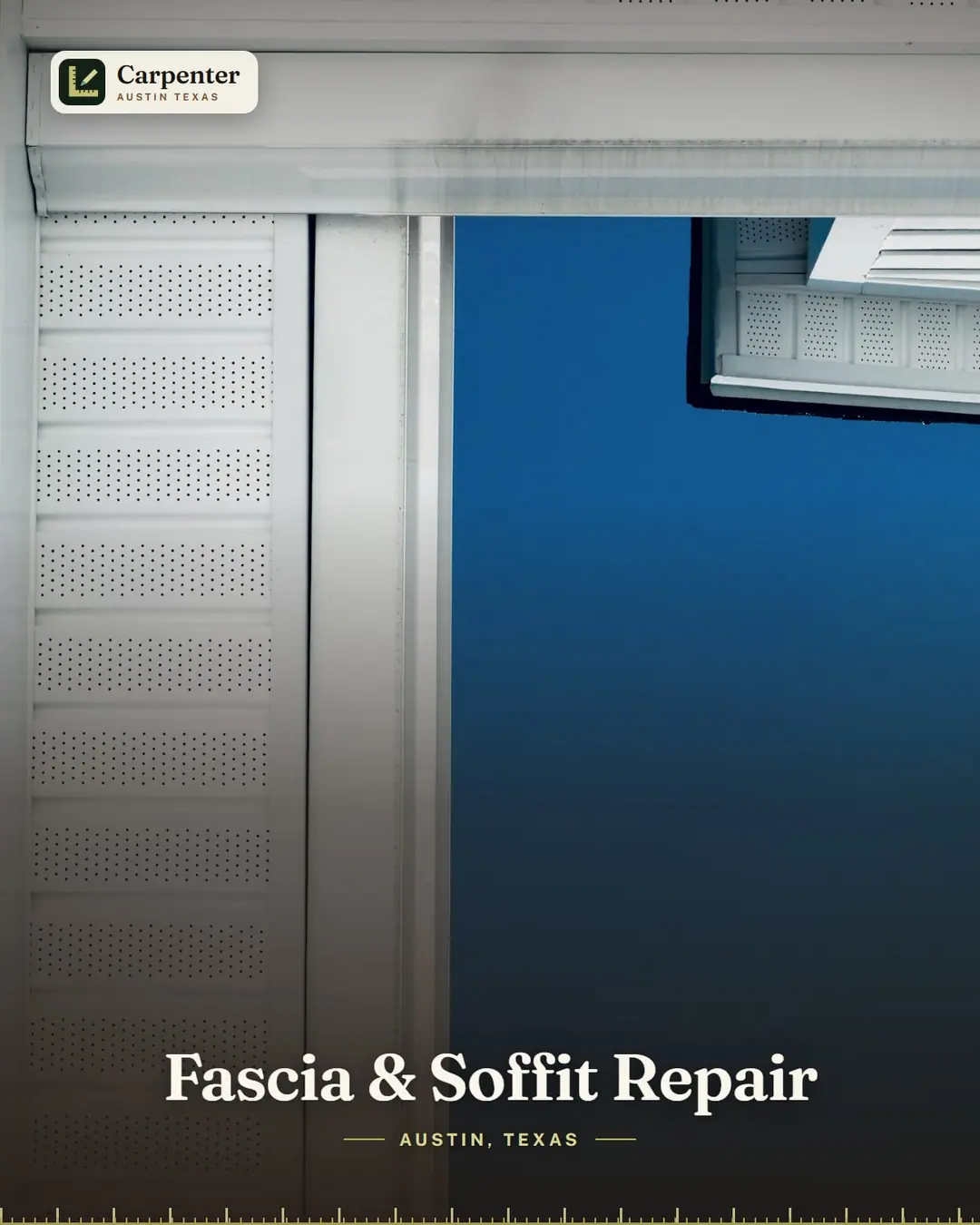
Outdoor and exterior · Austin, TX
Fascia & soffit repair and replacement in Austin, TX
The gutter is pulling away from a fascia board that feels soft under your thumb. Paint is peeling all along the roofline. Or there's a ragged hole in the soffit, and something has been scratching in the attic at night ever since.
Read more
Carpenter Austin Texas does fascia and soffit repair across Austin. We replace fascia boards and soffits, and we repair the rafter tails behind them, using materials and vents picked for Central Texas heat and storms. Because we're carpenters, fascia repair with us means fixing the wood behind the board instead of wrapping metal over it. Soffit repair includes the vents and the gaps animals use to get in.
Every estimate is free and in writing. For trim, siding and porches, see our page on exterior carpentry in Austin.
Rot at the roofline spreads into rafters. Get it checked and priced in writing. We show up on time, protect your plants and driveway, and clean up the debris.
- Free written estimateYou know the scope and the price before anyone picks up a saw.
- On time, as promisedWe show up on the day and at the time we agreed.
- Your home protectedFloors, furniture and the yard are covered while the work goes on.
- Clean job siteThe work area is swept and cleared before we leave.
- Built for Texas weatherLumber, fasteners and finishes chosen to hold up to Austin heat, storms and clay.
- Jobs of every sizeOne rotted porch post gets the same care as a custom build.
The numbers behind this work
- 122.8days a year at 90°F or moreAustin averages 122.8 days a year with highs of 90 degrees or hotter, about four months of heat that exterior wood, paint and sealers have to survive.NOAA climate normals · 1991-2020
- 36.25 inaverage yearly rainfallAustin's official climate station averages 36.25 inches of rain a year, much of it in a few hard storms, which is why end grain, fascia and sills need sealing and drainage.NOAA climate normals · 1991-2020
- 128 sq ftsiding or floor-deck repair with no permitAustin exempts siding, floor-decking and roof-decking repairs of up to 128 square feet each from a building permit; larger repairs need one.City of Austin Development Services · 2026
- 70%chance of termite damage within 25 yearsTexas A&M AgriLife puts the chance that an unprotected Texas home suffers some termite damage within 25 years at about 70 percent.Texas A&M AgriLife Extension · E-368
01Good to know
What fascia and soffits do
In short
Fascia, soffit, rafter tails and drip edge work as one system, so a failure in one part soon reaches the others.
The roof edge is built from a few parts that work together
- Fascia: the vertical board along the roof edge. Gutters hang on it.
- Soffit: the underside of the roof overhang. It's often vented to pull air into the attic.
- Rafter tails: the ends of the roof rafters. The fascia is nailed to them.
- Sub-fascia: a framing board some houses have behind the finished fascia.
- Drip edge: the metal flashing at the edge of the roof that sends water into the gutter.
Together, these parts shed water away from the walls, hold up the gutters, let the attic breathe and keep animals out. A rotted fascia, for example, lets water into the soffit and the rafter tails behind it.
Fascia carries more load than it looks
A gutter full of rain and wet leaves is heavy, and every hanger pulls on the fascia and the rafter tail behind it. That is why fascia is fastened into the rafter ends, not just into other trim.
Soffit vents are only half of attic airflow
Air drawn in at the soffit has to leave near the ridge or high on the gables. Blocking either end slows the flow and leaves the attic hotter and damper than it should be.
Open eaves show every rafter tail
On houses with exposed tails, the rafter ends are part of the look, so their shape, spacing and paint matter as much as their strength.
02Warning signs
Signs your fascia or soffit needs repair
In short
Most roofline problems can be spotted from the ground. Look for these four signs, and act before the rot moves from the board into the rafters.
- Sign 01
Rot behind the gutters
Peeling paint, dark stains or soft wood along the fascia are the first signs. They show up most at downspout corners and inside corners, where water overflows the gutter.
The usual cause is a drip edge that is missing or too short, so water runs behind the gutter instead of into it. Clogged gutters do the same thing by spilling over the back.
Inside corners deserve a close look. Two roof planes pour water into one gutter corner, and that corner is also where gutter seams and fascia joints meet. Paint that fails there first is often the earliest warning on the whole roofline.
- Sign 02
Sagging gutters and wavy rooflines
A gutter pulling away from the house, or a fascia line that dips between rafters, means the fasteners have lost their grip. Either the fascia has rotted, or the rafter tails behind it are failing.
Re-screwing the gutter into rotten fascia doesn't last. The new screws go into the same soft wood, and the next heavy rain full of leaves pulls them out again.
- Sign 03
Holes, nests and animal damage
Chewed openings, droppings, bird or wasp nests and scratching in the attic all point to animals. Squirrels, raccoons and birds look for soft or gapped soffits, carpenter bees bore into bare wood, and woodpeckers follow insects into soft boards.
The animals have to be out before anyone closes the opening, so a licensed wildlife removal company handles that part first. Then we repair the wood.
- Sign 04
Stained, drooping or missing soffit panels
Water stains, mildew, panels sagging between supports or blown out after a storm all need a look. So do vents that are blocked or crushed.
A stain on the soffit can come from a roof leak above it. We check the source first, because new soffit under an active leak just stains again.
Checking the roofline from the ground
Walk the house with binoculars on a bright morning. Look along the bottom edge of the fascia for dark lines, peeling paint and gaps at the corners. Then sight down each gutter: a straight fascia line is a good sign, and dips between rafters point to soft wood or failing tails.
Watch the roofline during a heavy rain if you can do it safely from the ground. Water spilling over the back of the gutter, or streaming down the fascia face, shows exactly where the drip edge or gutter is failing.
Listen near the eaves in the evening. Scratching or rustling in the soffit around dusk or dawn usually means something is living there.

Wood should be cut, fitted, and finished like it’s meant to last a lifetime.
03What we do
Fascia repair and replacement
In short
For fascia repair in Austin, most of the work is replacing the failed run of board, not patching it. Fascia carries the weight of the gutters and everything in them, so a patched board is a weak spot right where the load is.


Fascia board replacement follows the same steps each time:
- Take the gutters down so we can reach the board
- Cut out the rotted run back to sound wood
- Join new board to old with a scarf or butt joint centered over a rafter
- Back-prime the new board and seal its ends
- Fasten it with corrosion-resistant fasteners
- Add or correct the drip edge
- Prime and paint
We match the board size to what's already there, whether that's 1x6, 1x8 or a 2x board, and match any profile on the face. Then the gutters go back up.
Rot often goes past the fascia into the rafter tails behind it. Nobody can see it until the fascia comes off, and it is the part of the job that changes the price most.
There are three ways to fix it. We can sister new lumber alongside a rafter that is still sound further in. We can splice a new tail onto the rafter. Or, when several tails in a row are gone, we rebuild that section of the eave.
On bungalows with exposed rafter tails, new tails are cut to match the shape of the originals so the eave still looks right from the street. If the rot runs further into the roof framing, or there are signs of termites, it becomes a structural job and goes through our wood rot repair process. HomeGuide's cost guide lists rafter tail repair as one of the larger line items. The cost section below gives its figures.
Ask about thisRead the wood rot & termite damage repair page
The drip edge is the metal flashing at the edge of the roof. It should send water into the gutter. When it's missing or too short, water runs down behind the gutter and soaks the face of the fascia every time it rains. That is the usual reason fascia rots again after it was replaced.
When the drip edge or the first course of shingles has to be lifted, Carpenter Austin Texas coordinates with your roofer or gutter installer, so each trade does its own part in the right order.
What makes a fascia repair last
Joints belong over rafters. A splice that floats between rafters has nothing behind it, so the gutter load flexes it and the paint cracks along the seam. Placing every joint over solid framing keeps the fascia line straight and the joint tight.
End grain needs as much care as the face. Fascia ends at corners and splices drink water fastest, so they are sealed before the board goes up and painted after. A corner where two boards meet should be closed tight, since an open miter invites both water and wasps.
Hanger placement matters too. Gutter hangers fastened into a rafter tail or a solid sub-fascia hold far better than hangers screwed only into the face of a board.
04What we do
Soffit repair and replacement
In short
Soffit repair in Austin covers three jobs: fixing the material itself, getting the attic vents right, and closing the holes animals use. Each is covered below.


Older Austin homes usually have soffits made of solid wood boards, plywood panels or tongue-and-groove beadboard. We replace the failed panels or boards and add backing or nailers where the old ones have rotted or pulled loose.
On older homes, the bead profile matters. A new run of beadboard has to match the old spacing and shape, or the patch shows from the ground. Every new piece gets primed on all faces before it goes up.
When most of a soffit run is sound, we repair it in kind. When nearly all of it has failed, or the house never had proper venting, replacing it with new material often makes more sense.
In most vented attics, soffit vents are where the air comes in. It flows up under the roof and out through vents near the ridge. When soffit vents are blocked, painted over or missing their baffles, heat and moisture get trapped in the attic. In an Austin summer, that is a lot of heat.
Common vent options:
- Individual rectangular or round vents cut into the soffit.
- Continuous strip vents running the length of the eave.
- Perforated soffit panels.
Austin's Wildland-Urban Interface code changes this on some lots. For new construction and additions in mapped WUI zones, vents need ember-resistant mesh with 1/8-inch openings or a WUI-approved vent. The City's guide also says attic vents can't go in soffits or eaves at all, except in the outermost zone.
Once a licensed wildlife company has the animals out, we close the openings for good. That means solid wood or PVC repairs instead of patches, screened vents, and sealed corners where the fascia meets the soffit, which is a favorite entry point for squirrels.
Bare wood gets painted, since carpenter bees prefer it. A pest control company handles any active bee or wasp nests before we close things up.
Look up at the corners where the fascia meets the soffit and the roof. A small gap is enough for a young squirrel or a wasp, and those corners are where wood is often cut short or has shrunk away over time.
Getting airflow right
Vents should line up with open rafter bays. A soffit vent under a blocked bay, or under insulation packed tight to the roof deck, moves almost no air. In attics with loose insulation, baffles keep a clear channel from the vent up past the insulation.
Painted-over vents are common on older houses. Several coats of paint can close the screen openings almost completely, so the attic behaves as if it had no soffit vents at all. Replacing those vents restores airflow without changing the soffit around them.
Soffit work is also a good time to look at the attic side of the eave for gaps in insulation and signs of past leaks, since the eave is open and easy to see into.
05Side by side
Fascia and soffit materials compared
In short
Match the material to the spot on the roofline: the style of the house, how wet that run stays and any rules for the lot.
| Material | Pros | Cons in Austin | Typical use |
|---|---|---|---|
| Wood (cedar, primed pine) | Matches older homes, takes paint well | Rots when paint or drip edge fails | Historic and older homes, exposed eaves |
| Cellular PVC | Doesn't rot | Expands and contracts with heat | Fascia at gutter lines, wet spots |
| Fiber cement | Non-combustible | Heavy to handle at height | Homes in WUI zones, Hardie-sided homes |
| Aluminum or vinyl wrap and soffit | Low upkeep | Can hide rot when wrapped over bad wood | Newer homes, over sound wood only |
Choosing material by location
Different runs of one roofline can take different materials. A fascia run below a valley that floods its gutter in every storm is a candidate for a rot-proof board, while a sheltered run on an older house can stay in painted wood to match the rest.
Mixing materials works when sizes and paint match. Board widths, thicknesses and edge profiles need to line up at every joint, or the change shows from the ground. Paint ties the pieces together, so plan on the same color and sheen across the whole run.
Before choosing wrap, have the wood under it probed. Wrap over sound, dry wood can protect it, but only if the wood was checked first.
Our take
For material cost alone, HomeGuide's national soffit and fascia guide (November 2025) lists wood at $3.50 to $8.50 per linear foot, PVC at $2.50 to $7.50 and aluminum at $3.25 to $7.50.
Never wrap metal over rotted wood. The wrap hides the rot and traps water against it, and the first sign of trouble becomes a gutter falling off.
06Checklist
What damages fascia and soffits in Austin
In short
These six local causes are behind most roofline damage in Austin, and each has a carpentry fix.

At a glance
- Sudden heavy storms overflow gutters and push water behind the fascia. The fix is a correct drip edge and gutters that are clean before storm season.
- Hail and high winds crack boards and blow soffit panels loose. The fix is replacing damaged panels and fastening the new ones to solid backing.
- Long summers of heat and UV break down paint and caulk along the roofline. The fix is priming every face of new wood and repainting before the paint fails through.
- Squirrels, raccoons, birds, carpenter bees and woodpeckers go after soft or gapped wood. The fix is solid repairs, screened vents and painted wood.
- Older central Austin homes, both pre-war bungalows and mid-century houses, still have original wood eaves and exposed rafter tails under many coats of paint. On homes built before 1978, that paint likely contains lead, so scraping it calls for lead-safe work practices.
- In west Austin's mapped WUI zones, vent and soffit rules apply to new construction and additions.
Which part of the roofline fails first
Not every side of the roofline wears the same way. The side under overhanging trees collects the most leaves, so its gutters overflow soonest and its fascia stays wet longest. The west side takes the afternoon sun, so paint there cracks first.
Low points matter too. Inside corners, valleys and the ends of long gutter runs carry the most water, so fascia rot tends to cluster there. A downspout too small for the roof area above it backs water up at the same spots.
Start where these overlap, such as an inside corner under a tree, and check those spots after every major storm.
07How it works
Our fascia and soffit repair process
In short
A roofline repair opens the eave, fixes the rafter tails behind it, and closes it up with water and airflow set right, with you seeing what was hidden.
- Step 01
We inspect from a ladder, probe the fascia, rafter tails and soffit, check the drip edge, and look from the attic side if it's reachable
From the ladder, the probe goes into the fascia at its bottom edge and at each joint, then into any rafter tail that can be reached. The bottom edge and the corners where two runs meet hold water longest, so soft wood shows there first. The drip edge gets checked by looking under the first shingles: it should hang over the back of the gutter, not stop short of it.
From the attic side, a flashlight along the eaves shows dark stains on the roof deck, wet insulation, daylight where there should be none, and droppings or nesting material. Insulation stuffed into the eave can also block the soffit vents from inside.
Mention any noises, leaks or stains you have noticed, and where. A ceiling stain near an outside wall often traces back to the roof edge.
What to expect You point out where you have seen stains or heard animals, and we show you what the probe and flashlight turned up.
- Step 02
You get a written estimate, with a separate allowance for any rafter-tail rot found once the boards are off
Fascia is priced by the run, so the estimate lists which sides of the house need work and roughly how much board on each. Soffit, vents and drip edge sit on their own lines, so you can see what each part of the roofline costs and choose what to do now.
The rafter-tail allowance is there because rafter rot cannot be measured until the fascia is off. It is used only if rot is found, and only after you have seen it and approved the work. If a whole section of eave turns out to need rebuilding, that is priced and approved separately before it goes ahead.
Read what the estimate says about finish paint, and ask about any line you do not follow before you approve it.
What to expect You read the estimate side by side with the roofline, ask about the rafter-tail allowance, and approve the sections you want done.
- Step 03
We protect plants, AC units and the driveway
On homes built before 1978, federal rules require lead-safe practices for paid work that disturbs paint.
Roofline work drops debris from height: old nails, paint chips, rotted wood, nesting material and the muck from inside gutters. Tarps go under the whole run being worked, beds get covered, and the driveway gets protected where ladders stand and old boards are stacked.
AC condensers sit close to the eaves on many houses, so they get covered against falling debris and uncovered when they need to run. Park cars away from the work area so nothing lands on them.
On a house built before 1978, fascia and soffits often carry many coats of old paint. Lead-safe practice means plastic sheeting below the work, misting to hold dust down, no open-flame burning or uncontrolled power sanding, and a HEPA cleanup. Keep children and pets away until cleanup is done.
What to expect You move cars and outdoor furniture clear of the eaves and see tarps laid below the roofline before any wood comes down.
- Step 04
We take down the gutters and remove the failed wood
Gutters come down first, hangers and all, so nothing pulls on the fascia while it is being cut. Downspouts are disconnected where they join the gutter. Old gutters often hold wet leaves and grit, and that debris comes out before they are set aside.
The failed fascia is cut back to sound wood, ending over a rafter so the new joint has something solid behind it. Soffit boards or panels that are stained, sagging or chewed come out next, which opens the eave and shows the rafter tails, any sub-fascia and the top of the wall.
This is the point where hidden rot shows up. If rafter tails are soft, you are shown before anything else is cut or priced.
What to expect You may be called over to look up into the open eave and see the rafter tails before repairs start.
- Step 05
We repair the rafter tails, install new fascia, soffit and vents, and add drip edge. If overflow has also damaged the walls, our Austin siding repair can be done in the same visit
Before new fascia goes on, a string line pulled along the rafter tails shows whether they sit in a straight plane. A tail that sits high gets trimmed and one that sits low gets packed out, so the finished fascia runs straight instead of following every old dip in the eave.
New fascia is back-primed and its ends sealed, then fastened into each rafter tail with corrosion-resistant fasteners. Soffit goes up on solid backing, with vents placed between rafters so air can move up into the attic. The drip edge is set to lap over the back of the gutter line, so water falls into the gutter instead of behind it.
Where vents meet attic insulation, the airway has to stay open, or new vents do little.
What to expect You see straight new fascia and soffit going up, and you can ask where the vents sit and how the drip edge laps the gutter.
- Step 06
We prime the new wood, rehang the gutters, clean up, and show you photos of the hidden repairs
New wood is primed promptly, because bare fascia in Austin sun turns gray and checks at the surface, and paint holds poorly on that damaged layer. Nail holes are filled, and corners are closed where the fascia meets the soffit, the joint squirrels like most.
Gutters go back up with their fall toward the downspouts checked, since a gutter rehung dead level holds standing water against the new fascia. Hangers go into solid new wood rather than old screw holes.
The photos of hidden repairs are worth keeping. They show what the rafter tails looked like and how they were fixed, which helps if you sell the house, file a claim or plan a new roof later.
What to expect You look over the finished roofline from the yard, see photos of the hidden rafter work, and keep them for your records.
08Pricing
Fascia and soffit repair cost in Austin
In short
Price follows the length of failed roofline, how high it sits, and how much rafter-tail work turns up once the fascia is off.
HomeGuide's soffit and fascia repair guide (national, November 2025) lists soffit repair at $4 to $22 per linear foot and fascia board repair at $5 to $12 per linear foot. Combined eave repair runs $9 to $34 per linear foot, with an average repair of $500 to $2,600.
The same guide puts rafter tail repair at about $650 to $1,000 for one side of a home and $2,000 to $4,000 for a full roofline. It puts painting the eaves at $400 to $2,800. When fascia board replacement also turns up rotten rafter tails, the rafter figures get added on top of the fascia ones.
We found no Austin-specific published figures, so treat these as national ranges, not our prices. Your free written estimate prices your roofline after we've seen it.
Height changes the setup more than the wood
A single-story eave can often be reached from a ladder, while a second-story gable or an eave above a sloped porch roof may need taller equipment. That setup costs much the same for one board or a whole side.
Rafter tails are the swing factor
Fascia can be measured from the ground, but tails cannot be judged until the board is off. That is why the estimate separates them, and why a long run of rotten fascia raises the odds of tail work.
Doing the roofline in one pass saves repeat setup
Fascia, soffit, vents and paint all use the same ladders and site protection, so combining them avoids paying for that work twice.
09Rules & permits
Permits, roofers and insurance
In short
Most fascia and soffit work needs no building permit. The City of Austin's list of work exempt from a residential building permit includes "repairing or replacing exterior trim components including wood fascia, trim, and soffits." Exempt work still has to meet code. Changes to rafters or roof framing beyond a simple repair may need a permit.
- Fascia and soffit
- On the City's permit-exempt list; must still meet code
- In-kind historic repair
- No review needed on contributing properties
Historic homes follow their own rules
For contributing properties in local historic districts, routine maintenance and in-kind repairs don't require historic review. Changing the material, such as wood fascia to PVC, is an exterior change, and that goes through review.
When shingles or drip edge have to be lifted, we coordinate with your roofer.
On insurance, sudden storm damage may be covered, while rot that built up over years usually isn't. Read your policy, and photograph damage soon after a storm.
Repairs stay exempt, framing changes may not
Replacing fascia and soffit is on the City's exempt list, but rebuilding rafters or roof framing beyond a simple repair may need a permit. Ask before work starts if the eave needs more than new tails.
Settle the order of work with your roofer
If a new roof is planned, fascia repair comes first so the new drip edge goes onto sound wood. If shingles must be lifted for drip edge work, agree in advance who lifts and reseals them.
Document storm damage right away
Dated photos from the ground, plus close-ups taken during the repair, help separate sudden storm damage from older rot, which is often the question an insurer asks.
10Why us
Why choose Carpenter Austin Texas for fascia and soffit work
In short
We fix rafter tails instead of hiding them under aluminum wrap.
- We set the drip edge and venting right, so the same board doesn't rot again in a few years
- The materials we use are picked for Austin heat, storms and wildlife
- We show up on time, protect your property, clean up, and put every estimate in writing
Questions to ask before you hire
Ask what happens to the rafter tails if they are soft. A clear answer names the repair, such as sistering or rebuilding the eave, and says you will see the damage before it is priced. A vague answer can mean the tails will simply be covered.
Ask how the drip edge will be handled. If the original problem was water running behind the gutter, new fascia without a corrected drip edge will rot the same way.
Ask how soffit vents and animal entry points will be dealt with. A roofline job is the best chance to close gaps and open blocked vents while everything is already within reach.
Wood should be cut, fitted, and finished like it’s meant to last a lifetime.
11DIY or pro
DIY fascia repair or call a carpenter?
The short answer
From a safe ladder, a homeowner can clean gutters, touch up paint and caulk small gaps.
Call a pro for anything at second-story height or on a steep roof, where a fall is the real risk. The same goes for gutters that have to come down, and for soft wood that may run back into the rafter tails. Animal activity needs a wildlife company first. On homes built before 1978, sanding or scraping old paint can release lead dust, and paid work is covered by EPA's lead-safe rules.
Ladder safety comes first
Set the ladder on firm, level ground, extend it past the gutter line, and never lean it against a gutter, which can crush or pull loose. Keep three points of contact and move the ladder rather than reaching sideways.
Gutter cleaning is the most useful job you can do yourself
Scoop debris out by hand rather than blasting it with a hose, which can push water behind the fascia. Flush the downspouts last and watch where the water comes out.
Stop if a screwdriver or your hand sinks into the fascia while you work
Soft wood at the roof edge will not hold a ladder or a gutter safely.
12Care & upkeep
Keeping your roofline dry
In short
Clean gutters, a correct drip edge and sound paint keep most rooflines dry, and the rest is catching damage early.
At a glance
- Clean gutters before the spring and fall storm seasons.
- Check that the drip edge laps into the gutter, not behind it.
- Trim tree limbs that give squirrels a bridge to the roof.
- Repaint fascia as soon as the paint starts to fail.
- Look at the soffits after hail or high winds.
- Keep soffit vents clear of paint, insulation and nests.
When to look and what to look for
Clean gutters before the spring storms and again after leaves drop in late fall, and add a check after any storm that brings down branches. Oak tassels and pollen in spring can clog gutters as badly as fall leaves.
Each time you clean, look at the fascia face below every inside corner and downspout outlet. Fresh stains or flaking paint there mean water is escaping the gutter.
Once a year, look into the attic along the eaves with a flashlight. Pull insulation back from the vents, and watch for droppings, daylight or damp wood.
Good to know
Catch it early and it's a board, not a rafter.
13Service area
Fascia and soffit repair across Austin
In short
Roofline problems follow the style and age of the house, from open bungalow eaves to boxed eaves on newer homes.
Central Austin
Central Austin older bungalows and cottages, historic districts like Hyde Park, and renovations on tight lots.older bungalows and cottages, historic districts like Hyde Park, and renovations on tight lots.
(737) 415-9388Central Austin, TX
North Austin
North Austin mid-century ranch homes in established neighborhoods.mid-century ranch homes in established neighborhoods.
(737) 415-9388North Austin, TX
North Central Austin
North Central Austin mid-century houses, many due for new trim or decks.mid-century houses, many due for new trim or decks.
(737) 415-9388North Central Austin, TX
Northeast Austin
Northeast Austin newer subdivisions sitting on the clay east of I-35.newer subdivisions sitting on the clay east of I-35.
(737) 415-9388Northeast Austin, TX
Northwest Austin
Northwest Austin Hill Country lots on sloped limestone, with decks built for the view.Hill Country lots on sloped limestone, with decks built for the view.
(737) 415-9388Northwest Austin, TX
Far North Austin
Far North Austin newer subdivisions where builder-grade trim and fences often need upgrades.newer subdivisions where builder-grade trim and fences often need upgrades.
(737) 415-9388Far North Austin, TX
East Austin
East Austin older homes east of I-35 on clay soil, with plenty of infill and renovation.older homes east of I-35 on clay soil, with plenty of infill and renovation.
(737) 415-9388East Austin, TX
West Austin
West Austin hillside homes on limestone, where decks and stairs follow the slope.hillside homes on limestone, where decks and stairs follow the slope.
(737) 415-9388West Austin, TX
South Austin
South Austin established neighborhoods with a mix of older and newer homes.established neighborhoods with a mix of older and newer homes.
(737) 415-9388South Austin, TX
South Central Austin
South Central Austin older houses around neighborhoods like Travis Heights, many with porches and original trim.older houses around neighborhoods like Travis Heights, many with porches and original trim.
(737) 415-9388South Central Austin, TX
Southeast Central Austin / Riverside
Riverside older homes, rentals and newer infill south of Lady Bird Lake.older homes, rentals and newer infill south of Lady Bird Lake.
(737) 415-9388Riverside, Austin, TX
Southeast Austin
Southeast Austin growing neighborhoods on clay soils, where doors and trim feel the ground move.growing neighborhoods on clay soils, where doors and trim feel the ground move.
(737) 415-9388Southeast Austin, TX
Southwest Austin
Southwest Austin hillside lots with decks and views toward the Hill Country.hillside lots with decks and views toward the Hill Country.
(737) 415-9388Southwest Austin, TX
What changes with the house
Older central houses with open eaves show their rafter tails, so repairs there are as much about matching shape and spacing as about strength. Many of those eaves carry layers of old paint, which brings lead-safe practice into the job.
Newer houses usually have boxed eaves with plywood, fiber cement or vented panel soffits. Problems there tend to start at gutter corners and where roof planes meet, because those spots carry the most water.
Houses under large trees anywhere in the city see more gutter overflow and more animal visits, so their rooflines need checking more often.
Good to know
Open bungalow eaves with exposed rafter tails are most common in the older central neighborhoods. On the west side, WUI vent rules can shape new roofline work.
14Questions
Fascia and soffit repair FAQs
Cost questions
01How much does it cost to replace a fascia board?
HomeGuide's national guide (November 2025) cites $5 to $12 per linear foot for fascia board repair. Your total depends on the length of the run, how high it is, and whether the rafter tails behind it need work. We price it after seeing the roofline.
02Is soffit repair expensive?
Not usually, for a small panel repair. Full runs that include new vents or rafter work cost more, and the cost section above gives HomeGuide's published ranges for both kinds of job.
03Is it cheaper to wrap fascia in aluminum?
Up front, yes. But wrap only belongs on sound wood. Over rot, it hides the problem and traps water against it, so the repair costs more when it's finally found.
04Why did my estimate include an allowance for rafter tails?
Rafter rot stays hidden until the fascia comes off. The allowance keeps the price honest without guessing. We only use it if we find rot, and only after you've seen it and approved the work.
05Does homeowners insurance cover fascia and soffit damage?
Sudden storm damage may be covered. Long-term rot and wildlife damage usually aren't. Check your own policy, and photograph any storm damage soon after it happens.
Signs and causes
01What causes fascia boards to rot?
Water. Overflowing or clogged gutters, a missing drip edge, roof leaks and bare wood where paint has failed all let it in. Fix the water source, or new fascia rots the same way.
02Can a roof leak cause soffit damage?
Yes. Water running down the roof deck soaks the soffit from above. The leak has to be fixed first, by a roofer, and then we repair the wood.
03How do I know if my rafter tails are rotten?
A sagging roof edge, soft wood where the tails are exposed, or fascia that won't hold screws are the usual clues. You only know for sure once the fascia is off.
04Why do squirrels keep getting into my soffit?
Soft wood, gaps at the corners and branches overhanging the roof. After the animals are removed, we repair in solid material, and you can trim back the limbs they use to reach the roof.
05Is peeling paint on fascia a sign of rot?
Not always. Paint that keeps peeling in the same spot, though, usually means moisture behind it. Push a screwdriver into the wood there and see if it sinks.
06Can bad fascia damage my siding or foundation?
Yes. Overflowing water runs down the walls and soaks the siding, then pools beside the foundation. On Austin's clay soils, that wetting and drying moves the foundation.
Process and timing
01How long does fascia and soffit repair take?
A small section often takes a day. A full roofline can take a few days, and rafter repairs add time on top, so your written estimate includes the expected schedule for your house.
02Do I need to be home for fascia repair?
Usually not, after the walkthrough. We need gate access and a heads-up about pets.
03Do you need to remove my roof shingles?
Usually not. Sometimes the first course of shingles or the drip edge has to be lifted, and we coordinate that with your roofer.
04Do you paint the new fascia and soffits?
New wood is primed promptly either way. Whether finish painting is included is written into your estimate.
05Can you repair fascia on a two-story house?
Yes, with the right ladders or a lift. Height does add to the price.
06Should fascia and soffit be done before a new roof?
Yes, together or just before. That way the roofer installs the new drip edge onto sound fascia.
Materials and ventilation
01Which fascia material works best in Texas?
There isn't one answer. Cellular PVC resists rot at gutter lines. Cedar suits older and historic homes. Fiber cement fits where non-combustible material matters, such as WUI zones.
02Should I replace wood soffits with vinyl?
On a newer home, that can work. On an older or historic home, wood keeps the original look and may be required for in-kind repair. Either way, never cover rot.
03Do I need vented soffits?
Most vented attics rely on soffit vents to bring air in. Some designs, such as sealed attics with insulation fixed under the roof deck, don't use them at all. We check first.
04Can you match old beadboard soffits?
Usually. Many common bead profiles are still made, and we match the spacing and shape to what's on your house.
05What is a sub-fascia?
A framing board behind the finished fascia. It gives a straight, solid surface to nail to, and it's often added when an eave is rebuilt.
06Do soffit vents need to be ember-resistant in Austin?
For new construction and additions in mapped WUI zones, yes. Vents need ember-resistant mesh with 1/8-inch openings or a WUI-approved vent, and the City's guide limits attic vents in soffits to the outermost zone.
Permits and pests
01Do I need a permit to replace fascia in Austin?
Generally no. The City of Austin's exempt-work list includes repairing or replacing wood fascia, trim and soffits. The work still has to meet code.
02Can I replace fascia on a historic house without review?
In kind, yes. For contributing properties in local historic districts, routine maintenance and in-kind repairs don't require review. Changing the material or design does.
03Do lead paint rules apply to old fascia?
Yes, for paid work that disturbs paint on homes built before 1978. EPA's RRP rule requires certified firms and lead-safe practices, apart from minor exterior jobs disturbing 20 square feet of paint or less.
04Do you remove animals from soffits?
No. A licensed wildlife company removes them first, so no animal gets sealed inside. Then we repair the wood and close the openings.
05Can termites damage fascia boards?
Yes, though less often than at ground level. Wood kept damp by an overflowing gutter can draw insects. We replace the damaged boards and fix the gutter problem that kept them wet, and a licensed pest company handles any treatment.
06How do I stop carpenter bees drilling my fascia?
Keep every face of the wood painted, and replace boards that are riddled with holes. PVC is an option at problem spots. A pest professional should handle active nests.
15Keep exploring
Related carpentry services in Austin
In short
Fascia & soffit repair is one part of what we do. The same crew handles the services below, so one call covers the whole job.

Exterior carpentry
Exterior trim, siding, fascia and porch carpentry in Austin. We fix the wood behind the trim and flash it right. Free written estimates across Austin.
See the service
Siding repair
Wood and Hardie siding repair in Austin, from one cracked board to a full wall. We check the sheathing and flashing behind it. Free written estimates.
See the service
Porches
New porches and porch repair in Austin: floors, columns, railings, steps and ceilings, built on footings for clay soil. Free written estimates.
See the service
Decks
Carpenter Austin Texas builds custom decks in Austin: cedar, composite and pine boards, railings, pool and rooftop decks, and replacements. Free estimates.
See the service
Outdoor living
Carpenter Austin Texas designs and builds outdoor living spaces in Austin: pergolas, patio covers, gazebos, screened porches and catios. Free estimates.
See the service
Fences & gates
Cedar privacy, horizontal, picket and split rail fences built by Austin carpenters, with posts set for clay or limestone. Free written fence estimate.
See the service


Free written estimate
Call an Austin carpenter today
Solid fascia, sealed soffits, sound rafter tails, built for Austin storms. You get a written estimate, we show up on time, and we leave a clean site.
- Homeowners
From a single rotted porch post in a 1920s bungalow to a custom cedar deck overlooking the Hill Country.
- Older Austin homes
Original trim, porches and windows repaired with lumber, fasteners and finishes chosen for Central Texas.
- Businesses and property managers
Tenant improvements, commercial millwork and ongoing repairs for rental homes.
