


Every job gets a free, written, line-item estimate before work starts.
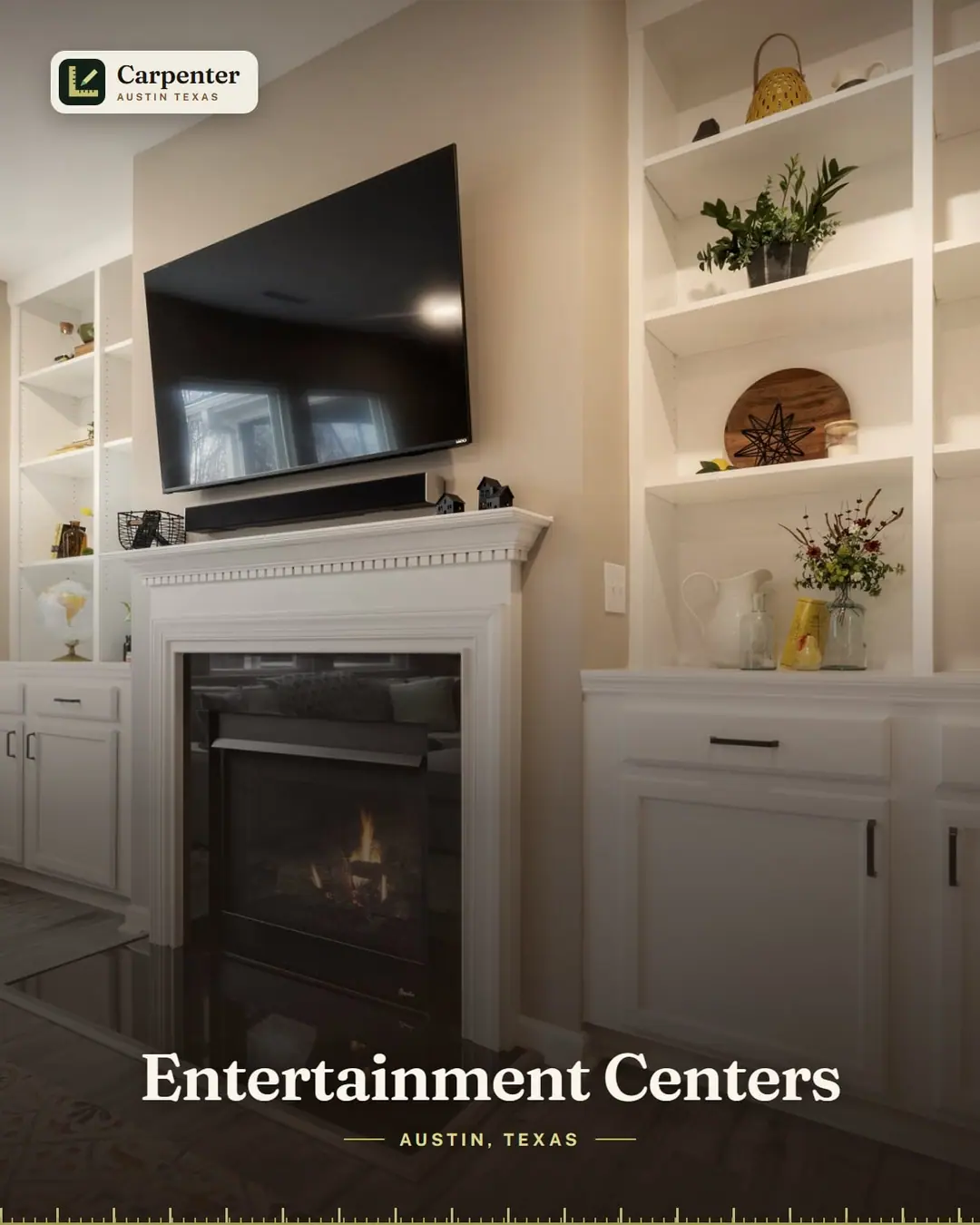
Interior carpentry · Austin, TX
Custom entertainment center & media wall building in Austin, TX
A 75-inch TV hangs in the middle of a blank wall. Cords drop from it to a console stacked with boxes, controllers and a soundbar that doesn't quite fit. Next to it sits a fireplace that never lined up with anything.
Read more
Carpenter Austin Texas designs and builds custom entertainment centers and media walls for Austin homes. Each one is fitted from wall to wall, with hidden cable runs, ventilated storage for the AV gear, and shelves and lighting placed where you want them. If you're looking for an entertainment center Austin builders fit to the room rather than ship flat, or a media wall Austin homeowners can plan around a specific TV, this page walks through the choices.
Every estimate is free and written, and we work in all 13 areas of the city. Media walls are part of our custom built-ins and woodwork service.
Send us your wall width and TV size. We'll measure, sketch a layout and give you a clear written price, then show up on time, protect your floors and clean up before we leave.
- Free written estimateYou know the scope and the price before anyone picks up a saw.
- On time, as promisedWe show up on the day and at the time we agreed.
- Your home protectedFloors, furniture and the yard are covered while the work goes on.
- Clean job siteThe work area is swept and cleared before we leave.
- Built for Texas weatherLumber, fasteners and finishes chosen to hold up to Austin heat, storms and clay.
- Jobs of every sizeOne rotted porch post gets the same care as a custom build.
The numbers behind this work
- 80%of home buyers want a walk-in pantry80 percent of home buyers want a walk-in pantry and 80 percent want table space for eating in the kitchen.NAHB, What Home Buyers Really Want · 2024
- 81%of home buyers want main-level hardwood81 percent of home buyers want hardwood flooring on the main level of the house.NAHB, What Home Buyers Really Want · 2024
- 112.9%of a minor kitchen remodel recoupedA minor kitchen remodel costing $28,458 returns $32,141 at resale nationally, recouping 112.9 percent of its cost.Zonda Cost vs. Value · 2025
- $571,000median Austin home valueThe median owner-occupied home in Austin is worth $571,000, the asset that well-built cabinets, floors and doors protect.U.S. Census, ACS 2024 · 2024
01Side by side
How an entertainment center, media wall and TV wall differ
In short
People use these three names loosely. Here's how we use them.
| Type | What it is | Build size |
|---|---|---|
| Built-in entertainment center | Cabinets and shelves built around a TV, usually base cabinets with open or glass-door uppers | Medium to large |
| Media wall | A full wall treatment, often floor to ceiling, with a recessed TV niche, an optional electric fireplace and built-in lighting | Largest |
| Custom TV wall | A decorative backdrop of slats, panels or shiplap behind the TV, with a floating console | Lightest |
How to tell which one you need
Start with what has to live on the wall. If you own a receiver, a game console, a turntable or a shelf of board games, you need closed cabinet depth, which points to a built-in entertainment center or a media wall. If the TV, a soundbar and a streaming stick are all you have, a TV wall with a floating console carries them without eating floor space.
Then look at the wall itself. A media wall usually means framing a new surface in front of the old one, so it suits a long, uninterrupted wall with no windows or doors to work around. A built-in can step around a window, a thermostat or a light switch with cabinets of different heights.
The three can also mix. Plenty of rooms end up with base cabinets from a built-in, a slat backdrop behind the TV and floating shelves at the sides.
Our take
A built in entertainment center Austin families use as their main storage wall suits a living room or game room where games, books and remotes need a home. Media walls Austin homeowners order usually go on the biggest wall in an open-plan room, where a fireplace or TV niche becomes the center of the room. A custom TV wall Austin condos and smaller rooms suit costs least and takes up the least floor space.
For a freestanding TV stand, see the custom furniture page linked further down.
02Warning signs
Signs a built-in entertainment center is right for your room
In short
If two or more of these sound like your living room, a built-in usually solves more problems than another piece of furniture.
- Sign 01
Your TV is wider than any console the stores sell
- Sign 02
Cords, game consoles and streaming boxes sit in plain view
- Sign 03
The living room has nowhere to put board games, books or the six remotes
- Sign 04
An alcove or fireplace wall leaves awkward gaps that furniture can't fill
- Sign 05
You live in a newer Austin subdivision with one huge blank wall in the open-plan living area
- Sign 06
You want the wall to look like it came with the house
What to check before you call
Take stock of what you own. Count the devices that need power and a cable, note which ones you touch daily, and set aside anything you would rather hide. That list decides how many closed cabinets you need and how many outlets sit behind them.
Look at the wall too. Note where the outlets, cable jack and light switches are, whether a window or vent sits close to a corner, and whether the baseboard runs straight. Anything you want moved, such as an outlet where the TV will hang, is easier to plan now than after the cabinets go in.
Think about traffic as well. A unit that projects into the room narrows the walkway in front of it, so measure from the wall to the nearest sofa or door swing and keep a comfortable path.

Wood should be cut, fitted, and finished like it’s meant to last a lifetime.
03What we do
Entertainment center and media wall styles we build
In short
Fixr's cost guide groups entertainment centers into floating, corner, standard and full-wall types. We follow a similar split below, with the fireplace wall and the TV backdrop added because they come with their own planning questions.
These run floor to ceiling. The bottom row is base cabinets with doors or drawers. Above, open shelves or glass-door cabinets flank the TV opening, and crown molding ties the top into the room's existing trim.
They suit living rooms and game rooms where the wall has to hold everything: the TV, the gear, the books and the photos. One tip before we draw anything. Measure the gear you own. An AV receiver is far deeper than a paperback, so the cabinet that holds it needs more depth than the shelves beside it.
Ask about adjustable shelves on the upper runs. Shelf pins let you move a shelf later to fit a tall vase or a row of records, while a few fixed shelves add stiffness where a long span might otherwise sag under books.
Here we frame a new wall a few inches out from the existing one, and the TV sits in a niche above or beside an electric fireplace insert. Many inserts let you run the flame effect with the heater off. That's handy in an Austin August.
You choose the insert first. Its spec sheet sets the opening size, the clearances and the power it needs, and we build the frame to those numbers. Electric inserts usually want a dedicated circuit, which a licensed electrician installs.
With a real wood-burning or gas fireplace, the job changes. We design the cabinets around the existing firebox and keep every piece of wood outside the fireplace maker's clearances. The mantel has its own page: custom fireplace mantels in Austin.
A floating console hangs on the wall with no legs. Hidden cleats fasten it into the studs, and the floor underneath stays clear for a robot vacuum or a basket. Paired with a few floating shelves, it gives a clean, modern look to a smaller room or a condo.
How much a hung console can carry depends on what's behind the drywall. We find the studs and check for blocking before we commit to a size, and if the framing won't carry the load, we add blocking or change the design.
Keep a floating console high enough for a vacuum and your feet to clear it, and not so deep that it reads as a ledge to sit on. A hung unit is built for media gear and decor, not for people leaning or sitting on it.
Some rooms have a corner, an alcove or a space beside the stairs where furniture never fits and dust collects. A built-in can use that space with an angled or L-shaped layout.
Viewing angle comes first. A corner TV has to face the sofa, not the hallway, so we check sight lines from the seats before setting the niche. Older Austin houses with odd room shapes, such as bungalows with a fireplace on the diagonal, often end up with this kind of unit.
Corner units can waste the deep back corner. A diagonal face, a turntable shelf or a door into a blind cabinet keeps that space usable, so the awkward spot becomes storage for things you reach for less often.
A TV wall puts a feature backdrop behind the screen. Options include vertical wood slats, board-and-batten or shiplap, usually with a floating console below. The paneling also hides a cable chase, so wires run from the TV to the console without showing.
Acoustic slat panels, with felt behind the slats, can soften echo in a room with hard floors. We'll talk through whether they suit your room. If you want the whole room paneled, not just the TV wall, that's a separate service: see wood accent walls.
Slats and shiplap need a flat base. On a wavy wall, a backer panel or furring strips go up first, so the lines run straight and the gaps between boards stay even from floor to ceiling.
Proportion and depth come first
Proportion matters more than style. A unit looks right when the TV opening, the side shelves and the base cabinets share a clear grid, with the TV centred on the wall or deliberately offset to balance a window or fireplace. Before you pick a style, measure the wall and note where its centre falls relative to the sofa.
Depth is the other early decision. Base cabinets that hold gear need room for the deepest box plus the cables behind it, while the shelves above can be shallower so the wall does not feel heavy. A stepped profile like that also keeps the upper shelves from blocking light from a nearby window.
04What we do
Planning your media wall: TV size, height and tech
In short
Most regrets with media walls come from three things decided too late: the TV height, where the cables go and how the gear stays cool. These sections cover the questions to settle before any wood is cut.
We build the niche around your exact TV model, plus room for the mount and for air to move around the back of the set. Bring us the model number, not just the screen size, because two TVs with the same screen size can differ in width and depth.
Plan for the next TV too. An oversized niche, or trim pieces that come off with a few screws, lets a bigger set go in later without rebuilding the wall.
For height, the screen center should sit close to eye level from your sofa. The right number depends on seat height, viewing distance and screen size, and the TV maker's guidance wins over any rule of thumb. Before we build, tape the TV outline on the wall and sit down to check it.
A TV mounted high over a fireplace is a common mistake, and it means watching with your chin up. An offset layout fixes it, with the TV beside the fire rather than over it, and so does a low, linear insert that lets the screen come down closer to eye level. Recessed niches also need an articulating mount. The TV can then pull out when you need to reach the cables.
A TV's plug-in power cord isn't made to run inside a wall. In-wall power goes through a recessed outlet behind the TV, installed by a licensed electrician, with a recessed low-voltage box beside it for the HDMI and network cables.
We build a cable chase or run conduit from that box down to the cabinet, so you can pull new cables in five years without opening the wall.
Receivers and game consoles make heat. Their cabinets get rear vents, cut-outs in the back panel, and a quiet fan where the gear runs hot. Closed doors can block a remote. Perforated or glass doors fix that, and so do RF or Bluetooth remotes. Keep low-voltage cables away from the fireplace's heat path.
We build the woodwork. Buying, wiring and programming the AV gear is a job for an AV installer.
Plan a way in for later. A removable back panel or a lift-out shelf in the gear cabinet lets you reach power strips and cable ends without pulling the unit apart when you swap a device.
LED strips under shelves and in a cove at the top of the wall add light without a lamp. Put them on a dimmer so they don't glare on the screen.
A soundbar shelf should be sized to the bar you own, with an open front so sound isn't blocked. Speakers can sit behind cut-outs covered in acoustic fabric. In-wall speakers need their wiring run while the wall framing is still open, so tell us at the start.
Choose one light colour for the whole wall. Mixing warm and cool strips on different shelves looks patchy, and the LED drivers need a ventilated spot you can reach later, often inside a base cabinet.
Settle these before design starts
Write down every device and its connections before the layout drawing. For each one, note whether a remote needs to see it, whether it needs a wired network connection and how hot it runs. That list sets the cabinet doors, the vent pattern and how many cables the chase has to carry.
Think about glare as well as height. A screen facing a big window or a glass door catches reflections in the afternoon, so check the wall at the time of day you watch most. Shelf lighting should point down or into the shelf, never toward the screen or the sofa.
05Side by side
Materials and finishes for entertainment centers
In short
Paint costs least, stain-grade hardwood costs most, and a mix puts wood where your eye lands first.
| Option | Look | Best for |
|---|---|---|
| Painted MDF and plywood | Smooth, costs least, any color | Modern white walls or a wall painted one deep color |
| Stain-grade white oak or walnut | Warm wood grain, costs most | Rooms where the wood is the feature |
| Mixed | Painted cabinets with wood floating shelves or a wood slat backdrop | Splitting the budget, with wood where it shows most |
How each finish wears
Painted cabinets show chips on the edges hands touch, such as door corners and drawer fronts near the floor. A hard, cured cabinet coating resists that far better than wall paint, and keeping a little of the finish for touch-ups lets you fix a nick later.
Stain-grade wood hides small scuffs in its grain, but wide panels need care. Veneered plywood stays flat across a large door or side panel where solid boards would cup, so most stain-grade units mix solid edges and frames with veneer panels.
Pick the door style with cleaning in mind. Flat slab doors wipe clean in one pass, while shaker doors and detailed profiles collect dust in their inside corners.
Our take
Whatever the face looks like, the boxes that carry AV gear are built from plywood, because a receiver and a stack of consoles get heavy. Doors and drawers get soft-close hinges and slides.
Big west-facing windows are common in Austin living rooms, and the afternoon sun fades stain and yellows some clear coats. We choose UV-stable finishes for walls that get that light.
Species is one of the biggest cost levers. Fixr's guide lists board-foot prices that climb from pine through oak and cherry to walnut, so the same design in walnut costs noticeably more than in paint-grade wood.
06How it works
Our entertainment center building process
In short
Six steps take you from a measured wall to a finished unit, and you see and approve the plan before anything is built.
- Step 01
Free in-home measure
We record the wall, the outlets, the studs, any fireplace and your TV model.
The measure starts with the wall itself. We record its width and height, check it for plumb and level, and mark where the studs run, because those studs carry everything that hangs. Outlets, switches, cable jacks, vents and the thermostat all get located, since any of them can land behind a cabinet side or in the middle of the TV niche.
We also note the floor: its material, whether it slopes and how the baseboard meets it. If there is a fireplace, we record the firebox, the hearth and any existing mantel. Your TV model number and a list of your devices let us size the niche and the gear cabinets to real dimensions rather than guesses.
Tell us what bothers you about the room now. Glare, a cramped walkway or a soundbar that never fit are easier to solve at the start.
What to expect You show us the wall, tell us what you watch and store, and hand over the TV model number and your device list.
- Step 02
Layout drawing
You see the design with the TV height marked on it, and you can ask for changes.
The drawing turns the measurements into a plan. It shows the cabinet layout, the shelf spacing, the TV niche and the TV height, plus where the cable chase, vents and any lighting go. Seeing the TV height marked against your seating helps you judge it before anything is built.
Your big decisions happen here: open shelves or doors, paint or wood, door style, hardware and whether lighting is part of the plan. Moving a shelf or changing a door on paper is simple, while the same change after the cabinets are built means rework.
If you have a larger TV in mind for later, say so now so the niche can allow for it.
What to expect You review the layout, check the marked TV height against your usual seat and ask for any changes you want.
- Step 03
Written estimate
It lists the scope, the materials and any electrician work the plan needs.
The estimate turns the approved drawing into a scope you can check line by line. It lists the cabinets and shelves, the materials and finish, the trim, any new wall framing and any removal of an old unit. Where the plan needs a new outlet or circuit, that electrician work is listed so you know it belongs to the job.
Read it side by side with the drawing. Check that the door count, the lighting and the fireplace insert, if you have one, all appear, and ask about anything vague. Items you supply yourself, such as the TV or the insert, should be named clearly so nothing gets missed.
What to expect You read a written, itemized scope, compare it with the drawing and ask about anything unclear before you approve it.
- Step 04
Build
We make the cabinets and frame any new wall.
Cabinet boxes are cut and assembled from plywood, and the boxes that hold gear are built to carry a receiver and a stack of consoles. Back panels for those cabinets get their vent cut-outs and cable holes now, which is cleaner than cutting them after install.
If the design includes a recessed niche or an electric fireplace, a new wall is framed out from the existing one. The frame is checked for square and plumb, and blocking goes in wherever the TV mount, the insert and any floating shelves will fasten. Any new wiring has to go in while the frame is still open.
Solid wood parts are left to settle to the conditions in your house before final fitting, so they do not move after install.
What to expect You see the cabinets take shape and, on a media wall, the new frame go up in front of the old wall.
- Step 05
Install
We scribe the unit to the walls and floor, add trim and prepare the cable chases.
The cabinets are set level first, shimmed where the floor dips, and fastened into studs or blocking. Scribing comes next: the edge of each end panel and filler is traced to the wall's real shape and trimmed so it meets the wall without a gap, even where the wall bows.
Crown, base and face trim tie the unit into the room. Cable chases stay open at both ends so the TV and gear cables can be pulled through, and the vent paths behind the gear cabinets are checked so nothing blocks them.
Walk the unit with us at this stage if you can. Small things, like the exact height of a floating shelf, are easy to adjust before the trim is finished.
What to expect You see the unit fixed to the wall, the edges scribed tight to it and the trim go on around it.
- Step 06
Finish and walkthrough
Doors get hung, every drawer gets tested with you, and we clean up before we leave.
Doors are hung and adjusted so the gaps between them run even, and the soft-close hinges and slides are set so nothing slams or drifts open. Shelves go in, any lighting is tested on its dimmer, and the cable chases are checked so you can see where each run comes out.
During the walkthrough you open every drawer and door yourself. Check that your remotes work through the doors you chose, that the gear cabinets can breathe and that the niche fits your TV with room for the mount. Point out anything that sticks or rubs while we are still there.
Clean-up covers dust, offcuts and the floor protection, so the room is ready to use.
What to expect You test every door and drawer with us, check the TV fit and the remote, then get the room back clean.
07Pricing
Entertainment center and media wall cost in Austin
In short
National figures give you a starting range. Fixr's built-in entertainment center guide, last updated January 2023, puts the typical cost at about $5,000 to $15,000, with a national average near $9,000. Bob Vila's 2023 guide puts simpler custom built-ins around a TV at about $1,500 to $4,000.
Mixing doors and open shelves balances the budget
Every door adds hinges, a finished face on both sides and fitting work, so a wall of closed cabinets costs more than the same wall with open shelving. Doors where you need to hide gear and open shelves elsewhere keep the price in check.
Finishing in your home adds prep
Spraying or brushing a finish on site needs masking, ventilation and drying space. Ask how your estimate handles finishing, because it affects both the cost and how you use the room during the job.
Hidden work is part of the price
Framing, blocking behind a floating console and cable chases do not show once the wall is done, but they decide whether it holds its load and stays easy to update.
08Austin conditions
Media walls in Austin homes: local considerations
In short
Newer slab-on-grade homes in Mueller, Circle C and Avery Ranch have flat drywall and big open-plan walls. That's the easiest setting for a framed media wall, because the new frame can go up square and plumb.
Older central houses are different
Bungalows in Hyde Park, Travis Heights, Bouldin Creek and East Austin have plaster walls, corners out of plumb and pier-and-beam floors that rise and fall with the clay soil. We scribe the unit to the walls and leave room at the trim for that movement, so a seasonal shift doesn't crack a joint.
Austin's humid summers and dry, air-conditioned winters make solid wood swell and shrink. We let solid lumber acclimate in your house before install and use stable plywood or MDF panels for wide doors, which would otherwise warp.
West-facing living rooms take strong afternoon sun, so finishes there are picked to resist fading.
On permits
the City of Austin's list of work exempt from building permits includes "cabinets, countertops, and similar finish work." Low-voltage wiring under 25 volts is also on the exempt list. A new circuit or outlet for a TV or an electric fireplace is not, so that part goes to a licensed electrician and may need an electrical permit.
Plaster walls hide their studs
Older central Austin houses often have plaster on wood lath, where a stud finder struggles and careless fastening can crack the surface. Pilot holes, slow drilling and confirming each stud before fixing keep the wall intact.
Exterior walls run warm in summer
A media wall on a west-facing exterior wall picks up heat through the wall itself, on top of the heat from your gear. Extra venting, and keeping the hottest equipment on an interior side, helps the electronics.
Slab floors are rarely flat
Even newer Austin homes on slabs can have dips across a long wall. Cabinets are shimmed to a level line rather than following the floor, and the base trim is scribed to hide the difference.
09Why us
Why choose Carpenter Austin Texas for your entertainment center
In short
One crew plans, builds and trims the whole wall, and you get a clear written estimate and straight advice before work starts.
- 01One crew designs, builds and trims the wall, so it looks like part of the house
- 02We pick materials for Austin heat and humidity
- 03We plan the vents, cables and TV height before we build anything
- 04We show up on time, protect your home and clean up every day
- 05You get a clear written estimate and honest advice, including when a simple floating console will do
Questions worth asking any builder
Ask how the unit will be fastened and what it is fastened to. A good answer names studs, blocking and the load from the gear, not just screws into drywall or plastic anchors.
Ask where the cables, vents and outlets go before you see a price. A builder who plans those early avoids a finished wall that runs hot or needs holes cut later.
Ask what the estimate leaves out, such as the TV, a fireplace insert or electrician work. Two quotes only compare fairly when they cover the same scope.
Wood should be cut, fitted, and finished like it’s meant to last a lifetime.
10Side by side
Custom built-in vs store-bought entertainment center
In short
A custom built-in costs most and fits best, a kit sits in the middle, and a store-bought stand costs least and moves with you.
| Custom built-in | Ready-to-assemble media wall kit | Store-bought stand | |
|---|---|---|---|
| Fit to wall | Scribed wall to wall | Standard widths, gaps filled with trim | Sits in front of the wall |
| Cable management | Chases and recessed boxes | Some cut-outs | Cords on show |
| Storage | Planned around your gear | Fixed layout | Limited |
| Materials | Plywood, hardwood or MDF, your choice | Mostly MDF or particleboard | Mostly particleboard |
| Lifespan | Decades with care | Years | Years |
| Resale appeal | Reads as part of the house | Can, if fitted well | Leaves with you |
| Cost tier | Highest | Middle | Lowest |
When a kit makes sense
A kit can work well on a standard, flat wall in a newer house, where its fixed widths land close to the wall size. The trouble comes with odd widths, out-of-plumb walls and wavy baseboards, where fillers and trim have to hide the difference.
Check the panel material before you buy. Particleboard holds screws poorly once a hole is stripped, and it swells if water gets in at a cut edge, so a kit that will hold a heavy receiver or a large TV deserves a close look at its load ratings.
If you buy a kit, measure the wall first and leave room for scribing at both ends, so the end panels can meet an uneven wall without a gap.
Our take
Ready-to-assemble media wall kits ship nationwide and sit in the middle on price. They still need fitting, scribing and trim to look built in, and we can install one for you. For a console you can move, see custom furniture.
11Service area
Areas we serve for entertainment centers and media walls
In short
We build entertainment centers and media walls in all 13 areas of Austin listed below.
Central Austin
Central Austin older bungalows and cottages, historic districts like Hyde Park, and renovations on tight lots.older bungalows and cottages, historic districts like Hyde Park, and renovations on tight lots.
(737) 415-9388Central Austin, TX
North Austin
North Austin mid-century ranch homes in established neighborhoods.mid-century ranch homes in established neighborhoods.
(737) 415-9388North Austin, TX
North Central Austin
North Central Austin mid-century houses, many due for new trim or decks.mid-century houses, many due for new trim or decks.
(737) 415-9388North Central Austin, TX
Northeast Austin
Northeast Austin newer subdivisions sitting on the clay east of I-35.newer subdivisions sitting on the clay east of I-35.
(737) 415-9388Northeast Austin, TX
Northwest Austin
Northwest Austin Hill Country lots on sloped limestone, with decks built for the view.Hill Country lots on sloped limestone, with decks built for the view.
(737) 415-9388Northwest Austin, TX
Far North Austin
Far North Austin newer subdivisions where builder-grade trim and fences often need upgrades.newer subdivisions where builder-grade trim and fences often need upgrades.
(737) 415-9388Far North Austin, TX
East Austin
East Austin older homes east of I-35 on clay soil, with plenty of infill and renovation.older homes east of I-35 on clay soil, with plenty of infill and renovation.
(737) 415-9388East Austin, TX
West Austin
West Austin hillside homes on limestone, where decks and stairs follow the slope.hillside homes on limestone, where decks and stairs follow the slope.
(737) 415-9388West Austin, TX
South Austin
South Austin established neighborhoods with a mix of older and newer homes.established neighborhoods with a mix of older and newer homes.
(737) 415-9388South Austin, TX
South Central Austin
South Central Austin older houses around neighborhoods like Travis Heights, many with porches and original trim.older houses around neighborhoods like Travis Heights, many with porches and original trim.
(737) 415-9388South Central Austin, TX
Southeast Central Austin / Riverside
Riverside older homes, rentals and newer infill south of Lady Bird Lake.older homes, rentals and newer infill south of Lady Bird Lake.
(737) 415-9388Riverside, Austin, TX
Southeast Austin
Southeast Austin growing neighborhoods on clay soils, where doors and trim feel the ground move.growing neighborhoods on clay soils, where doors and trim feel the ground move.
(737) 415-9388Southeast Austin, TX
Southwest Austin
Southwest Austin hillside lots with decks and views toward the Hill Country.hillside lots with decks and views toward the Hill Country.
(737) 415-9388Southwest Austin, TX
How the houses differ across town
The building stock changes more than the work does. Central and East Austin have plenty of older houses with plaster walls, uneven floors and smaller rooms, where corner units and scribed built-ins earn their keep.
Newer subdivisions farther out tend to have open-plan living rooms with a tall, long wall, which suits a full media wall or a fireplace wall. Condos in the central areas often suit a floating console and a TV backdrop.
Wherever you live, the first step is the same: a measure of the wall and a list of what needs to live on it.
Good to know
We also build wood storage for bedrooms and pantries. See custom closets.
12Questions
Entertainment center & media wall FAQs
Cost and value
01How much does a custom media wall cost in Austin?
Fixr's January 2023 guide puts built-in entertainment centers at about $5,000 to $15,000 nationally. Where yours falls depends on scope: a slat backdrop with a floating console sits near the bottom, while a full wall with a fireplace insert and lighting sits near the top. A free measure gets you an Austin price in writing.
02Is a built-in entertainment center worth the money?
It is if you'll stay in the house for a while and want the storage and the finished look. For a short-term rental, or a house you'll sell next year, a good freestanding console usually makes more sense.
03Does an electric fireplace insert add much to the cost?
Yes. You pay for the insert itself, a dedicated circuit from an electrician and extra framing to hold the insert at the right height. Larger linear inserts need a wider frame, and the build costs more as a result.
04Is a floating TV console cheaper than a full media wall?
Usually much cheaper, because it uses less material and less labor. The trade-off is storage. You get one or two drawers instead of a wall of cabinets, and the wall reads as furniture rather than architecture.
05Are large built-in entertainment centers outdated?
The bulky units built in the 1990s and 2000s for deep tube TVs are. Today's media walls use a shallow niche for a flat screen and LED lighting built into the shelves. Plan the niche for a bigger TV.
06Will a media wall help my home sell?
A well-built wall in neutral colors can appeal to buyers who need the storage. A very personal design, such as a bold color or a niche sized to an unusual TV, may not. If you might sell within a few years, keep the finishes neutral.
07Can you build around the TV I already own?
Yes. Send us the model number before design starts. We size the niche to that model and, if you want, leave room for a larger set later.
Design, TV and tech
01How high should a TV be on a media wall?
Close to eye level from your usual seat. Viewing distance, seat height and screen size all shift the exact number, and the TV maker's guidance is the final word. Tape the TV's outline on the wall and sit on the sofa for a few minutes before you commit.
02Can a TV go above a fireplace?
It can, but it often ends up too high, and the heat has to be managed. A mantel or shelf between the fire and the screen deflects rising heat, and the clearances in the fireplace maker's manual still apply to every piece of wood around it. An offset layout avoids both problems.
03How do you hide the cables on a media wall?
We use recessed power and low-voltage boxes behind the TV, a chase or conduit inside the build, and grommets into ventilated cabinets. Loose power cords never run inside the wall. The electrician installs a proper outlet instead.
04Will my remote work through closed cabinet doors?
Infrared remotes need line of sight, so solid doors block them. Your options are perforated or glass doors, an IR repeater, or a remote that uses RF or Bluetooth. Decide before you pick the doors.
05Do AV components overheat inside built-in cabinets?
They can, without airflow. We cut vents in the back panel, leave gaps behind the gear and add a quiet fan where a receiver runs hot. Gear also stays out of the cabinets nearest a fireplace.
06Can you add built-in speakers or a soundbar shelf?
Yes. Soundbar shelves are sized to the bar, and speaker cut-outs get fabric grilles. In-wall speaker wiring has to be run before the wall is closed, so your AV installer should plan it with us at the start.
07What styles of media walls are popular in Austin homes?
Three looks suit a lot of Austin houses: a neutral painted wall with wood floating shelves, a white oak slat backdrop, and a modern linear electric fireplace under the TV. A 1920s bungalow may call for painted cabinets with trim that matches the original.
Fireplace, electrical and permits
01Do I need an electrician for a media wall with a fireplace?
Yes, for any new circuit or outlet. Electric fireplaces often need a dedicated circuit, per the maker's specs. A licensed electrician does that wiring, and we build the frame around the outlet locations.
02Do I need a permit for an entertainment center in Austin?
The woodwork itself usually doesn't. The City of Austin's permit-exempt list includes "cabinets, countertops, and similar finish work." New electrical circuits and outlets aren't on that list, so they may need a permit pulled by the electrician.
03Can you build a media wall around a gas or wood-burning fireplace?
Yes. All combustible wood stays outside the clearances the fireplace maker requires. The surround closest to the firebox may need non-combustible material such as stone, tile or steel, with the wood starting beyond it.
04Can you remove my old entertainment center first?
Yes. We take it out, patch the wall and floor behind it, and deal with old outlet holes or cable openings before the new build starts. If an old outlet is no longer needed, the electrician can close it properly.
05Can a media wall be built on an exterior wall?
Yes, with a few checks. Exterior walls hold insulation, so new boxes and cable runs have to be planned around it, and that wall may get more sun through nearby windows. We check both before framing.
06Will the media wall damage my walls or floors?
No more than any fixed cabinet. We fasten into studs, protect floors while we work and scribe the unit to the floor instead of cutting the floor. If you remove the wall later, the patching is limited to the fixing points.
07Is wall framing needed for a recessed TV niche?
Usually, yes. A new wall framed a few inches out from the old one creates the recess without cutting into the original wall. The TV and its mount set how deep that frame needs to be.
Process, timeline and care
01How long does it take to build a custom entertainment center?
The time splits into design, ordering materials, building, installation and finishing. Specialty items like a fireplace insert or a load of walnut can add lead time before building starts, depending on what the supplier has in stock. Your written estimate includes the timeline for your wall.
02Is the media wall built in my house or in a shop?
It depends on the design, and the estimate tells you which parts are built where. Any work done in your house gets floor protection, dust control at the saw and a clean-up at the end of each day.
03Can I use the living room during the build?
Partly. The work zone takes up the wall and some floor in front of it, and we clean it each evening. On finishing days, the room needs ventilation and may be off limits for a day while the coating dries.
04How do I clean and care for a painted or wood media wall?
Dust with a soft cloth. Use mild soap and water on painted surfaces, and skip ammonia sprays on wood finishes. Keep plants and drinks off unprotected tops, or use coasters and trays.
05Can I change the TV size later?
Yes, if you plan for it. An oversized niche, trim pieces that unscrew or an adjustable mount all make a later upgrade easier. Bring it up at design time.
13Keep exploring
Related carpentry services in Austin
In short
Entertainment centers is one part of what we do. The same crew handles the services below, so one call covers the whole job.
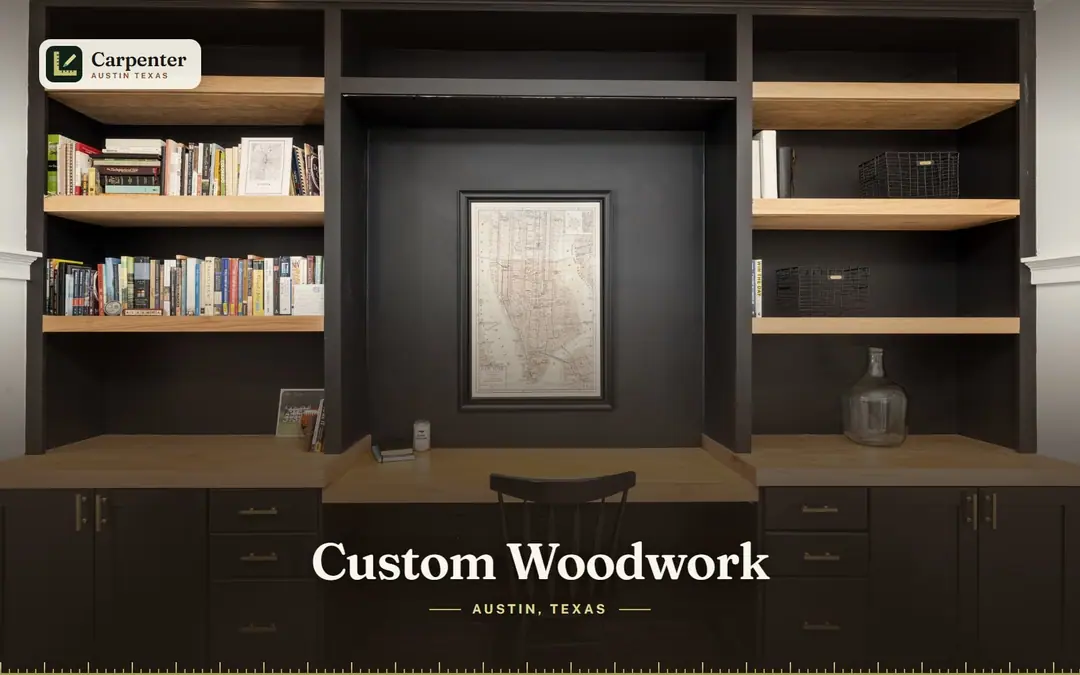
Custom woodwork
Custom woodwork for Austin homes: built-in bookshelves, office built-ins, window seats and Murphy beds, scribed to your walls. Free written estimates.
See the service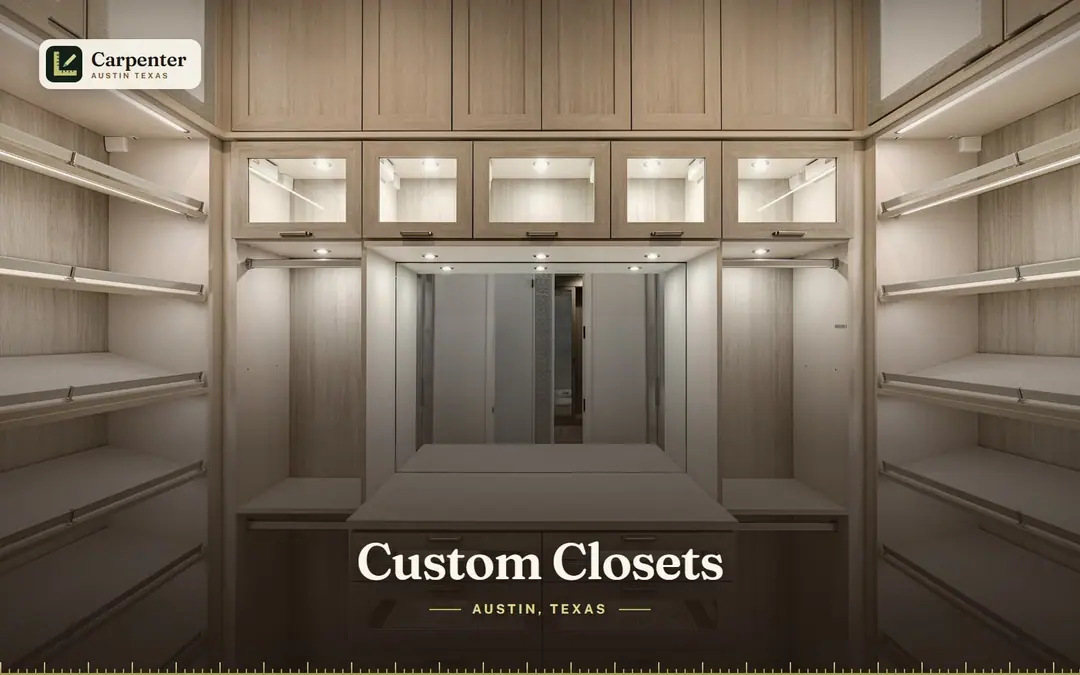
Custom closets
Wood walk-in closets, reach-in closets and pantry shelving built and installed by Austin carpenters, scribed to your walls. Free measure and written price.
See the service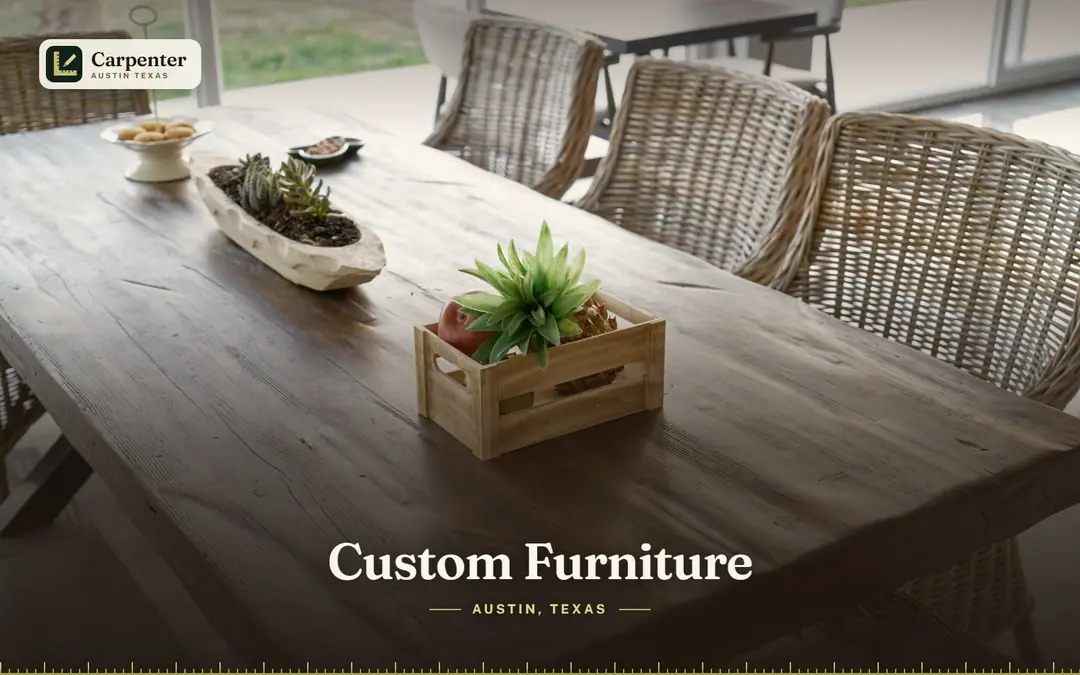
Custom furniture
Solid-wood dining tables, beds, desks and consoles built to order in Austin, plus repairs to loose joints and heirloom pieces. Free written quote.
See the service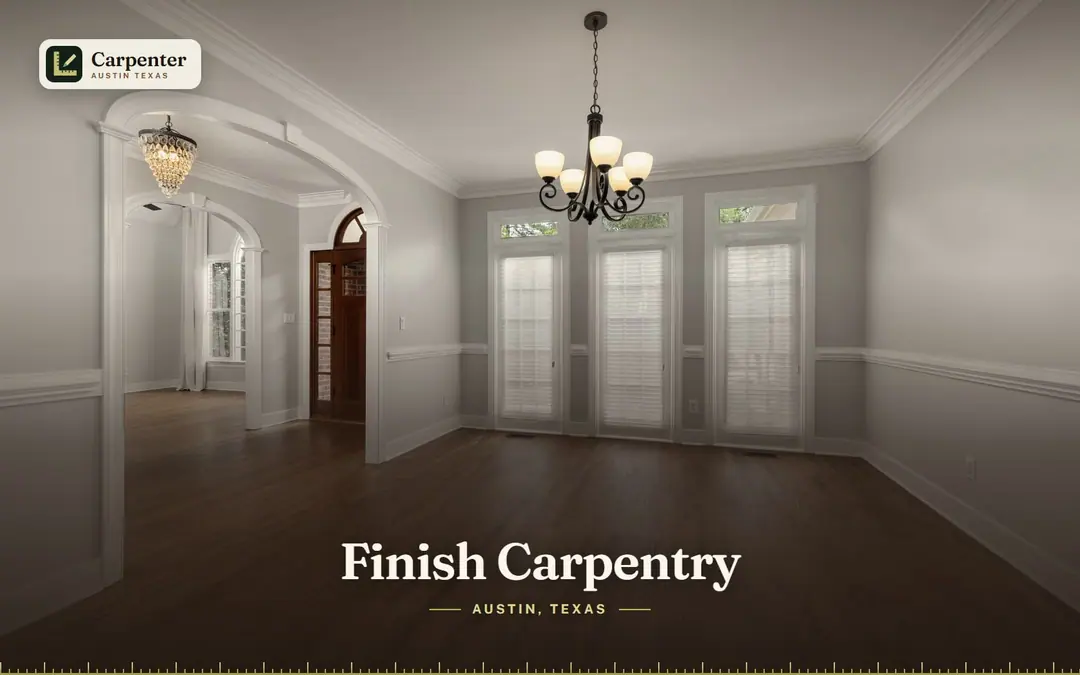
Finish carpentry
Carpenter Austin Texas installs trim, baseboards, casing, wainscoting and wood ceilings in Austin homes, with coped joints and a free written estimate.
See the service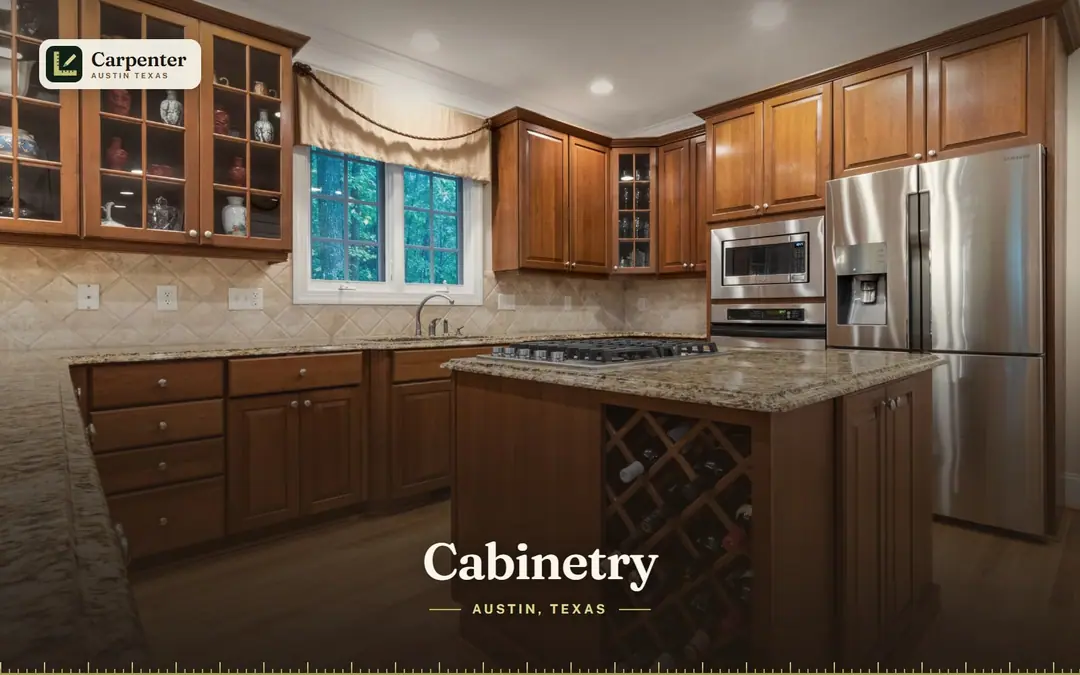
Cabinetry
Custom kitchen cabinets, islands, vanities and garage cabinets built for Austin homes, plus cabinet refacing and repair. Free measure and written estimate.
See the service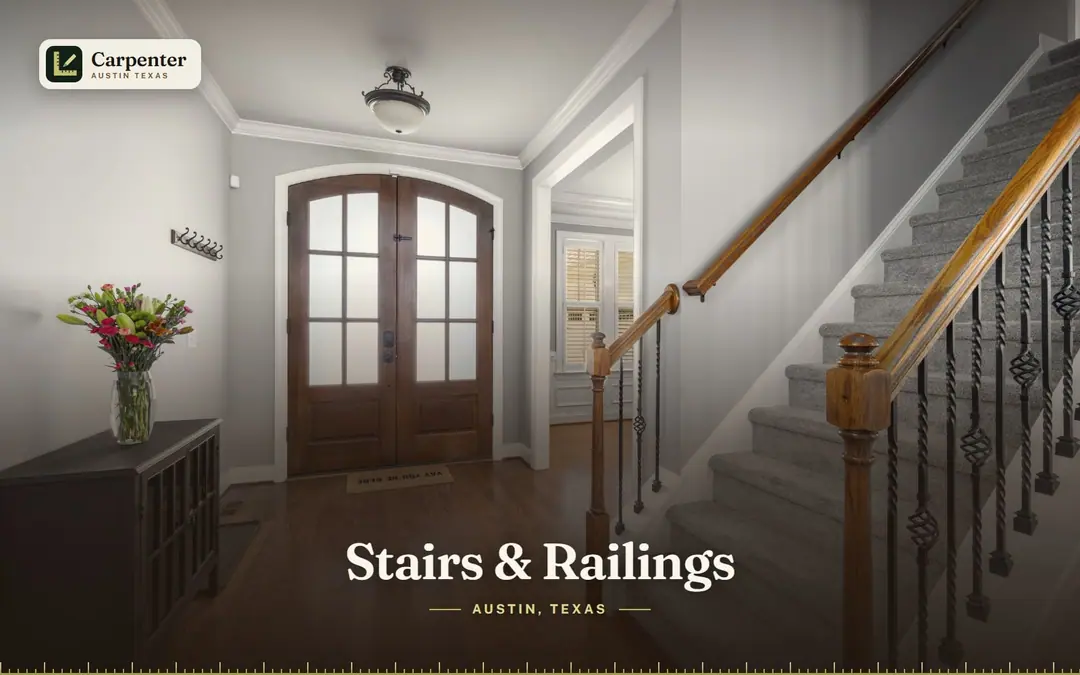
Stairs & railings
Custom staircases, stair railings, floating stairs and stair repair in Austin, TX. Layouts checked against code and a free written estimate for every job.
See the service


Free written estimate
Call an Austin carpenter today
Free measure, layout and written estimate, with no pressure.
- Homeowners
From a single rotted porch post in a 1920s bungalow to a custom cedar deck overlooking the Hill Country.
- Older Austin homes
Original trim, porches and windows repaired with lumber, fasteners and finishes chosen for Central Texas.
- Businesses and property managers
Tenant improvements, commercial millwork and ongoing repairs for rental homes.
