


For published numbers, HomeAdvisor's Austin exterior trim repair cost page reports an average of about $820, with a typical range of roughly $487 to $1,308, based on 2026 data. HomeGuide's national cost guide from February 2026 puts minor exterior trim repairs at $100 to $400 and extensive trim repairs at $500 to $1,200. The same guide lists replacing exterior trim at $3 to $11 per linear foot. Those figures show what homeowners report paying; they are not our prices.

Outdoor and exterior · Austin, TX
Exterior carpentry & trim repair in Austin, TX
Paint is peeling off the window casings again. The bottom of a corner board has gone soft. After a long summer or one bad hailstorm, the miters at the trim joints have opened up wide enough to slide a coin into.
Read more
Carpenter Austin Texas is an Austin carpenter that does exterior carpentry in Austin. We repair and replace exterior trim, then handle the rest of the wood on the outside of the house, including siding, fascia, porches, carports and dormers. Exterior trim repair is most of our outside work. Exterior wood repair on gates, stairs and brackets fills in the rest.
Our owner puts it plainly: wood "should be cut, fitted, and finished like it's meant to last a lifetime." For outside work, that means lumber, fasteners and finishes picked for Central Texas summer heat, sudden storms, shifting clay soil and termites. We work in all 13 parts of Austin, and every estimate is free and written.
Tell us what's peeling, splitting or soft. We'll come out, probe the wood, and give you a clear written estimate. We show up when promised, protect your yard and home while we work, and clean up before we leave.
- Free written estimateYou know the scope and the price before anyone picks up a saw.
- On time, as promisedWe show up on the day and at the time we agreed.
- Your home protectedFloors, furniture and the yard are covered while the work goes on.
- Clean job siteThe work area is swept and cleared before we leave.
- Built for Texas weatherLumber, fasteners and finishes chosen to hold up to Austin heat, storms and clay.
- Jobs of every sizeOne rotted porch post gets the same care as a custom build.
The numbers behind this work
- 122.8days a year at 90°F or moreAustin averages 122.8 days a year with highs of 90 degrees or hotter, about four months of heat that exterior wood, paint and sealers have to survive.NOAA climate normals · 1991-2020
- 36.25 inaverage yearly rainfallAustin's official climate station averages 36.25 inches of rain a year, much of it in a few hard storms, which is why end grain, fascia and sills need sealing and drainage.NOAA climate normals · 1991-2020
- 128 sq ftsiding or floor-deck repair with no permitAustin exempts siding, floor-decking and roof-decking repairs of up to 128 square feet each from a building permit; larger repairs need one.City of Austin Development Services · 2026
- 70%chance of termite damage within 25 yearsTexas A&M AgriLife puts the chance that an unprotected Texas home suffers some termite damage within 25 years at about 70 percent.Texas A&M AgriLife Extension · E-368
01Warning signs
Signs your home's exterior woodwork needs attention
In short
Firm wood under failed paint usually means a trim repair, while wood a screwdriver sinks into points to rot that needs a closer look.
- Sign 01
Peeling or blistering paint bunched at joints and end grain, which means water is getting into the wood at the cut ends
- Sign 02
Soft or crumbling wood at the bottom of corner boards and door or window casings, where rain splashes and sprinklers hit
- Sign 03
Open miters and gaps between trim and siding, which let rain run behind the boards
- Sign 04
Split, cupped or warped boards, a sign the wood has been wetting and drying unevenly
- Sign 05
Round holes from carpenter bees or ragged holes from woodpeckers, usually in bare or soft wood
- Sign 06
Daylight, nests or droppings at the soffits, which tell you animals have found a gap
- Sign 07
Siding boards that are loose, cracked or bulging after a storm
How to read what you find
Start on the lowest few inches of each wall and work up. Rain splash, sprinkler spray and wet mulch hit there every day, so rot almost always shows first at the bottom of corner boards, door casings and the water table. Push the screwdriver in at an angle rather than straight down, and compare it with a spot you know is sound.
Look up as well. A dark stain under a window sill or a streak below a gutter end shows where water runs. Paint that peels in sheets down to bare wood usually means moisture is pushing out from behind, while paint that cracks in a fine grid is old and brittle but often sits on sound wood.
Photograph every spot you find. A record from one spring to the next shows whether a gap is growing or holding still.
Good to know
A rule of thumb helps here. If the paint has failed but the wood under it is firm, it's a trim repair. If a screwdriver sinks in, or the damage runs into the sheathing or framing, the job needs the assessment described on our wood rot and termite damage repair page.
02What we do
Exterior trim repair in Austin
In short
Exterior trim repair is the core of this page. Trim is usually the first wood on a house to fail, because it sits at every edge where sun and water hit hardest: corners, window heads, the bottom of the wall. Below, we cover what counts as trim, how we decide between repair and replacement, which materials last here, and the installation details that keep new trim from failing the same way.
Exterior trim is every finished board that frames an opening, a corner or an edge:
- Window and door casing: the flat or shaped boards around the outside of each opening.
- Brick mould: the thicker molding set tight against window and door frames.
- Sills and aprons: the sloped board under a window and the trim below it.
- Corner boards: the vertical boards where two walls meet.
- Frieze and rake boards: the trim under the eaves and along the sloped roof edge of a gable.
- Water table or skirt boards: the horizontal band at the bottom of the wall.
- Gable and decorative trim: shingles, vents and ornament in the gable end.
- Column wraps: the boxed trim around porch or carport posts.
Fascia and soffit are trim too, but they carry gutters and vent the attic, so they get their own page on fascia and soffit repair in Austin.
Every board gets probed and moisture-checked before we price anything. What we find decides the fix.
Small, surface-level damage on sound wood can usually be repaired in place. That might mean filling and patching, splicing in a new piece of wood (a dutchman), or consolidating a small soft spot with epoxy, then priming and painting. When the damage goes through the board, sits in the end grain, or runs along most of its length, a new piece is the better repair. And if the sheathing, studs or sill plate behind the trim is wet or soft, the job stops being trim work and follows the wood rot repair process.
Damage Typical fix Why Surface rot or cracks on otherwise firm wood Patch, dutchman or epoxy, then prime and paint Keeps the original board and its profile Rot through the board, at end grain, or along most of its length Replace the piece A patch won't hold when the board itself has failed Wet or soft sheathing, studs or sill plate behind the trim Rot repair first, then new trim New trim over wet framing fails again Here is how the common trim materials behave on Austin houses.
Material Best for Watch out for in Austin Cedar Traditional houses and painted trim Heartwood resists rot, but end grain still needs sealing Primed finger-jointed pine Low-cost trim up high and out of the weather Swells and fails fast near the ground and where roofs meet walls Cellular PVC Trim near grade and other wet spots Grows and shrinks with heat, so joints and fastening need care Fiber cement (such as HardieTrim) Houses with Hardie siding Heavy, and cutting it makes silica dust that has to be controlled Engineered wood (such as LP SmartSide) Paint-ready trim on newer houses Every cut edge has to be sealed Each maker publishes its own installation guide, and we follow the current one for the product going on your house. Our order of choice is simple. First we match the house, so new trim looks like it belongs. Then we match the exposure: a sheltered porch casing and a sun-baked west corner board near the sprinklers don't need the same material.
Mixing materials on one house is normal. Cellular PVC can run along the bottom of a wall while cedar stays on the upper casings, as long as the profiles and paint match. PVC takes paint, but a dark color on a hot wall can make it move more, so check the maker's color guidance before you choose.
These six details separate trim that lasts from a quick patch:
- Head flashing or a drip cap above windows and doors, so water runs off instead of into the joint
- Back-priming and sealing every cut end before the board goes up
- Stainless or hot-dipped galvanized fasteners, set flush and not overdriven
- A gap between trim and roofing, decks and soil, so end grain can't wick water
- Sealant only where the design calls for it, never as a cover-up for a bad joint
- Prompt priming and paint, especially on south and west walls
In Austin, sun breaks down paint and caulk over the summer. Then a sudden storm pushes water into every crack at once, so trim installed without these details fails faster here.
Caulk has a job, but a small one. It belongs at gaps the design leaves for it, such as where trim meets a window frame. It does not belong along the top edge of a drip cap or across the bottom of siding laps, where it traps water that should drain out.
What a good trim repair looks like
Look at the joints first. Where two lengths of trim meet along a wall, a long angled scarf joint sheds water better than a square butt joint, because the upper piece laps over the lower one. The angle should slope down and out, so water runs away from the wall instead of into it.
Check the bottom edge. New corner boards and casings should stop short of the ground, a deck or a roof surface, with the end grain sealed and painted. A board that runs straight into mulch or onto shingles will wick water up its end, however well its face is painted.
Look for nail heads that sit flush rather than sunk into a dimple, and for caulk only at joints that need it. A thick bead smeared over a gap usually means the joint behind it was never fitted.

Wood should be cut, fitted, and finished like it’s meant to last a lifetime.
03What we do
Our exterior carpentry services
In short
Beyond trim, Carpenter Austin Texas handles every wooden part of the outside of the house, from siding boards down low to the rafter tails behind the gutters. The short sections below point to the pages that go into each service in depth. New decks are built by our deck team; see Austin deck builders.
We repair wood and Hardie fiber-cement siding, from swapping a few cracked or rotted boards to replacing a full wall. When boards come off, we check the sheathing and flashing underneath before closing it up. Read more about siding repair in Austin.
Fascia rots behind gutters, and soffits sag or get chewed open by squirrels and birds. We replace both and repair the rafter tails behind them, with vents set up so the attic still breathes and animals stay out. See fascia & soffit repair.
We build new front and back porches sized and styled to suit the house. We also repair porch floors, columns, railings and steps. See porch building and repair in Austin.
Exterior wood repair covers the weathered pieces that aren't trim: gates, exterior stairs, shutters, beams and decorative brackets. When the damage turns out to be rot or termites inside the structure, it goes through our wood rot process instead. Odd-job fixes inside and out are on the Austin carpentry repairs page.
We install new exterior casing, brick mould and sills around existing windows and doors, and re-trim openings after a window replacement. If the window itself has failed, our Austin window installers can help.
Why one carpenter for all the outside wood
Exterior wood fails as a system. A clogged gutter soaks the fascia, water runs down behind the frieze board, and the corner board below rots at the bottom. Fixing only the piece you can see leaves the source in place, so the same spot fails again.
When one carpenter looks at the whole wall, the repair order makes sense. Stop the water at the top, fix the structure behind, then put siding and trim back so each upper layer laps over the one below it.
When you call, list every outside problem you know about, even small ones on a gate or a step. Grouping them into one visit makes better use of the trip and gives you one written estimate to plan around.
04What we do
Dormers and carports
In short
Two larger exterior builds sit outside the trim-and-repair work above. Each section below stands on its own, because the planning for each is different.
Dormer construction in Austin usually starts with an attic or upstairs room that has too little headroom and too little light. A dormer pushes part of the roof out to give you standing room and a window, and it changes how the house looks from the street.
The main types are:
- Gable dormer, with its own small peaked roof.
- Shed dormer, with a single roof plane sloping more gently than the main roof, which gives the most interior space.
- Hip dormer, with a roof that slopes on three sides.
- Eyebrow dormer, with a low curved roof line.
- Doghouse or decorative dormer, mostly for looks and light.
The work itself means cutting into the roof, then framing the dormer walls, headers and roof. Sheathing, roof tie-in and flashing come next, followed by siding and trim to match the house and the new windows.
Planning comes first. Changing rafters can call for an engineer's design. A dormer changes the roof structure, so plan on a City of Austin building permit. If the house is a city landmark or a contributing property in a local historic district, a visible roof change also needs historic review. How long it takes depends on the dormer's size and on keeping the opened roof covered against weather. When a dormer is part of a larger room addition, that is planned as an addition project. We price dormers after a site visit.
Carports in Austin mostly go up for two reasons: hail and summer sun. A carport keeps both off your car and costs less than enclosing a garage.
You can attach a carport to the house or build it freestanding. Metal kits exist, but we build in wood: timber posts, beams and rafters, with a roof that matches the house so the carport looks planned rather than added on.
Design details we work through:
- Post bases held off the ground on concrete piers, so the wood never sits in water.
- Enough height and width for the trucks you park there.
- Roof slope and drainage, so water runs away from the house and the driveway.
- Trim and paint that match the house.
Check the rules before anything is built. A carport is a structure, so expect a building permit, setback limits and impervious cover limits. HOA approval may apply. In local historic districts, a street-facing carport also goes through historic review. Patio covers for outdoor living are a separate service. Like dormers, carports are priced after we see the site.
Questions to settle before design starts
For a dormer, start in the attic. Note the height at the center of the space and which way the rafters run, because both affect whether a shed or gable dormer gives you more usable room. Think about the stairs too: a dormer only helps if you can reach the new space comfortably.
For a carport, measure the vehicles you own now and the ones you might own next, with doors open and any roof rack on. Then think about where roof water will go. A carport roof that dumps rain onto a walkway or against the house wall creates a new problem the day it is finished.
For both, find your lot survey and any HOA guidelines before the first visit. Setbacks and approvals shape the design as much as style does.
05What we do
Why Austin weather is hard on exterior wood
In short
Central Texas wears out exterior wood in a few specific ways, and each one changes how we install and repair trim here.
Long, hot summers and strong sun break down paint and caulk first on the south and west sides of a house. Once the film cracks, the next storm puts water straight into the end grain.
Our fix starts with material. In the worst spots we often suggest cellular PVC or fiber cement instead of wood. Any wood we install is back-primed and painted with a quality exterior paint. When we inspect a house, those two walls get checked first.
Spring and fall storms in Austin can push rain sideways into trim joints, and hail cracks paint films and splits brittle old boards. Many trim repairs start right there.
After a hailstorm, walk the house and look closely at trim and siding on the side the storm came from. Photograph any damage right away, with the date. Whether insurance pays depends on your policy, so check your policy before you file.
Much of east Austin sits on expansive Blackland Prairie clay. It swells when it rains and shrinks in drought, and foundations move a little with it each season. That movement opens miter joints, cracks caulk lines and racks door and window trim out of square.
West of I-35, homes on shallow limestone move less. They see more runoff and splashback instead. Our fix: joint details that allow for movement, and trim repair done after any structural problem is addressed, not before.
Subterranean termites go after wood near the ground, especially where trim or siding touches soil. Carpenter bees bore into unpainted fascia and trim. Woodpeckers open up boards that are already soft or full of insects.
The carpentry fix is to keep wood off the soil and paint every face of it. Infested pieces get replaced. For active termites, call a licensed pest control company for treatment, and see the wood rot and termite page linked above for the repair.
Austin adopted a Wildland-Urban Interface (WUI) code on April 9, 2020, and an updated version took effect July 10, 2025. It applies to properties in mapped zones near wildland, and much of that mapped area sits along the city's west side. Existing buildings don't have to be changed. New construction and new additions do have to meet it. In the closest zones, exterior walls need ignition-resistant facing, soffits need solid or approved material, and vents need ember-resistant mesh. Attic vents generally can't sit in soffits except in the outermost zone. If your lot is in a WUI zone, that shapes what we can install.
Matching the fix to each wall
Every house has a hard side and an easy side. The west wall takes the hottest afternoon sun, the side facing incoming storms takes the wind-blown rain, and the wall nearest the sprinkler heads stays wet at the base. One house can need three different fixes.
Use that wall-by-wall view to set priorities. Fix the walls where water is getting in first, then the walls where sun is wearing out the paint, and leave sound, sheltered walls for the next paint cycle.
Paint color matters on the hot walls. Dark colors absorb more heat, so wood swells and shrinks more and paint films crack sooner. Lighter colors are easier on trim that faces west or south.
06Side by side
Permits, HOAs and historic districts for exterior work
In short
Most trim work needs no permit. The City of Austin's list of work exempt from a residential building permit includes "repairing or replacing exterior trim components including wood fascia, trim, and soffits." It also exempts siding that doesn't exceed 128 square feet and isn't part of a fire-resistance-rated assembly. Exempt work still has to meet the building code.
- Trim and fascia
- On the City's permit-exempt list; must still meet code
- Siding exemption
- Up to 128 square feet, not fire-rated assemblies
| Work | Permit usually needed? | Notes |
|---|---|---|
| Repairing or replacing exterior trim, fascia and soffits | No | On the City's exempt list; must still meet code |
| Siding up to 128 sq ft | No | Not if it's part of a fire-resistance-rated assembly |
| Siding over 128 sq ft | Yes | Plan for a permit on larger replacements |
| New porches, carports and dormers | Yes | Structural work; WUI rules may apply on the west side |
| Any change to roof or wall framing | Yes | Structural work is not on the exempt list |
Before you plan a larger exterior job
Once a repair reaches the framing, such as a rotted header over a window or a soft sill plate, the permit question changes. Structural work is not on the exempt list, so a trim job that grows into framing repair needs a fresh look at permits.
For siding, add up the total area you plan to replace, not the size of each board. Several small patches on different walls add up, and a job that started small can pass the exempt size once rot is found behind it.
For historic and HOA properties, take photos of the existing trim before any work starts. Clear photos of profiles, materials and colors make it easier to show that a repair is in kind.
Our take
Historic properties add a second layer. In Austin's local historic districts, exterior changes to contributing properties need review by the Historic Preservation Office or the Historic Landmark Commission. Routine maintenance and in-kind repairs are the exception. City landmarks go through the Commission. Our historic home restoration page explains the process.
If you live in a subdivision with an HOA, read its architectural guidelines before work starts, because color and material changes may need approval.
07How it works
Our exterior carpentry process
- Step 01
Call us
A few phone photos of the damage help us plan the visit.
The photos that help most are one wide shot of each damaged wall and one close shot of each problem spot. The wide shot shows how high the work sits, whether a tall ladder or scaffold is needed, and what is around it: a roof, a fence, a flower bed or a pool. The close shot shows whether only the paint is peeling or the wood itself has opened up.
Tell us roughly when the house was built if you know. A house built before 1978 changes how old paint is handled on site. Mention anything you have already tried, such as caulk over a soft spot or a fresh coat of paint, because a recent paint job can hide rot that no photo will show.
Note when you first saw the problem and whether it showed up after a storm. That timing is useful if you later talk to your insurer.
What to expect You send a few phone photos and a short description, and we set a time to walk the house with you.
- Step 02
We walk the house with you, probe and moisture-check the wood, and look behind trim where it's safe to do so
The probe is usually an awl or a screwdriver pushed into the wood at an angle. Sound wood resists and lifts a long splinter. Rotted wood gives way and breaks off in short, crumbly pieces. The lowest few inches of corner boards and casings, the ends of sills and any joint where paint has bubbled get probed first.
A pin moisture meter shows whether wood that still feels firm is holding water. A wet reading under a sound surface usually points to water coming from above, such as a missing drip cap or a gutter that overflows. Where a loose board or a missing nail allows a look behind the trim without damaging anything, the housewrap and sheathing get checked too.
You decide which walls are in scope. Ask which problems are urgent and which can wait for the next paint cycle.
What to expect You walk the house with us, watch the soft spots get probed, and point out the areas that worry you most.
- Step 03
You get a clear written estimate that lists trim, siding and fascia separately, with an allowance for hidden damage spelled out
Separate lines let you compare and choose. If the budget is tight, you can approve the trim on a wet west wall now and leave a sound but tired wall for later. Each line names the material, so you can see whether a board is being matched in cedar or switched to cellular PVC near the ground.
The hidden damage allowance is the honest part of the estimate. Rot behind trim often cannot be seen until the board comes off, so the allowance tells you in writing what could change and how it would be handled. If the damage goes past it, work stops, you see what was found, and you approve a price before anything continues.
Read the estimate for what is left out as well as what is included, such as finish paint, so nothing surprises you later.
What to expect You read a written estimate line by line and decide which walls and pieces to approve now.
- Step 04
On work day we protect plants, paths and the house
On homes built before 1978, federal rules require lead-safe practices whenever paint is disturbed.
Protection starts at the ground. Drop cloths or plastic go under each work area to catch paint chips, old nails and sawdust. Plants close to the wall get tied back or covered, and paths and driveways get covered where ladders and lumber sit. Point out anything fragile before work starts, such as a new bed or a low irrigation head.
On a house built before 1978, old paint may contain lead. Lead-safe practice means plastic sheeting to contain chips, misting to keep dust down, no open-flame burning or uncontrolled power sanding of painted wood, and a careful cleanup with a HEPA vacuum. Keep children and pets away from the work area until cleanup is done.
Turn off the sprinklers on that side of the house the night before, so the ground and the wood are dry when work begins.
What to expect You see plastic laid at the base of each wall and plants covered, and you keep children and pets clear of the work area.
- Step 05
We remove the failed wood, fix what's behind it, and install new flashing and back-primed material
Old trim comes off with a flat bar, worked slowly so the siding and the next board survive. Once it is off, the sheathing and housewrap behind it are visible for the first time. Wet or soft sheathing, studs or sill plate change the job, and that is when the hidden damage allowance comes into play.
With the opening sound, the water details go in. A head flashing or drip cap sits above windows and doors, tucked behind the housewrap so water runs out over it, not behind it. Torn housewrap gets patched shingle style, upper layers over lower ones. Every new board is cut to length and its cut ends are sealed before it goes up.
Fasteners go in flush with the surface. An overdriven nail crushes the wood fibers and leaves a small cup that holds water.
What to expect You may be called over to see what was behind the trim, and you approve any extra work before it goes ahead.
- Step 06
We prime the new wood, clean up, and walk the finished work with you
Fresh wood left bare in Austin sun turns gray and checks at the surface, and paint grips that damaged layer poorly. That is why new wood gets primed promptly, with nail holes filled and joints sealed where the design calls for sealant.
Cleanup covers old trim, cut-offs, bent nails and the plastic under each work area, which is folded inward so chips stay inside it. Walk the beds and the lawn edge yourself afterward too, since a stray nail is easy to miss in mulch.
On the final walk, look at each repaired spot from close up and from the yard. Run a hand along the new joints and ask about anything you see differently. Note the day the primer went on, so finish paint goes on within the window the primer label allows.
What to expect You walk the finished walls with us, check each repair up close, and ask about anything that looks off.
08Pricing
Exterior carpentry and trim repair cost in Austin
In short
Price follows how much wood fails, how high it sits, the material chosen and what turns up behind it.
Dormers and carports are priced per project after a site visit
Every job starts with a free written estimate, so you see the scope and price before any work begins.
Access can cost as much as the wood
Trim on a second-story gable or above a sloped roof needs taller ladders, roof brackets or scaffold, and setting those up takes labor whether you replace one board or ten. Grouping high repairs into one visit spreads that setup across more work.
Hidden damage is the biggest unknown
Rot behind trim stays invisible until the board comes off, which is why the estimate carries a separate allowance. A wall with water stains, soft edges at the sheathing or a history of leaks is more likely to use it.
Profiles and paint add up quietly
Matching an old profile from built-up stock pieces takes more cutting and fitting than running a standard casing, and whether finish paint is in the scope changes the total.
09Why us
Why Austin homeowners choose Carpenter Austin Texas for exterior work
In short
When trim comes off, we fix what's behind it and flash the opening properly before new wood goes up.
- The lumber, fasteners and finishes we use are chosen for Central Texas heat, storms, clay soil and termites
- We show up when we said we would
We protect your home and yard while we work and clean up before we leave.
- You get a clear written estimate and honest answers
That includes telling you when a board doesn't need replacing yet.
What to ask any exterior carpenter
Ask how they decide between repair and replacement, and listen for probing and moisture checks rather than a guess from the driveway. Ask what goes above a window head before new casing goes up. An answer that names a drip cap or head flashing tells you the opening will be detailed, not just covered.
Ask what happens if rot turns up behind a board. You want a clear answer: work stops, you see it, and you approve a price before anything continues. Ask how the cut ends of new boards are sealed and which fasteners go into the trim.
Compare written estimates line by line, not just the totals. A lower bid that leaves out back-priming or flashing is often the one that costs more later.
Wood should be cut, fitted, and finished like it’s meant to last a lifetime.
10DIY or pro
DIY trim repair or hire a carpenter?
The short answer
Some trim work is fine to do yourself. Re-caulking a failed joint is one. So is spot-priming bare wood, or swapping a short piece of trim at ground level.
Call a carpenter when the wood is soft past the surface, or when the work is above first-floor height and the ladder becomes the risk. The same goes for trim that has to be custom-matched, or for water getting behind the siding. Houses built before 1978 need extra care. EPA's Renovation, Repair and Painting rule requires anyone paid to disturb paint in those homes to be certified and to follow lead-safe practices; homeowners doing their own work should follow EPA's lead-safe guidance too. A look from us costs nothing.
If you re-caulk a joint yourself, cut out the old caulk first instead of laying new caulk over it. Clean and dry the joint, use a paintable exterior sealant, and tool it into the gap rather than leaving a thick bead on the surface. Paint over it once it has cured, following the label.
Spot-priming works only on sound wood
Scrape loose paint back to a firm edge, let the wood dry out after rain, and use an exterior primer suited to the surface. If the scraper keeps digging into soft fibers, stop, because priming over rot seals the water in.
On a house built before 1978, treat old paint as if it contains lead, and avoid dry scraping and power sanding.
11Care & upkeep
Keeping exterior trim in good shape
In short
A short walk each spring and after storms catches small paint and caulk failures before they turn into rot.

At a glance
- Walk the house each spring and after big storms.
- Clean gutters before storm season so water doesn't sheet down fascia and trim.
- Aim sprinklers away from siding and trim. Spray hitting the bottom of a wall every night is one of the most common reasons we find rot there.
- Keep soil, mulch and shrubs a few inches below and away from trim.
- Re-caulk and touch up paint at the first crack.
- Watch for carpenter bee holes in spring.
A simple yearly routine
Do the spring walk on a dry morning with a screwdriver, a flashlight and your phone. Start on the side that takes the afternoon sun, then the side storms usually hit, and finish with the sheltered walls. Photograph anything that has changed since last year.
Check the sprinklers while they run, not just when they are off. A head knocked sideways by a mower can spray the same corner board every night without anyone noticing. Turn the head or swap it for one with a tighter pattern.
After a hailstorm, look at painted trim on the storm side for small dents and cracked paint film. Seal and touch up those spots soon, because cracked paint lets water in long before the wood looks damaged.
Good to know
If you find soft wood, call before it spreads to the next board.
12Service area
Exterior carpentry across Austin
In short
Each part of Austin wears trim out a little differently, so the inspection changes with the house and the ground it sits on.
Central Austin
Central Austin older bungalows and cottages, historic districts like Hyde Park, and renovations on tight lots.older bungalows and cottages, historic districts like Hyde Park, and renovations on tight lots.
(737) 415-9388Central Austin, TX
North Austin
North Austin mid-century ranch homes in established neighborhoods.mid-century ranch homes in established neighborhoods.
(737) 415-9388North Austin, TX
North Central Austin
North Central Austin mid-century houses, many due for new trim or decks.mid-century houses, many due for new trim or decks.
(737) 415-9388North Central Austin, TX
Northeast Austin
Northeast Austin newer subdivisions sitting on the clay east of I-35.newer subdivisions sitting on the clay east of I-35.
(737) 415-9388Northeast Austin, TX
Northwest Austin
Northwest Austin Hill Country lots on sloped limestone, with decks built for the view.Hill Country lots on sloped limestone, with decks built for the view.
(737) 415-9388Northwest Austin, TX
Far North Austin
Far North Austin newer subdivisions where builder-grade trim and fences often need upgrades.newer subdivisions where builder-grade trim and fences often need upgrades.
(737) 415-9388Far North Austin, TX
East Austin
East Austin older homes east of I-35 on clay soil, with plenty of infill and renovation.older homes east of I-35 on clay soil, with plenty of infill and renovation.
(737) 415-9388East Austin, TX
West Austin
West Austin hillside homes on limestone, where decks and stairs follow the slope.hillside homes on limestone, where decks and stairs follow the slope.
(737) 415-9388West Austin, TX
South Austin
South Austin established neighborhoods with a mix of older and newer homes.established neighborhoods with a mix of older and newer homes.
(737) 415-9388South Austin, TX
South Central Austin
South Central Austin older houses around neighborhoods like Travis Heights, many with porches and original trim.older houses around neighborhoods like Travis Heights, many with porches and original trim.
(737) 415-9388South Central Austin, TX
Southeast Central Austin / Riverside
Riverside older homes, rentals and newer infill south of Lady Bird Lake.older homes, rentals and newer infill south of Lady Bird Lake.
(737) 415-9388Riverside, Austin, TX
Southeast Austin
Southeast Austin growing neighborhoods on clay soils, where doors and trim feel the ground move.growing neighborhoods on clay soils, where doors and trim feel the ground move.
(737) 415-9388Southeast Austin, TX
Southwest Austin
Southwest Austin hillside lots with decks and views toward the Hill Country.hillside lots with decks and views toward the Hill Country.
(737) 415-9388Southwest Austin, TX
What changes from one area to another
In older central neighborhoods, original wood trim often has profiles that are no longer stocked. Saving the sound pieces and matching only the failed ones keeps the house looking right, and on historic properties it supports an in-kind repair.
On clay soil, trim joints can open and close with the seasons. A gap that appears in a dry summer may partly close after a wet spring, so it pays to check whether a joint is still moving before it is filled.
On newer houses, the failures often sit in finger-jointed pine near the ground and where roofs meet walls, the two places that material handles worst.
Good to know
The problems change with the area. Older central neighborhoods have more original wood trim and siding, while east of I-35 the clay soil moves and opens joints, and on the west side WUI rules can limit which materials go on.
13Questions
Exterior carpentry FAQs
Cost and estimates
01Is exterior trim repair cheaper than replacing all the trim?
Usually, yes. If most of the trim is sound, repairing only the failed pieces costs less. Full replacement makes more sense when the same failure shows up on every wall, when you want to switch to PVC, or when the whole house is being repainted anyway and the old trim is near the end.
02Do you charge for an exterior carpentry estimate in Austin?
No. Estimates are free and written. Each one lists the scope wall by wall, names the materials, and shows a separate allowance for hidden damage, so you know what could change and why.
03Why can trim repair cost more once work starts?
Hidden damage. Rot in the sheathing or studs behind trim often can't be seen until the board comes off. Your written estimate flags that risk up front. If we find it, we stop, show you, and price the extra work, and nothing continues until you approve the change.
04Does homeowners insurance pay for storm-damaged trim?
Sometimes. Sudden damage from a storm or hail may be covered, while wear and rot usually are not. Check your own policy, and photograph the damage soon after the storm, with dates. When we inspect, we can write down what we find, but we can't promise what an insurer will pay.
05How much does it cost to build a carport in Austin?
We haven't found reliable published Austin pricing for wood carports. The price depends on size, attached or freestanding design, roof type, the number of concrete piers and the permit. We give you a written price after a site visit, once we've measured and checked the setbacks.
Materials and durability
01Which exterior trim material holds up best in Austin's climate?
No single material wins everywhere. Cedar suits traditional houses and takes paint well. Cellular PVC belongs near the ground and in spots that stay wet. Fiber cement pairs with Hardie siding. We choose by exposure and by the style of the house.
02Is PVC trim better than wood trim?
In wet spots, often. Cellular PVC won't rot and termites don't eat it. It does expand and contract with heat, it costs more than pine, and on an older house it can look different from the original wood. We use it where water sits.
03How long should exterior trim last in Texas?
Upkeep matters more than age. Well-flashed trim that is repainted before the paint fails has no set lifespan, while trim with open joints or bare end grain can rot within a few seasons of Austin storms. Keep the joints sealed and the paint intact.
04Can you match old or custom trim profiles?
Common profiles, yes. Most can be matched with stock molding. Unusual profiles can often be built up from several stock pieces so the finished shape matches the original.
05Should exterior trim be primed on all sides?
Yes, for wood trim. Back-priming and sealing every cut end stops moisture from soaking in from behind. Wet backs and dry faces are what make boards cup and split, and paint fails faster on wood that keeps moving.
06What fasteners do you use for exterior trim?
Corrosion-resistant stainless or hot-dipped galvanized nails or screws, matched to the trim material. Plain steel rusts. Rusting fasteners stain the paint and slowly lose their grip.
Timing and process
01How long does exterior trim repair take?
Small repairs can often be finished in a day or less. Whole-house trim work takes longer. Your written estimate gives the expected schedule for your job, including drying time for primer and paint between coats.
02Do I need to be home during exterior work?
Usually not. After the first walkthrough, all we need is gate access and a heads-up about pets and sprinkler schedules, so no dog gets out and nothing gets soaked. We'll show you the finished work when you're back.
03Can you work on exterior carpentry in the Austin summer heat?
Yes. Carpentry goes on through the summer. Paint and sealants are applied within the temperature limits on the manufacturer's label, which on the hottest days means doing that part of the job in the cooler hours.
04Do you paint the trim after repairing it?
New wood is primed promptly so it is never left bare to the weather. Whether finish painting is part of your job is spelled out in the written estimate.
05What happens if you find rot behind the trim?
We stop. You see photos of what we found, then we explain the options and the price, and nothing goes ahead without your approval. Rot in the structure follows our wood rot repair process.
06How long does it take to build a dormer?
It depends on the dormer's size, any engineering and the time the permit takes. Once the roof is opened, it is covered the same day so the house stays dry. We give you a schedule with the estimate.
Permits, HOAs and historic homes
01Do I need a permit to replace exterior trim in Austin?
Generally no. The City of Austin's exempt-work list includes repairing or replacing exterior trim components, including wood fascia, trim and soffits. Exempt work must still meet the building code, and historic properties may need a separate historic review for changes that aren't in kind.
02Do I need a permit for a carport in Austin?
Plan on one. A carport is a new structure, so it is not on the City's exempt list, and it has to fit within setback and impervious cover limits for your lot. We check those limits before design starts.
03Do I need HOA approval for exterior repairs?
Like-for-like repairs often don't need it. Changes to color, material or structure often do. Read your HOA's architectural guidelines first, and get approval in writing before work starts.
04Can I replace trim on a house in a historic district?
Usually, if the repair is in kind. Routine maintenance and in-kind repairs are exempt from review for contributing properties in local historic districts. Changing the material or design of trim needs review by the Historic Preservation Office or the Historic Landmark Commission.
05Do lead paint rules apply to trim repair on older homes?
Yes, for paid work. On homes built before 1978, EPA's RRP rule requires firms that disturb paint to be certified and to use lead-safe work practices. Small jobs under 20 square feet of exterior paint can be exempt, so ask how your job is classed.
06Do Wildland-Urban Interface rules affect exterior repairs?
They can. Existing buildings in Austin's mapped WUI zones don't have to be brought up to the code. New construction and additions do, which affects exterior wall facing, soffit material and vents. Check your property's zone before you plan new exterior work.
Scope and related work
01What is the difference between exterior carpentry and siding contractors?
Siding contractors mostly install siding. An exterior carpenter also repairs trim, fascia, framing and porches, along with the wood behind them. That matters when a repair has to match an old profile or fix rot under the boards.
02Do you repair exterior trim on brick or stone homes?
Yes. Brick and stone homes still have wood window and door trim, fascia, soffits and gable ends, and those parts fail the same way they do on a wood-sided house.
03Can you build a dormer on an existing Austin home?
Often, yes. It depends on the roof framing, height limits and, in historic districts, whether review allows the change. We start by looking at the attic framing.
04Do you handle small exterior repairs and odd jobs?
Yes. Small jobs are welcome. Group several small repairs into one visit and they cost less to do together. The estimate is free either way.
05Can you fix exterior trim damaged by woodpeckers or bees?
Yes. We patch or replace the damaged boards, then prime and paint all faces, because carpenter bees prefer bare wood. For an active nest, call a pest professional before we close it up.
14Keep exploring
Related carpentry services in Austin
In short
Exterior carpentry is one part of what we do. The same crew handles the services below, so one call covers the whole job.

Siding repair
Wood and Hardie siding repair in Austin, from one cracked board to a full wall. We check the sheathing and flashing behind it. Free written estimates.
See the service
Fascia & soffit repair
Fascia and soffit repair in Austin, including rafter tails, drip edge and attic vents. Carpentry built for Texas storms. Free written estimates.
See the service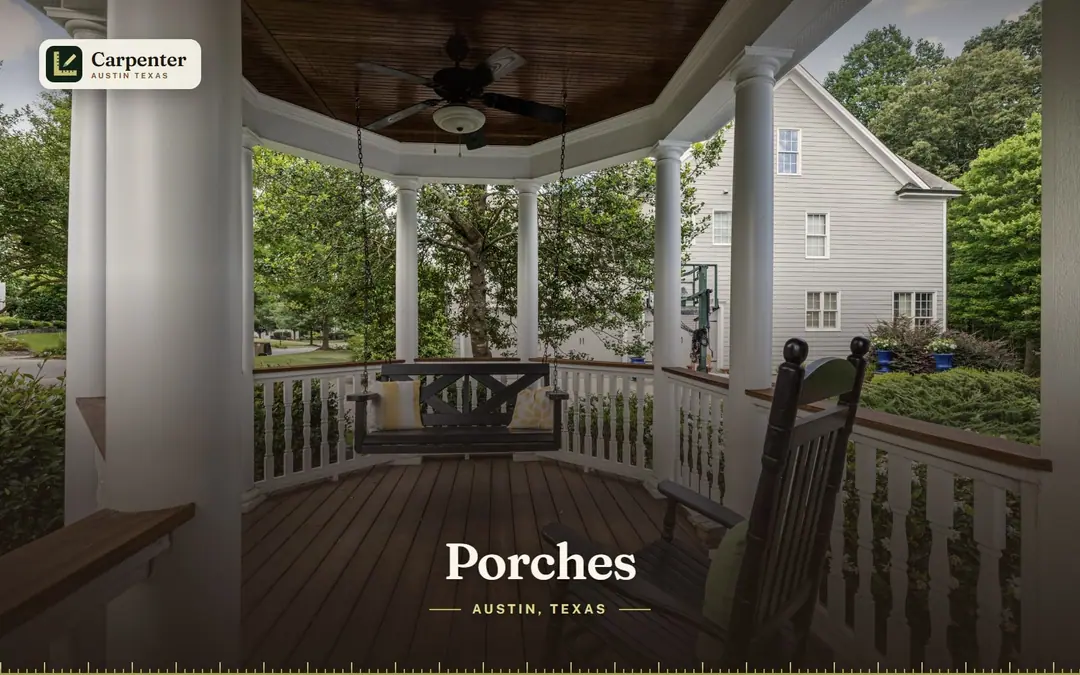
Porches
New porches and porch repair in Austin: floors, columns, railings, steps and ceilings, built on footings for clay soil. Free written estimates.
See the service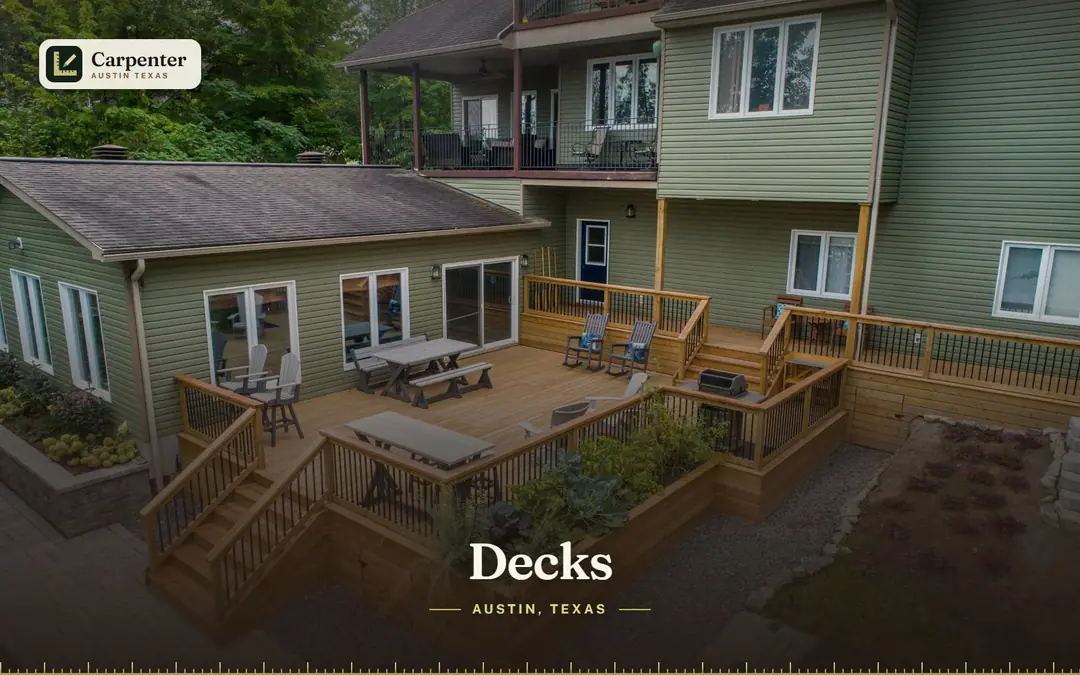
Decks
Carpenter Austin Texas builds custom decks in Austin: cedar, composite and pine boards, railings, pool and rooftop decks, and replacements. Free estimates.
See the service
Outdoor living
Carpenter Austin Texas designs and builds outdoor living spaces in Austin: pergolas, patio covers, gazebos, screened porches and catios. Free estimates.
See the service
Fences & gates
Cedar privacy, horizontal, picket and split rail fences built by Austin carpenters, with posts set for clay or limestone. Free written fence estimate.
See the service


Free written estimate
Call an Austin carpenter today
Trim, siding, fascia, porches, carports and dormers, built for Austin weather. You get a clear written estimate, we show up on time, and we leave a clean site.
- Homeowners
From a single rotted porch post in a 1920s bungalow to a custom cedar deck overlooking the Hill Country.
- Older Austin homes
Original trim, porches and windows repaired with lumber, fasteners and finishes chosen for Central Texas.
- Businesses and property managers
Tenant improvements, commercial millwork and ongoing repairs for rental homes.
