


Our free estimate itemizes these so you can compare quotes line by line.
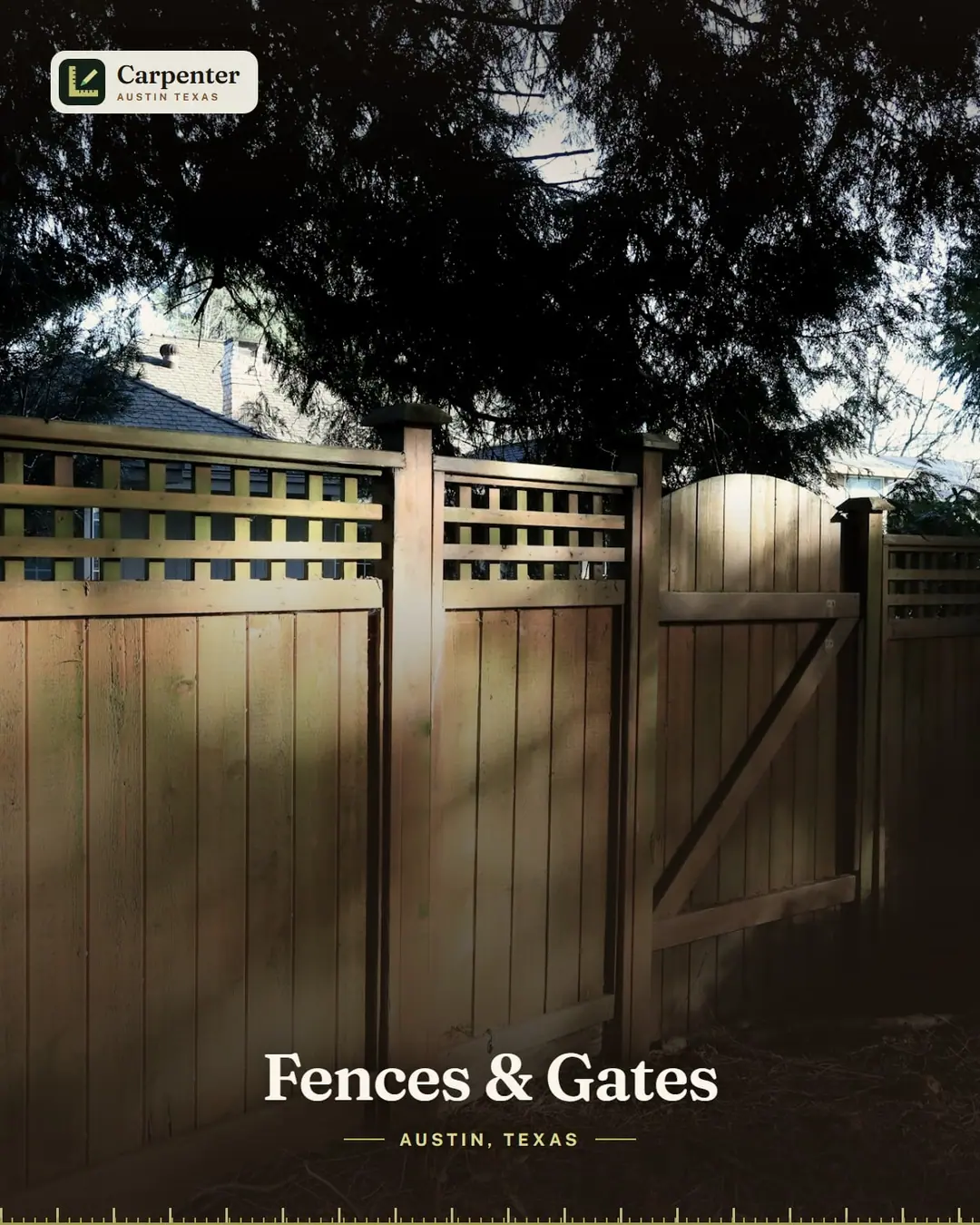
Outdoor and exterior · Austin, TX
Wood fence & gate installation in Austin, TX
Fence installation in Austin usually starts with one of a few goals: privacy from the street or the neighbors, a yard where kids and dogs can't wander off, or a new fence that won't lean after the next wet spring. We do wood fence installation across Austin, from cedar privacy fences and horizontal designs to picket fronts, split rail boundaries and custom gates.
Read more
At Carpenter Austin Texas we're local carpenters in Austin, so we build a fence the way we'd frame a wall. Posts go in for the soil on your lot, whether that's clay east of I-35 or limestone to the west. Rails are fastened square, gates are braced, and the cedar and screws are picked to handle heat, sudden storms and termites. As a fence builder we work in every part of the city. We give free written estimates, show up when we say we will, and clean up before we leave.
We measure your fence line, check the soil and HOA rules, and give you a clear written price.
- Free written estimateYou know the scope and the price before anyone picks up a saw.
- On time, as promisedWe show up on the day and at the time we agreed.
- Your home protectedFloors, furniture and the yard are covered while the work goes on.
- Clean job siteThe work area is swept and cleared before we leave.
- Built for Texas weatherLumber, fasteners and finishes chosen to hold up to Austin heat, storms and clay.
- Jobs of every sizeOne rotted porch post gets the same care as a custom build.
The numbers behind this work
- 6 fttallest solid fence on a property lineA solid fence along an Austin property line may not be more than 6 feet high measured from natural grade, and any fence over 7 feet at any point needs a permit.City of Austin Development Services · 2026
- 50%replaced, and the whole fence must meet codeIf more than 50 percent of the total length of an existing Austin fence is replaced, the whole fence has to meet the current safe-fencing code.City of Austin Development Services · 2026
- 2 in / 9 inpicket spacing rule above the top railAustin's safe-fencing rules bar vertical pickets above the top rail unless they are spaced less than 2 inches or more than 9 inches apart.City of Austin Development Services · 2026
- 90 to 150days a year the clay stays crackedThose shrink-swell cracks stay open for 90 to 150 cumulative days in most years, moving pier-and-beam floors, decks and fence posts with them.USDA soil survey · Houston Black series
01What we do
Wood fence styles we build in Austin
In short
Most Austin backyards end up with a 6 ft cedar privacy fence, because it blocks the view and keeps dogs in. Still, the style should follow the job. A front yard wants something lower and more open. A long property boundary on a big lot may only need rails, and a newer house might call for a modern horizontal look. Any of these can include a matching gate. Here is how each one is built.
Cedar is the default for privacy fences in Austin because its natural oils help it resist moisture and insects, and it handles our heat with less twisting than untreated pine. For most homeowners asking about wood fence installation in Austin, this is the fence they mean. Common builds:
- Side-by-side pickets, the standard and most affordable layout
- Board-on-board, where pickets overlap so no see-through gaps open as the boards shrink
- Shadowbox or good-neighbor, with pickets on alternating sides so both neighbors get the same view
- Taller 8 ft builds, which the City allows only in certain cases (see the permit section below)
The details are where a carpenter-built fence pulls ahead. A top cap and trim board shed rain and stiffen the top edge. A rot board at the bottom keeps pickets off the dirt. Picket spacing stays even down the whole run, and rails go on the owner's side. A privacy fence makes sense if you have dogs that dig or jump, a pool, or a house on a busy street.
Horizontal fences in Austin show up most on newer builds and remodels, where the long, low lines match flat roofs and modern siding. The boards look simple, but the framing behind them takes more work than a vertical fence.
A horizontal board spans post to post with nothing holding up its middle. Over a long span, it sags. That's why horizontal fences need closer post spacing or a mid-post or stiffener on longer runs. Boards are usually cedar, set either tight together for full privacy or with a reveal gap between them. The wider the gap, the more your neighbors see, so we work out gap width with you before any board is cut.
All that extra framing and labor costs money. Absolute Fence & Gate's Austin cost guide (August 2026) lists horizontal cedar at about $45 to $70 per linear foot, against $25 to $35 for a standard cedar privacy fence. Those are one installer's published figures, not our price; your written estimate gives ours.
If you live in an HOA neighborhood, get approval before you commit. Many HOAs have rules on fence style, so send the design to your board before the build is scheduled.
Picket fences in Austin are mostly front-yard fences. They suit the cottages and bungalows in the older central neighborhoods, and they're built lower than a backyard fence so the house still shows from the street. You can paint them white or leave the cedar natural, and choose dog-eared or flat-cut tops.
One local rule changes how we design them. Under the City of Austin's Safe Fencing rules, new residential fences can't have spiked or pointed pickets above the top rail. Pickets that rise above the top rail also can't be spaced more than 2 inches and less than 9 inches apart. We lay out every picket fence to meet that rule from the start.
Split rail fences in Austin fit larger lots and acreage edges, especially in west and southwest Austin. A 2- or 3-rail fence marks a property line without blocking the view across it.
It isn't a privacy fence. If you need it to hold a dog, we can add wire mesh behind the rails. Because it uses far less wood than a privacy fence, the cost per foot is lower. The posts still need proper setting, though. A split rail post sunk too shallow in clay will lean within a few seasons, and in limestone the hole may need to be drilled.
Wood gates in Austin come in two main types: walk gates for people, wheelbarrows and mowers, and double driveway gates for a car or trailer.
Most gates sag for the same reasons. All the weight hangs off one hinge post, there's no diagonal brace, or the post is too small for the load. We build gates to stop that from happening:
- A square frame, screwed together before any pickets go on
- A diagonal brace running from the bottom hinge corner up to the top latch side
- A heavier hinge post, set deeper than the line posts
- Heavy-duty hinges and a latch sized for the gate's weight
For wide or heavy gates, an anti-sag cable kit or a steel gate frame are options. Every gate is built to match the fence style around it. Absolute Fence & Gate's August 2026 guide lists walk gates at roughly $150 to $300 each, with driveway gates and automatic openers quoted separately; we price your gates in your written estimate.
Think about the widest thing that has to pass through. A mower, a wheelbarrow or a trailer sets the gate width, and a gate wider than it needs to be is heavier and more prone to sag. Two narrower leaves can work better than one wide gate.
Matching the style to the job
Decide what the fence has to do before choosing how it looks. Keeping a dog in calls for a solid bottom edge and no easy footholds on the dog's side. Blocking the view from a neighbour's upstairs window may need a screen panel or a tree rather than a taller fence. Marking a boundary only needs a few rails.
Think about which side you will see. Rails face the owner on most builds, so the finished face points out. If you share the fence with a neighbour, or your yard is where people gather, a shadowbox or good-neighbour design gives both sides a finished look.
Mixing styles can work well. A picket front with a privacy fence along the back, tied together with matching posts and caps, keeps the street side open and the backyard private.
02What we do
Cedar grades, posts and hardware: what makes a wood fence last
In short
A wood fence usually fails at the posts and fasteners long before the pickets give out. Two quotes can both say "6 ft cedar privacy fence" and describe very different fences: one on steel posts with thick Western Red Cedar pickets, the other on pine posts with thin imported boards. These are the build details worth asking every fence company about before you sign.
"Cedar" on a quote can mean different woods. Western Red Cedar has more natural oil and stays more stable as it dries. Imported or mixed cedar costs less and often moves more as it dries. Grade matters too: knotty grades are the usual fence board, while clear grades cost more and have few or no knots.
Thickness counts as well. A thin picket cups and warps faster in August sun than a thicker one.
Ask each company two questions: which species, and which grade? If a quote just says "cedar," you can't compare it fairly to one that names Western Red Cedar.
Look over the boards when they arrive. Pickets with large loose knots, splits running in from the end or heavy cupping are better cut down for short pieces, so the run you look at every day is made from the straightest stock.
Post choice decides how straight the fence stays. You have three common options:
- Galvanized steel posts, which can't rot, won't feed termites and hold their line in clay that moves
- Cedar posts, which look traditional but can rot at the base where they sit in wet soil
- Pressure-treated pine posts, which cost less and resist rot better than untreated wood
Posts are typically about 8 ft apart, closer for horizontal and tall fences. Setting depth depends on fence height, the soil and wind exposure. We set it per lot after looking at the ground and the fence height, not by one number for every yard. A 4 ft picket fence in sandy loam and an 8 ft privacy fence on a windy corner lot in Northeast Austin don't need the same hole.
When the concrete goes in, we crown the top so it slopes away from the post. Flat or cupped concrete holds water against the wood, and that wet ring is where posts rot first. In west Austin, many post holes have to be drilled or core-cut through limestone.
- Exterior-rated, corrosion-resistant screws or ring-shank nails. Cheap fasteners rust, streak the cedar and work loose.
- Three rails on a 6 ft fence and more on an 8 ft fence, so pickets have fewer places to bow.
- A pressure-treated rot board (kickboard) at the bottom, so the pickets never touch the soil.
- A top cap to shed rain off the end grain, which means less warping along the top.
How to read a fence quote
Ask what holds the pickets on. The rails and their fasteners carry every picket, so ask how many rails each section gets, what the rails are made of and how they attach to the posts. Rails that are only toe-nailed into the face of a post tend to loosen first.
Look at how the posts finish at the ground. Concrete crowned above grade sheds water, while concrete left low or cupped holds a ring of water against the post. That small detail often decides when a wood post rots.
Check the picket layout across the whole run. Even spacing from end to end, with no odd wide gap at a corner, is a sign the layout was planned before the first board went on.

Wood should be cut, fitted, and finished like it’s meant to last a lifetime.
03What we do
How Austin soil, heat and storms affect your fence
In short
Central Texas is hard on wood. A fence sits in the soil and in full sun every hour of the year, and Austin gives it expanding clay, baking summers and sudden storms. Where you live in the city changes which of those does the most damage.
East of I-35, much of Austin sits on the Blackland Prairie's expansive clay. It swells when it's wet and shrinks and cracks in drought. Over a few seasons that movement loosens posts and tips them out of line, which is why so many east Austin fences lean.
West and southwest Austin, out toward the Hill Country, is the opposite problem: shallow limestone. Digging is hard, posts often need rock drilling, and a hole cut into solid rock can hold water like a cup around the post base.
We adjust for both. Post depth and footing size are set per lot. Where the soil is likely to move, steel posts are worth pricing. And where water could collect, we plan drainage at the post so the base isn't sitting wet.
Summer sun dries cedar out and turns it gray. Over time UV opens checks and small cracks in the boards.
A solid 6 ft privacy fence has no gaps for wind to pass through, so the whole force of a gust pushes on the boards and, through them, on the posts and rail fasteners. That's why post setting and rail fastening matter so much on a privacy fence. Hail dents and splits boards, and falling limbs take out whole sections.
Then there are termites. Central Texas has subterranean termites, including Formosan termites in places. A rot board and a clear strip of soil (no mulch piled against the pickets) give termites fewer ways in.
Stain won't stop termites, but it does slow the UV damage, which the staining section below covers.
Signs your fence is fighting the site
A fence that leans in one stretch after a wet spring, then settles partway back in summer, is riding on clay that swells and shrinks. The fix is in how the posts are set, not in bracing the boards.
Boards that grey and split faster on one side of the yard are usually on the south or west run, where the afternoon sun hits hardest. Those runs need their finish renewed sooner than shaded ones.
A section that rocks after a storm, with posts loose but still upright, often has rails that have pulled their fasteners. Catching that early stops the next storm from laying the whole panel down.
04What we do
Fence permits, HOA rules and Austin's safe fencing code
In short
Most backyard fences in the City of Austin don't need a building permit. Height, location and design rules still apply, though, and the information online often conflicts. The figures below come from the City of Austin's Fencing Regulations page, checked in October 2026. If you're in unincorporated Travis County or another city, your rules are different, so check with your own city or county.
- Property-line height
- Solid fence generally limited to 6 ft from natural grade
- Permit trigger
- Over 7 ft at any point, or in a floodplain
- Safe Fencing
- No spiked or pointed pickets above the top rail
The City's fencing page lists these permit triggers:
- The fence is in a floodplain, at any height
- The fence is more than 7 ft high at any point
- The fence is more than 6 ft high on residential property along a City of Austin public right-of-way (not an alley), which also requires a City letter of authorization
Height on a property line has its own limit. A solid fence along a property line generally can't be more than 6 ft high, measured from natural grade. The City allows 7 ft where the grade changes at least 1 ft along the fence. In some cases, 8 ft is allowed: with written consent from the adjoining owner where the grade changes 2 ft or more, next to commercial property, or on or within the building setback lines.
Corner lots need approval from Austin Transportation and Public Works so the fence doesn't block drivers' view of traffic. Some older pages online still quote an 8 ft permit threshold. We check your lot against the current rules before we quote.
The City of Austin passed updated Safe Fencing requirements on July 20, 2023, and they cover fences built on or after July 31, 2023. Under them, new residential fences can't have:
- Spiked pickets, spiked bars or other spiked decorations above the top rail
- Vertical pickets above the top rail spaced more than 2 inches and less than 9 inches apart
- Razor wire, or barbed wire at the top of a fence 6 ft or taller
Fences built before July 31, 2023 are exempt. But if more than 50% of an existing fence's length is replaced, the whole fence has to meet the rules. That matters when you replace most of an old pointed-picket fence: the new one can't copy the old design. We build flat-top designs that comply.
Many Austin-area HOAs control fence height, style and stain color, plus which side faces out. Most want approval before work starts. Send us your HOA guidelines and we'll design to them.
Use a survey or plat to place the fence on the right line. If you share a fence with a neighbor, talk before the old one comes down, since you both lose it for a few days. And before anyone digs, Texas 811 needs to mark the buried utility lines. Boundary disputes are a matter for a surveyor or a lawyer, not a fence builder.
Before you settle on a height
Height is measured from natural grade, not from a raised bed or the top of a retaining wall. A fence that looks level along its top can break the limit where the ground dips, so on uneven lots it pays to check the grade at several points along the line.
Corner lots need extra thought. A solid fence near the street corner can block drivers' view, which is why the City requires approval there. Lowering or opening up the section near the corner is one way to keep both the design and the sightline.
If you are replacing an old pointed-picket fence, count the footage you plan to replace. Replacing more than half of it brings the whole fence under the Safe Fencing rules, so the new design should be flat-topped from the start.
05How it works
Our fence installation process
In short
From the first walk along your line to the final gate check, every fence follows the same seven steps, with rules and utility marks checked before anything is dug.
- Step 01
Free on-site visit
we measure the line, check grade, soil and trees, and mark where gates go.
The visit starts at the corners. We find the end points of the run, measure the line and note every change in direction, because each corner and end needs a stronger post and adds to the count. A string or a few flags along the line show you where the fence will actually sit.
Grade comes next. Along a slope we look at how much the ground drops, so you can choose between stepped and racked panels and see whether a grade change affects the City's height limit. Trees near the line get checked for roots and limbs in the way of posts or rails.
Gate spots are marked where you actually walk, mow and roll out the bins, with room for each gate to swing clear.
What to expect You walk the line with us, point out where gates should go and tell us about dogs, pools or anything the fence has to keep in or out.
- Step 02
Written estimate
it lists the style, wood grade, post type, gates and stain options.
The estimate turns the walk into a written description: footage, height and style, the wood species and grade, the post type and how posts are set, each gate with its hardware, and stain options. Those details decide how long the fence lasts, so they are spelled out rather than left to a phrase like cedar fence.
This is when you choose between options such as side-by-side or board-on-board pickets, a cap and trim, or a horizontal design. If a neighbour is sharing the cost, the same written scope gives you both something clear to agree on.
Lay it beside any other quotes and compare the same lines, not just the totals.
What to expect You get a written estimate that names the wood, posts and gates, and you choose the style, height and stain options.
- Step 03
HOA and permit check, plus a Texas 811 utility locate before any digging
Before anything is ordered, the design is checked against the City of Austin fencing rules: height from natural grade, the permit triggers for floodplains, tall fences and fences along a public right-of-way, corner-lot sightline approval and the Safe Fencing limits on pickets above the top rail. If your HOA controls style, height, stain colour or which side faces out, its approval comes first.
A Texas 811 locate request gets buried utility lines marked before any post hole is dug. Private lines such as sprinklers, landscape lighting or a gas line to a grill are not covered by it, so point them out.
Utility meters and wastewater cleanouts must stay reachable, which can shift a gate or post.
What to expect You send any HOA guidelines, wait for approval where it's needed, and see paint or flags on the ground where buried lines run.
- Step 04
Tear-out
on a replacement job, we remove and haul off the old fence.
Pickets and rails come off first, then the posts, along with old concrete footings that sit where new posts will go. Old footings left in the ground can push a new post off its line or into a shallow hole, so they are dealt with rather than built around.
Tear-out also shows why the old fence failed. Rotted post bases, cupped concrete, termite damage or posts set too shallow tell you what the new build has to do differently.
The yard is open from the moment the old fence comes down, so plan for pets, and if the fence is shared, agree the timing with your neighbour beforehand.
What to expect You see the old fence come down and get hauled away. Keep pets inside or supervised while the line is open.
- Step 05
Posts
each post is set plumb, and concrete cures where needed before rails go on.
Post holes are dug or drilled to suit the soil and the fence height, and corner, end and gate posts are treated as the heavy-duty points of the run. On clay, the post and concrete are set to hold through swelling and shrinking; on limestone, holes may be core-cut into the rock.
Each post is set plumb in two directions and lined up to a string pulled tight between the ends, so the fence runs straight and the rails land evenly. The concrete is crowned so water runs away from the post instead of sitting in a ring around it.
Rails wait until the concrete has firmed up, because a post nudged while it sets can lean for good.
What to expect You see a straight row of posts along the string line. It's a good moment to confirm gate openings and the fence's exact position.
- Step 06
Rails, pickets, caps and gates go on, and we check that every gate swings freely and latches on its own
Rails go on the owner's side at even heights, fastened with exterior-rated screws or ring-shank nails. A rot board runs along the bottom so pickets stay off the soil, and pickets go on with a spacer so the gaps stay even from one end of the run to the other. On a slope, the panels step or rack the way you chose.
Caps and trim go on last along the top. Gates are built as square, braced frames, hung on the heavier hinge posts and adjusted until they swing freely and latch on their own, without a lift or a shove.
Try each gate yourself while the hardware can still be tweaked.
What to expect You watch the fence fill in and try each gate, checking that it swings freely and the latch catches without lifting.
- Step 07
Clean-up and a walk-through, so you see the finished line before we leave
Clean-up covers offcuts, sawdust, soil from the post holes and stray screws, with a careful sweep of the strip along the fence where kids and dogs play. Concrete splashes are cleaned off pickets and paths.
On the walk-through you sight down the line for straightness, check the top line and the gaps, push on posts, try the gates and look at how the bottom meets the ground. Small gaps under the rot board matter if you have a small dog.
You also get the care basics: keep sprinklers off the boards, keep mulch and soil clear of the bottom, and check gate hardware once a year.
What to expect You walk the finished fence with us, try every gate and raise anything that looks off before we leave.
Good to know
Many residential fences take a few days from post setting to the last picket. Long runs, rock and custom gates add time. Through all of it, we protect your yard while we work, keep materials off your lawn where we can, and leave the site clean at the end.
06Pricing
Fence installation cost in Austin
In short
Most fence company pages in Austin don't publish prices. Absolute Fence & Gate does: its Austin cost guide from August 2026 lists a standard 6 ft cedar privacy fence at about $25 to $35 per linear foot installed. For a 150 to 200 ft backyard, that's roughly $4,500 to $9,000. The same guide says going from 6 ft to 8 ft adds about 20 to 30% to materials, and it lists old fence removal as an add-on.
These are one installer's published 2026 ranges. They are not our prices. Use them to judge whether a quote is in the normal range, then compare line by line.
| Fence type | Typical published range | What moves it |
|---|---|---|
| 6 ft cedar privacy | $25 to $35 per linear foot | Board style, cedar grade, rock |
| Horizontal cedar | $45 to $70 per linear foot | Post spacing, gap width, board size |
| Walk gate | $150 to $300 each | Frame, hinges, width |
| 6 ft to 8 ft height | About 20 to 30% more in materials | Rails, post length, permit rules |
| Old fence removal | Listed as an add-on | Length, old concrete footings |
What your written estimate includes
Your estimate spells out the footage, height and style
It names the wood species and grade, the post type and how posts are set. Gates and hardware are listed, along with removal of the old fence, the stain option, the start window and clean-up.
When you compare quotes, compare the same things
A cheaper quote using a lower cedar grade and wood posts is a different fence, not a better deal.
Corner and gate posts cost more than line posts
They carry more load and often get heavier posts and bigger footings, so a short fence with many turns and gates can cost more per foot than a long straight run.
Access changes the labour
A narrow side yard, no alley, or a backyard reached only through a garage means materials are carried in by hand, and soil and old fence carried out the same way.
Rock is the wild card on the west side
Drilling or core-cutting through limestone takes more time and equipment than digging clay, so ask how rock is priced before work starts.
07What we do
Staining and caring for a new cedar fence
In short
A new cedar fence looks better and lasts longer with a finish and a little care each year. Here is what staining involves and what to check between coats.


Fence staining in Austin is mostly about the sun. Stain blocks UV, which slows graying and checking, and it cuts down how much the wood soaks up and dries out with each rain.
New cedar usually needs time to dry before the first coat, or the stain sits on the surface instead of soaking in. How long depends on the wood and the weather, so we check the boards before we stain.
You have three main finishes. Semi-transparent stain tints the wood but lets the grain show. Solid stain covers it like paint and hides mismatched boards. A clear sealer keeps the natural color for a while but gives less UV protection. Oil-based products soak deeper into the wood; water-based ones dry faster and clean up with water.
Expect to re-stain every few years, sooner on south- and west-facing runs that take the afternoon sun. If you're in an HOA, check the approved stain colors first.
An older fence can be stained too. It needs cleaning or brightening first, and any bad boards replaced. We offer fence staining as part of a new install or on its own.
- Aim sprinklers away from the fence.
- Keep soil, mulch and firewood off the bottom boards.
- Trim back vines and shrubs that hold moisture against the wood.
- Tighten gate hinges and latches once a year.
- After a big storm, walk the line and look for loose pickets and leaning posts.
- Watch for mud tubes on posts, a sign of termites.
If you find something that needs fixing, the next section points you to the right page.
Getting a stain job that lasts
Stain both faces and the top edges. Water gets in wherever wood is bare, and a fence stained only on the street side still swells and shrinks from the back. Board ends and the top edge soak up water fastest, so they need a full coat.
Pick a dry spell for staining. The wood needs to be dry on the surface and inside, and the stain needs time to soak in before rain or sprinklers hit it. Turn off sprinklers along the fence before and after the job.
Test the colour on a hidden board first. Cedar varies, and the same stain can look quite different on two boards from the same delivery.
08What we do
Fence repair, decks and other outdoor carpentry
In short
A fence is often one part of a bigger outdoor project. These two pages cover the jobs that come up most often alongside a new fence.


Not every old fence needs replacing. One leaning post, a sagging gate or a section the storm knocked over can often be fixed for far less than a new fence. Our page on fence repair in Austin covers post replacement, leaning fences, rot and storm damage.
Plenty of homeowners pair a new fence with a deck or a shade structure and want the cedar and stain to match across all of it. See our custom deck building page, or our work as an Austin outdoor living contractor for pergolas and covered areas.
Planning fence work alongside other projects
Build the deck or patio before the fence beside it when you can. Concrete, lumber and equipment are easier to bring in through an open side yard, and the fence can then be fitted neatly to the finished deck edge.
Match materials on purpose. Using the same cedar, cap style and stain on the fence, gates and a nearby pergola or deck rail makes the yard look planned. Buy stain for everything at once so the colour matches.
If only part of the old fence is failing, compare repair and replacement before planning around it. A repaired fence can carry on next to new work, though a new section beside weathered boards will look different until it greys or is stained.
09Why us
Why choose Carpenter Austin Texas as your Austin fence builder
In short
Carpenters frame and brace each gate like a door, choose lumber and fasteners for Central Texas conditions, and tell you plainly when repair beats replacement.
- 01Gates hang square and stay that way, because they're framed and braced like the doors in your house
- 02Lumber, posts and fasteners are chosen for Central Texas heat, clay and termites
- 03We show up when promised, protect your lawn and garden beds, and haul off the debris
- 04You get a clear written estimate and honest answers, including when repairing your old fence makes more sense than replacing it
- When you search for a fence builder in Austin, you'll find plenty of crews that install fences
We're carpenters first. Here's what that means on your fence line:
- As a fence company in Austin, Carpenter Austin Texas works by one rule
wood should be cut, fitted and finished like it's meant to last a lifetime.
What carpentry habits change on a fence
Carpenters work to a line. On a fence that means string lines for posts and rails, picket spacing planned from both ends, and a top line that follows the grade the way you chose rather than wandering.
Gates get the attention a door would: a square frame, a brace running the right way, a post that can carry the weight and hardware sized for it. That combination is what keeps a latch catching cleanly.
When a fence only needs a few posts or a new gate, you hear that before you hear a replacement price.
Wood should be cut, fitted, and finished like it’s meant to last a lifetime.
10Service area
Areas we serve for fence installation
In short
We build fences in every part of Austin, and the soil, slope and neighbourhood rules on your lot shape how each one goes in.
Central, North and North Central Austin
Central Austin
Central Austin older bungalows and cottages, historic districts like Hyde Park, and renovations on tight lots.older bungalows and cottages, historic districts like Hyde Park, and renovations on tight lots.
(737) 415-9388Central Austin, TX
North Austin
North Austin mid-century ranch homes in established neighborhoods.mid-century ranch homes in established neighborhoods.
(737) 415-9388North Austin, TX
North Central Austin
North Central Austin mid-century houses, many due for new trim or decks.mid-century houses, many due for new trim or decks.
(737) 415-9388North Central Austin, TX
Northeast, Northwest and Far North Austin
Northeast Austin
Northeast Austin newer subdivisions sitting on the clay east of I-35.newer subdivisions sitting on the clay east of I-35.
(737) 415-9388Northeast Austin, TX
Northwest Austin
Northwest Austin Hill Country lots on sloped limestone, with decks built for the view.Hill Country lots on sloped limestone, with decks built for the view.
(737) 415-9388Northwest Austin, TX
Far North Austin
Far North Austin newer subdivisions where builder-grade trim and fences often need upgrades.newer subdivisions where builder-grade trim and fences often need upgrades.
(737) 415-9388Far North Austin, TX
East and West Austin
East Austin
East Austin older homes east of I-35 on clay soil, with plenty of infill and renovation.older homes east of I-35 on clay soil, with plenty of infill and renovation.
(737) 415-9388East Austin, TX
West Austin
West Austin hillside homes on limestone, where decks and stairs follow the slope.hillside homes on limestone, where decks and stairs follow the slope.
(737) 415-9388West Austin, TX
South and South Central Austin
South Austin
South Austin established neighborhoods with a mix of older and newer homes.established neighborhoods with a mix of older and newer homes.
(737) 415-9388South Austin, TX
South Central Austin
South Central Austin older houses around neighborhoods like Travis Heights, many with porches and original trim.older houses around neighborhoods like Travis Heights, many with porches and original trim.
(737) 415-9388South Central Austin, TX
Southeast Central / Riverside, Southeast and Southwest Austin
Southeast Central Austin / Riverside
Riverside older homes, rentals and newer infill south of Lady Bird Lake.older homes, rentals and newer infill south of Lady Bird Lake.
(737) 415-9388Riverside, Austin, TX
Southeast Austin
Southeast Austin growing neighborhoods on clay soils, where doors and trim feel the ground move.growing neighborhoods on clay soils, where doors and trim feel the ground move.
(737) 415-9388Southeast Austin, TX
Southwest Austin
Southwest Austin hillside lots with decks and views toward the Hill Country.hillside lots with decks and views toward the Hill Country.
(737) 415-9388Southwest Austin, TX
What changes across town
Older central neighbourhoods often have narrow lots, mature trees on the line and fences shared with several neighbours. Working around roots, finding old footings and agreeing a design with each neighbour take more planning than on a newer lot.
East of I-35, clay that moves with rain and drought calls for careful post setting and water shed away from each post. West of MoPac, rock and slopes mean drilling, stepped or racked panels and a close eye on height where the grade drops.
In newer subdivisions, HOA rules often set the style, height and stain colour, and back fences are often shared along long lot lines with several owners.
Good to know
Each part of town needs a different post approach. Clay soils east of I-35 move with the weather, and rocky lots west of MoPac often need drilling. If you're just outside the city limits, ask us. We may still be able to help.
11Questions
Fence installation FAQs
Cost & estimates
01How much does a new wood fence cost in Austin?
One Austin installer, Absolute Fence & Gate, lists a 6 ft cedar privacy fence at about $25 to $35 per linear foot installed in its August 2026 guide. Your total depends on footage, height, the number of gates and whether the posts go into rock. Our written estimate gives you our exact price.
02Is a cedar fence worth the extra cost over pine?
For most Austin yards, yes. Cedar usually costs more upfront, but its natural oils help it resist rot, insects and warping in our heat. Untreated pine dries, twists and rots faster, so it may need replacing sooner.
03Do you charge to remove my old fence?
Removal and haul-off is usually its own line on a replacement job. You'll see it on your written estimate, along with what it covers, such as breaking out old concrete footings.
04Is it cheaper to build a fence in winter?
Not by itself. Demand drops in the cooler months, and digging can be easier when the clay isn't baked hard. But the price comes from the job (footage, height, wood, rock), not the calendar.
05Can neighbors split the cost of a shared fence?
Yes, and many do. We can write one estimate that both owners can review. How you split the cost is a private agreement between you and your neighbor, so put it in writing before work starts.
06How do I compare fence quotes fairly?
Line them up on the same terms: footage, height, cedar grade, post type (steel or wood), post depth, gate count and clean-up. When one quote is much cheaper, look for thinner pickets, a lower grade or shallower posts. Those are the corners that show up in a few years.
Materials & styles
01What wood should I use for a fence in Austin?
Cedar for the pickets, often on galvanized steel posts that stay put in clay. Pressure-treated pine is the budget option. The cedar section above explains how species and grade change the fence.
02What is a board-on-board fence?
A board-on-board fence has overlapping pickets on alternate sides of the rail. As the boards shrink in summer heat, the overlap keeps gaps from opening, so nobody can see through even after a dry August. You get more privacy, and pay for more wood.
03What is a good neighbor fence?
It's a fence that looks the same from both sides. Pickets alternate on each side of the rails, as in a shadowbox design, so neither neighbor gets stuck looking at bare rails and screw heads. Shared property lines and HOAs that care which side faces out are where it shows up most.
04Should fence posts be steel or wood?
Steel posts resist rot, termites and soil movement better than wood. Wood posts look traditional, and steel posts can be wrapped or hidden behind boards if you want the wood look. We recommend one or the other based on your soil and budget.
05How tall can a backyard fence be in Austin?
Most residential property-line fences in the City of Austin are limited to 6 ft from natural grade. Taller fences, up to 7 or 8 ft, are allowed only in certain cases, and some need a permit. The permit section above lists them.
06Which side of the fence should face my neighbor?
By convention, the finished side faces out toward the neighbor or the street, and many HOAs require it. Check your HOA rules first. A good-neighbor design avoids the question, since both sides look finished.
07Can you build a fence on a slope?
Yes. Stepped panels stay level and drop in steps down the hill. Racked panels follow the grade so the bottom stays close to the ground. Racking suits gentle slopes and keeps small dogs in; steps work better on steep ground. A slope can also change the City's height limits.
Permits, property lines & HOAs
01Do I need a survey before installing a fence?
Not always, but you need to know where the line is. An existing survey or plat usually does the job. If the property pins can't be found, or a neighbor disagrees about the line, hire a surveyor first. We build where you confirm.
02How far from the property line should a fence be?
Many owners build a few inches inside their own line to avoid disputes. Your HOA rules and any easements on your plat may set the spot for you, so check both before we mark post locations.
03Can I build a fence in a utility or drainage easement?
Sometimes, but at your own risk. A utility working in an easement may remove a fence to reach its lines. Your plat shows the easements. In Austin, a fence also can't block utility meters or wastewater cleanouts, so we keep those open.
04Does my HOA need to approve a new fence?
In most planned communities, yes. Approval can cover height, style, material and stain color. Send us your HOA guidelines and we'll design the fence to match before it goes to the board.
05Do you handle the 811 utility locate?
Texas 811 is the call-before-you-dig center: it notifies the utilities, and they mark their buried lines. No post hole goes in on our jobs until the lines are marked, and at the estimate visit we'll agree on who places the request. Ask us if you're unsure.
06Are pointed picket fences allowed in Austin?
Not on new residential fences inside the City of Austin. The 2023 Safe Fencing rules ban spiked or pointed pickets above the top rail. Flat tops meet the rule.
Installation process & timeline
01How long does fence installation take?
Many backyard fences take a few days once work starts. Long runs, rock drilling, custom gates and a wet week that leaves the clay too soft for setting posts can all stretch that. Your estimate gives a start window.
02Do I need to be home while the fence is installed?
Usually not, once we've done the walk-through together. Keep pets secured inside and leave gates and side access open so we can reach the fence line.
03What happens to my dog while the old fence is down?
Plan for some open time between tear-out and the new pickets going up. Tell us about your dog at the estimate visit so we can plan the order of work around it. Have a backup, like a crate or a leash run.
04Will fence installation damage my lawn or sprinklers?
Some trampled grass along the fence line is normal and grows back. Point out sprinkler heads and any irrigation lines that run near the fence at the estimate visit, so they get marked before anyone digs. We clean up before we leave.
05Can you install a fence after rain?
Light rain is fine. After heavy rain, saturated clay can push back the post setting, because posts and concrete need firm ground to sit right. We'd rather wait a day than set a post that leans by spring.
Care, lifespan & warranty
01How long does a cedar fence last in Austin?
That depends on the post type and setting, how much sun it gets, whether sprinklers hit it and how often it's stained. A well-built, maintained cedar fence lasts many years longer than untreated pine.
02Why is my new cedar fence turning gray?
That's UV weathering, and it's cosmetic. The sun breaks down the surface of the wood and turns it silver-gray. Stain or sealer slows it down.
03Should I stain a new fence right away?
Usually not. New wood often needs to dry first so the stain soaks in instead of sitting on top. How long to wait depends on the wood and the weather, and we check the boards before staining.
04Why do fence gates sag over time?
Gates sag when the weight on the hinge side pulls them down. A missing diagonal brace, an undersized hinge post or a post that has loosened in the soil are the usual causes. We build new gates to prevent it; a sagging gate on an existing fence is a repair job.
05Can a fence help with termites or make them worse?
A wood fence that touches the house or sits in soil can give termites a path. Keep soil and mulch off the boards. A rot board or steel posts lower the risk further, but none of that is pest control; if you see termites, a licensed pest company handles treatment.
12Keep exploring
Related carpentry services in Austin
In short
Fences & gates is one part of what we do. The same crew handles the services below, so one call covers the whole job.

Fence repair
Leaning fence, rotted post or sagging gate? We replace posts for Austin clay and limestone, rehang gates and fix storm damage. Free written estimate.
See the service
Exterior carpentry
Exterior trim, siding, fascia and porch carpentry in Austin. We fix the wood behind the trim and flash it right. Free written estimates across Austin.
See the service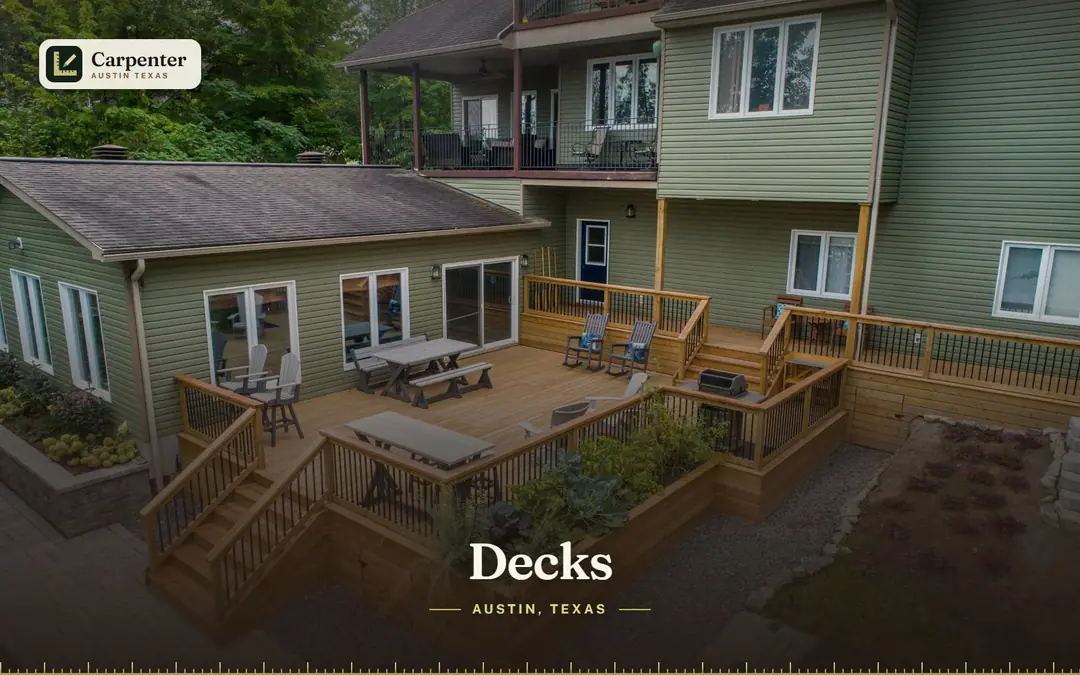
Decks
Carpenter Austin Texas builds custom decks in Austin: cedar, composite and pine boards, railings, pool and rooftop decks, and replacements. Free estimates.
See the service
Outdoor living
Carpenter Austin Texas designs and builds outdoor living spaces in Austin: pergolas, patio covers, gazebos, screened porches and catios. Free estimates.
See the service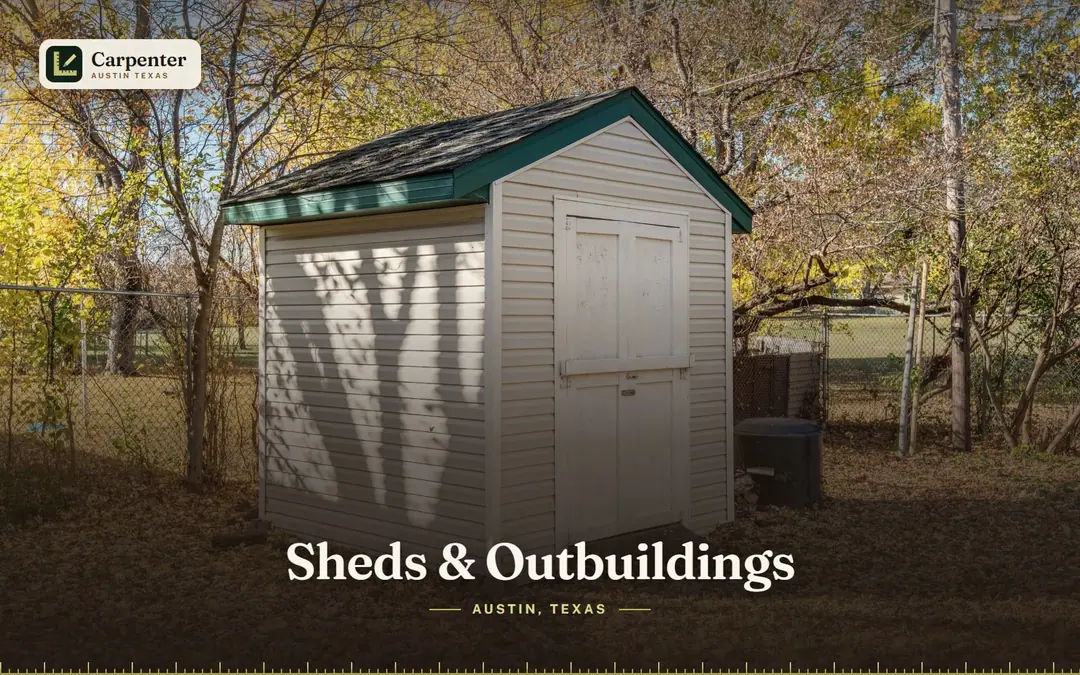
Sheds & outbuildings
Carpenter Austin Texas builds custom sheds in Austin on site: storage sheds, workshops, backyard offices, pool houses and garages. Free written estimates.
See the service


Free written estimate
Call an Austin carpenter today
Ready for a fence that stays straight? We show up on time, give honest answers and leave a clean site.
- Homeowners
From a single rotted porch post in a 1920s bungalow to a custom cedar deck overlooking the Hill Country.
- Older Austin homes
Original trim, porches and windows repaired with lumber, fasteners and finishes chosen for Central Texas.
- Businesses and property managers
Tenant improvements, commercial millwork and ongoing repairs for rental homes.
