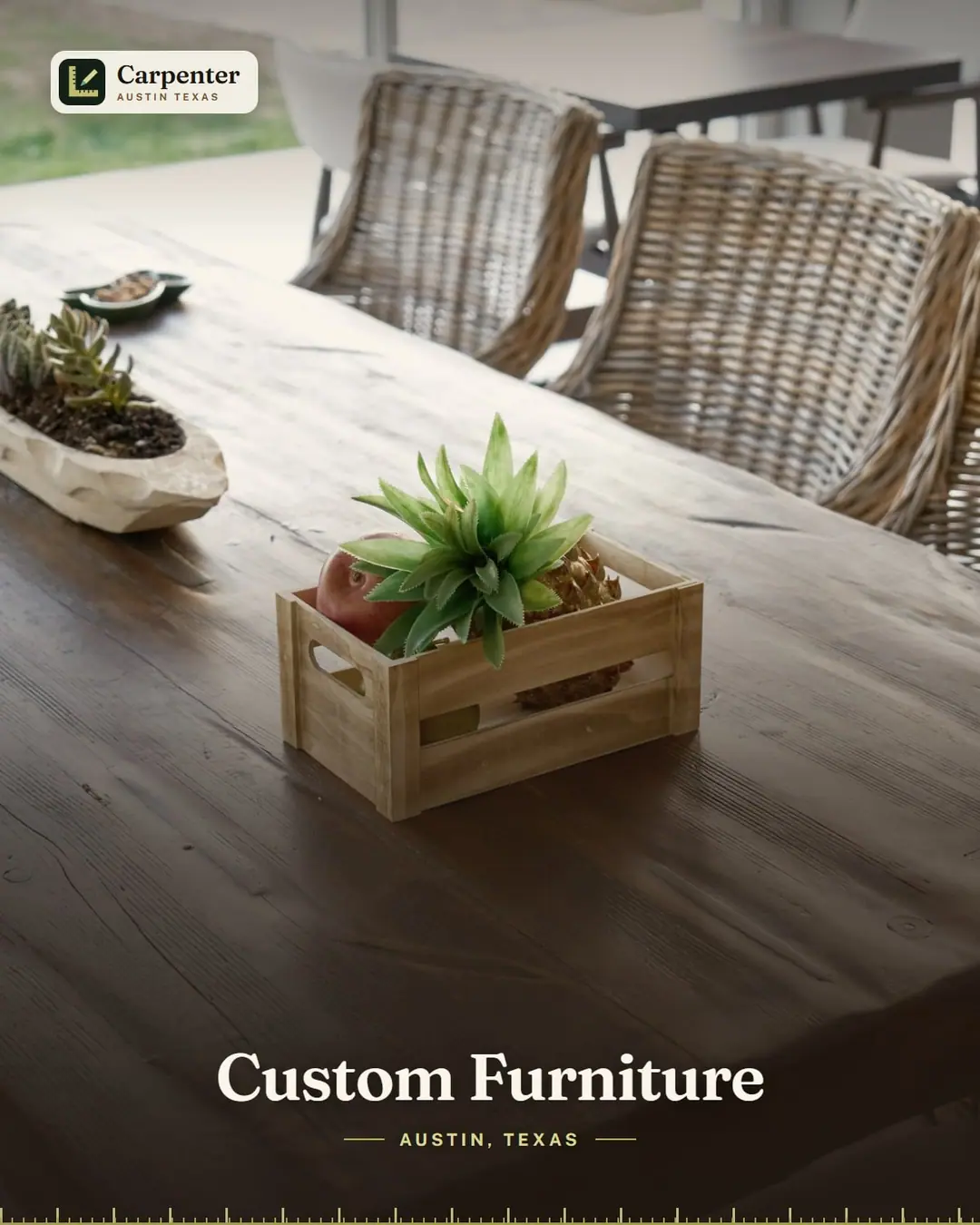
Custom wood furniture built to order in Austin, TX
The dining table you liked in the showroom is six inches too long for your room. The desk that fits is veneer over particleboard. And the oak table your grandparents ate at for forty years has a wobbly leg nobody has fixed.
Read more
Carpenter Austin Texas builds custom wood furniture to order: dining tables, benches, beds, desks, consoles and cabinets. We also repair solid-wood furniture that's worth keeping. Our view is that wood "should be cut, fitted, and finished like it's meant to last a lifetime," and a table you eat at every day is where that matters most.
If you're looking for custom furniture Austin families can hand down, or a custom furniture maker Austin homeowners can talk to face to face, this page covers the pieces, the woods, the costs and how we build. Custom wood furniture Austin homes can use for decades starts with a free written estimate. Furniture is one part of our wider custom woodwork in Austin.
Send a sketch, a photo you love or just the size you need. We'll come back with options and a clear written price, honest advice, and a delivery date we stick to.
Free written estimateYou know the scope and the price before anyone picks up a saw.
On time, as promisedWe show up on the day and at the time we agreed.
Your home protectedFloors, furniture and the yard are covered while the work goes on.
Clean job siteThe work area is swept and cleared before we leave.
Built for Texas weatherLumber, fasteners and finishes chosen to hold up to Austin heat, storms and clay.
Jobs of every sizeOne rotted porch post gets the same care as a custom build.
The numbers behind this work
80%of home buyers want a walk-in pantry80 percent of home buyers want a walk-in pantry and 80 percent want table space for eating in the kitchen.NAHB, What Home Buyers Really Want · 2024
112.9%of a minor kitchen remodel recoupedA minor kitchen remodel costing $28,458 returns $32,141 at resale nationally, recouping 112.9 percent of its cost.Zonda Cost vs. Value · 2025
$571,000median Austin home valueThe median owner-occupied home in Austin is worth $571,000, the asset that well-built cabinets, floors and doors protect.U.S. Census, ACS 2024 · 2024
01Good to know
Why hire a furniture carpenter for custom pieces
In short
The first reason is size. A furniture carpenter builds to your room, so the table seats your family in the dining room you actually have. A bed can fit an odd alcove, and a desk can fit the narrow wall between two windows.
The second is construction
A lot of store furniture is veneered particleboard held together with cam locks and staples. We build in solid wood with joints that are cut, not just screwed: mortise and tenon for legs and rails, and dovetails for drawers.
Third, you choose
The species, the stain, the edge shape, the hardware: all of it is up to you.
Fourth, solid wood can be repaired
Sand a scratched top and refinish it, or take a loose joint apart and re-glue it, and the piece goes back into daily use for years more. A particleboard table usually goes to the curb instead.
Last, your money goes to an Austin maker rather than a distant factory.
To be honest about the downside, custom furniture costs more up front and takes longer than buying off the showroom floor. One more distinction: if the piece is fixed to the wall, it's a built-in, and that work sits on our custom woodwork page.
The underside tells you more than the photo
Look under a store table: if the underside is a different material from the top, or the edge shows thin layers, the top is veneer over a core. That is not always bad, but it limits how often the surface can be sanded.
Drawers show build quality fastest
Pull a drawer all the way out and look at the corners. Interlocking joints and a solid bottom set in a groove last, while stapled corners and a hardboard bottom tacked on underneath tend to fail first.
A gentle push is a quick test
Press on a table corner. A frame with cut joinery stays still, while a frame held by cam locks racks side to side, and that movement wears the joints loose.
02What we do
Custom furniture we build
In short
Below are the freestanding pieces we build. Each section covers the usual options, the sizing and design choices, and a tip on materials.
The dining table is the piece most people come to us for. Common styles are trestle, pedestal, four-leg and farmhouse. A table can take extension leaves if you host big holidays and want a smaller table the rest of the year.
Seating depends on length, leg position and chair width, so we work out the size from the chairs you'll use and the number of people you want to seat, then check it against the room. Matching benches can slide under one or both sides.
Solid tops move with humidity across the grain. A good table lets them. We attach tops with clips or figure-8 fasteners that allow the wood to slide, and breadboard ends get pinned so the top can move under them without cracking.
Edges can be square, eased, chamfered or rounded over. If you also want a kitchen island to match, that's a cabinetry job, built as part of the kitchen.
Check leg position against your chairs. A trestle or pedestal base frees the corners and the ends, while four legs at the corners can block a chair at each end. Sit at a table you own and notice where your knees meet the apron.
We build platform beds, four-poster frames and canopy frames. Headboards can include shelves or hidden storage. Nightstands, dressers and chests can be built to match the bed or to fit a specific wall.
Bed frames use knock-down hardware, so the frame comes apart into rails and posts. That's how a king bed gets up a narrow staircase in a 1940s house.
Some older Austin homes have small bedroom closets, or none at all. A freestanding wardrobe solves that without touching the house, and it leaves with you when you move. For storage built into the wall, see Austin custom closets.
Decide on mattress support early. Slats or a solid deck change how the mattress breathes and how tall the bed sits, so bring the mattress size and thickness when you talk through the design.
Freestanding desks range from a small writing desk to a large executive desk with drawers. A solid wood top can also go on a motorized lift base for a standing desk. We build credenzas and file cabinets to match.
Cord management gets planned in, with grommets in the top and a tray underneath to hold the power strip. A keyboard tray can slide out from under the top.
If you want the whole office built into the wall, desk and shelves together, that's a built-in, covered on the custom woodwork page linked above.
Sit at your current desk and note the height that feels right for your chair and keyboard. Desk height, knee room under any drawer and the depth you need for a monitor are the dimensions that decide comfort.
Coffee tables can be plain or built with a shelf or drawers underneath. Entry consoles, sofa tables and side tables get scaled to the room, so a console behind a sofa matches the sofa's length and height.
Match the coffee table height to the sofa seat, about level or a little lower, so you can reach a cup without stretching. Leave enough walking room between the table and the front of the sofa.
We build freestanding bookcases, hutches, sideboards and buffets, bar cabinets and glass-front display cabinets.
Tall freestanding pieces can tip over if a child climbs them or a drawer gets pulled out with weight in it. Anchor every tall piece to a wall stud with an anti-tip strap. In a home with small children, don't skip it.
Shelf span matters as much as shelf thickness. Long shelves loaded with books bow under the weight, so a bookcase with wide bays may need a centre divider or a stiffening strip along the front edge of each shelf.
Measure the room, not just the spot. Note the clear floor space around where the piece will go, including room to pull out chairs, door swings and walkways. A piece that fits the wall but crowds the room never feels right, however well it is built.
Bring photos of pieces you like and of the room itself, with the floor, trim and nearby furniture in view. Note anything the piece must hold, such as a printer, a set of serving dishes or a record collection, so drawers and shelves are sized to real objects.
Wood should be cut, fitted, and finished like it’s meant to last a lifetime.
03Side by side
Woods and finishes for custom furniture
In short
Species decides the look, the hardness and a big share of the price.
Wood
Look
Durability
Best uses
Cost tier
White oak
Pale tan, straight grain, ray fleck when quartersawn
Hard, holds up to daily use
Dining tables, desks, beds
Middle
Red oak
Pinkish tone, open grain
Hard
Tables and casework, painted or stained
Lower
Walnut
Dark chocolate brown, lightens a little in sun
Medium-hard
Statement tables, consoles
Higher
Maple
Light, fine grain
Very hard
Tables that see heavy use, kids' furniture
Middle
Cherry
Reddish, darkens with light
Medium-hard
Traditional pieces, bedroom furniture
Middle to higher
Pecan
Light to medium brown, bold grain
Very hard
Texas-look tables and benches
Middle
Mesquite
Reddish brown, with knots and small checks
Very hard, very stable
Texas-look tables and accent pieces
Higher
Choosing a species for how you live
Hardness is only part of the choice. A very hard wood resists dents, but every wood scratches, and a pale wood hides scratches better than a dark one. Walnut and other dark tops show dust and fine scratches more readily than oak or maple.
Colour changes with light. Cherry darkens noticeably in sun, walnut lightens a little, and oak drifts toward amber under some finishes. If a new piece has to match old furniture, compare it with wood that has aged, not freshly sanded boards.
Judge any stain on the species you chose, since the same stain looks very different on open-grained oak and tight-grained maple, which can blotch.
Our take
Pecan and mesquite are the Texas favorites. Mesquite comes in short, narrow boards, so wide tops are glued up from many pieces, which adds labor.
Finishes come next. Oil and wax give a natural feel, but they need more upkeep and mark more easily. Waterborne polyurethane and conversion varnish form a hard film that resists water and wear, so they suit dining tables. Paint and milk paint give a farmhouse or colored look.
In Austin, a table near a big west- or south-facing window needs a UV-stable finish, or the side in the sun will fade first. Kitchen and dining pieces need water resistance above all.
04What we do
Furniture repair and antique woodworking repair
In short
Searching for a furniture carpenter near me, or a carpenter near me for furniture that's broken? We repair solid-wood furniture worth saving. We'll give you an honest quote, and we'll tell you when a piece isn't worth what the repair would cost.
The most common repair is a wobbly chair. A screw driven through a loose joint holds for a few months, then the joint works loose again and splits around the screw.
The lasting fix is to take the chair apart, clean the old glue off both surfaces, and re-glue and clamp it with the right glue for the job. New glue doesn't bond well to old glue, which is why the cleaning matters.
We also repair cracked or broken legs, split tabletops and drawers that stick. Broken drawer bottoms and worn runners get replaced. When a part is missing or too damaged to save, we make a new one to match the old in species, size and shape.
Note how the damage happened. A leg that snapped in a fall needs different work from one that loosened slowly, and knowing which tells you whether other joints on the same piece are close to failing.
Antique woodworking repair in Austin, Texas calls for a lighter hand than a modern piece. We try to keep as much of the original as possible.
The original finish and the original parts are usually worth more than anything new. Stripping an antique and refinishing it can lower its value to a collector. So the work starts with the least invasive fix: cleaning, re-gluing loose joints and repairing breaks in a way that matches how the piece was first made.
Where new wood is needed, we match the species and the period joinery as closely as we can.
If you think a piece may be valuable, get it appraised before anyone touches it, including us. An appraiser can tell you what not to do. Restoring a house is a different job, covered on our historic restoration page.
Do not clean an antique with water, silicone polish or stripper before it is looked at. A soft dry cloth is safe, and the old finish, marks and all, is part of the evidence of its age.
Stop using a loose chair or table until it is fixed. Every time someone sits on a wobbly chair, the loose joint grinds against itself and wears the wood, and a joint that could have been re-glued can split and need a new part.
Avoid quick fixes that make the real repair harder. Construction adhesive, wood filler pushed into a joint, or nails and screws through a loose tenon all have to come out again, sometimes taking original wood with them. Keep any broken pieces, even small splinters, since they can often be glued back.
05How it works
Our custom furniture process
In short
Six steps take you from a conversation about the piece to a finished table, bed or cabinet levelled on your floor.
Step 01
Consultation
We talk about how you'll use the piece, look at the room and go through your inspiration photos.
The first conversation is about use before looks. A dining table where the family eats, works and does homework needs a tougher finish and a different size than one used for occasional dinners. We ask who uses the piece, how often and what it needs to hold.
Your inspiration photos help us read the style you like: the leg shape, the edge, the colour and how heavy or light the piece looks. We also look at the room, the floor and the furniture nearby, because a new piece has to sit well with what is already there.
Bring a rough budget too, so the options we talk through stay realistic.
What to expect You tell us how the piece will be used, share your photos and show us where it will live.
Step 02
Measure
We measure the room and the route in: doorways, hallways and stairs.
The room measure sets the size of the piece and the space around it. For a table, that means room to pull out chairs and walk behind them. For a bed or dresser, it means drawer and door clearance and a clear path around the bed.
The route in matters just as much. We measure every doorway, hallway turn and stair the piece has to pass, including the headroom above a stair landing. A large piece that cannot make the turn has to be designed to come apart, with removable legs or knock-down hardware.
Point out any floor that slopes or dips, since the piece will be levelled on it at the end.
What to expect You show us the room and the way in while we measure the doors, halls and stairs the piece must pass.
Step 03
Design
You get a drawing with the dimensions, the wood and the finish, and you can ask for changes.
The drawing sets the dimensions, the wood and the finish, and shows how the piece looks. It becomes the reference for the build, so every measurement you care about should be on it.
This is when you settle the details that are hard to change later: the edge profile, the leg shape, the drawer layout, the hardware and the sheen of the finish. Ask how the top attaches and how wood movement is allowed for, since that decides whether a wide top stays flat.
Take the drawing into the room and mark the outline on the floor with tape to check the size in place.
What to expect You review the drawing, tape the outline on the floor and ask for changes until the size and details feel right.
Step 04
Written quote and schedule
Before we buy any wood, you get the price and the timeline in writing.
The quote puts the agreed design in writing: the piece, the species, the finish, any hardware or special parts and the price. The schedule sits beside it, so you know the order of work before any wood is bought.
Read the quote against the drawing. Check that the dimensions, the drawer count and the finish match what you approved, and that anything you are supplying, such as the mattress for a bed frame, is noted. Ask about anything unclear now.
Once you approve it, the wood for your piece can be chosen and ordered, matched in colour and grain across the parts that show.
What to expect You get the price and schedule in writing, compare them with the drawing and approve before any wood is bought.
Step 05
Build
We cut, join and assemble the piece.
Boards are laid out for grain and colour first, so a tabletop reads as one surface and the best figure sits where the eye lands. They are flattened, cut to size and glued into wide panels, with the grain arranged to help them stay flat.
Joints come next: mortise and tenon for legs and rails, dovetails for drawers. Each joint is test-fitted before glue goes on, then glued and clamped square. Tops get fasteners that let them move across the grain, and panels sit loose in their frames.
Every surface is sanded smooth before finishing, including the underside, so the finish goes on evenly.
What to expect Your piece is cut, joined and assembled to the approved drawing, with every joint fitted before glue goes on.
Step 06
Finish, deliver and set up
The finish cures, we bring the piece to your home, put it together where needed and level it on your floor.
The finish goes on in coats, sanded lightly between them, on every face of the piece so moisture moves in and out evenly. It cures before delivery, because a film that is dry to the touch is still soft and marks easily.
At your home, the piece comes in along the measured route, is assembled where it was built to come apart, and is levelled on your floor so it does not rock. Drawers and doors are checked in place, since a floor that slopes can make them drift.
You get care advice for the finish you chose, and the space is left clean.
What to expect You watch the piece come in, check that it sits level and the drawers run, and hear how to care for the finish.
06Pricing
Custom furniture cost in Austin
In short
Custom furniture is priced per piece. Most of the price comes from labor hours, then from the wood.
As national context, HomeAdvisor's custom furniture cost guide puts custom tables at roughly $1,000 to $30,000, with most between $2,000 and $8,000. It also notes that many makers charge by the hour plus materials. Those figures are national, not our prices.
Against store furniture, custom costs more up front, but it lasts longer and can be repaired when something breaks. Every piece starts with a free written quote.
Labor is most of the price
Glue-ups, joinery, sanding and finishing take hand time, so a complex piece in a modest wood can cost more than a simple piece in an expensive one.
Drawers and doors add up quickly
Each one needs its own box or frame, fitting and hardware, so a sideboard full of drawers costs more than the same size with open shelves.
Simplifying the design saves more than switching species
Square edges instead of a moulded profile, fewer drawers or a plainer base can cut labor without changing the look you care about most.
07Austin conditions
Building furniture that lasts in Austin's climate
In short
Austin summers are humid, with moist air coming up from the Gulf, and in winter the AC and then the heater dry the house out. Solid wood swells across the grain in the wet months and shrinks in the dry ones. A wide tabletop changes width between July and January.
We build for that
Lumber is kiln-dried, then acclimated before building. Tabletops attach with clips or figure-8 fasteners so they can slide. Breadboard ends get pinned to allow movement. Door panels float in their frames instead of being glued in, and every face gets the same finish, top and bottom, so moisture moves in and out evenly.
Cheap glued-up store tables often skip all of this
The top is screwed tight to the frame, so when it shrinks it has nowhere to go, and it cracks or cups.
Sun is the other factor
West-facing rooms with big windows fade finishes. A UV-resistant finish helps, and so does turning the piece now and then.
At home, keep solid wood furniture away from AC vents and direct sun, and use coasters.
Steady indoor air protects solid wood
Big swings between a closed-up hot house and a blast of cold AC move wood faster than gradual changes. Keeping the thermostat and humidity steady is the simplest way to protect a wide solid top.
Rooms by the patio door see more water
Pieces near a back door or a pool get wet glasses, damp towels and swimsuits. A film finish handles that better than oil and wax, so choose the finish for the room as well as the look.
Pier-and-beam floors shift with the seasons
In older Austin houses, floors rise and fall with the clay soil, so a table that sat level in spring can rock by late summer. Adjustable levelers on the legs make that an easy fix.
We build and repair solid-wood furniture, design each piece around your room and give you a clear written quote before work starts.
01
We build and repair furniture, so we know how it fails and design against it
02
We use solid wood and real joinery
03
Each piece is designed around your space and measured on site
04
You get clear written quotes and honest advice, including telling you when an antique isn't worth restoring
05
We deliver when we say we will and set up cleanly
As a custom furniture maker Austin homeowners can call directly, you deal with the people who build the piece
Questions to ask any furniture maker
Ask how the top is attached to the base. A maker who explains clips, figure-8 fasteners or slotted holes understands wood movement. One who says the top is screwed down tight may be building in a future crack.
Ask what finish they recommend for your use and how it gets repaired. A good answer covers how it protects the wood and what you do when it picks up a scratch or a water mark.
Ask about the parts nobody sees. Clean joints, a sanded underside and finish on the inside faces are signs of care where most buyers never look.
Wood should be cut, fitted, and finished like it’s meant to last a lifetime.
09Side by side
Custom furniture vs store-bought furniture
In short
Store furniture wins on speed and price, while custom wins on fit, solid wood and the chance to repair it for generations.
Custom furniture
Store-bought furniture
Size flexibility
Built to your exact size
Fixed sizes
Materials
Solid wood
Often veneer over particleboard or MDF
Joinery
Mortise and tenon, dovetails
Cam locks, staples, screws
Lifespan
Decades, often generations
Years
Repairability
Can be re-glued, re-finished, re-made
Often not worth repairing
Lead time
Weeks or more
Days
Upfront cost
Higher
Lower
Where the money goes in store furniture
Much of a store price pays for shipping, warehousing and retail space. To keep that price down, the piece itself has to be cheap to make, which is why flat-pack panels and cam locks are so common.
Mid-range store pieces can still be good value. Solid wood frames with veneered panels, real drawer slides and corner blocks under the top are signs of a better build, so check those details before you pay for the label.
If a store piece is close but the size is wrong, a custom piece is usually a better answer than forcing the wrong size into the room.
Our take
Store furniture wins on speed and price, and for a first apartment or a short stay it's the sensible choice. Custom wins for heirloom pieces, odd sizes and tables you'll use every day.
10Service area
Furniture carpenters serving all of Austin
In short
We measure on site and deliver custom furniture across all 13 areas of Austin listed below, and repair pieces from each of them.
Older houses in central Austin often have narrow doors, tight stair turns and low headroom above landings. Those routes shape the design, so large pieces there are more likely to be built to come apart.
Newer open-plan homes give more room to work but bigger spaces to fill. A dining table in a large great room may need more length or a heavier look so it does not seem lost.
Upstairs bedrooms in any part of town deserve a route check before a bed frame, dresser or wardrobe is designed, since the stair is usually the tightest point.
Good to know
Repairs are handled in each of these areas too. When you contact us, we'll tell you how your piece gets to us and back.
11Questions
Custom furniture FAQs
Cost and ordering
01
How much does a custom dining table cost in Austin?
HomeAdvisor's guide puts custom tables at roughly $1,000 to $30,000 nationally, with most between $2,000 and $8,000. Size, species and style move the price most. An oak four-leg table for six costs far less than a 10-foot walnut trestle. Send us the size and wood you want for a free written quote.
02
Is custom furniture worth the cost?
For pieces you use every day and plan to keep, usually yes. Solid wood with proper joints lasts for decades, and when it's damaged it can be repaired. For a short-term need, like a rental you'll leave in a year, store-bought furniture is often the smarter buy.
03
Can you build a piece from a photo I found online?
Yes, as a starting point. We adapt the design to your room and the wood you choose. We won't make an exact copy of a trademarked design, but the proportions and details you like can carry over.
Wood and design
01
What wood should I use for a dining table?
Pick a hard, stable species: white oak, walnut or maple. For a Texas look, pecan and mesquite are both very hard. Softwoods like pine dent easily under dropped plates and forks, which some people like as character and others don't.
02
Why does solid wood furniture crack, and how do you prevent it?
Solid wood moves with the seasons. It cracks when the construction holds it rigid, so the wood splits instead of sliding. We attach tops with fasteners that allow movement, float panels in their frames and finish every side the same, so moisture moves in and out evenly.
03
Can you match an existing piece of furniture?
Usually, yes. We match the species, the stain and the profiles so the new piece sits with the rest of the set. Bring the piece, or send clear photos plus a close-up of the wood grain and the edges.
04
What finish is most durable for everyday furniture?
Film finishes resist water and wear best. Waterborne polyurethane and conversion varnish both suit dining tables and desks. Oil finishes feel more natural under your hand but need re-oiling and show water marks sooner.
Repair and restoration
01
Is there a furniture carpenter near me who repairs wood furniture?
Yes. We repair solid-wood furniture across all 13 Austin areas, from loose chair joints to broken legs and split tops. Send photos of the damage and we'll tell you whether it's worth fixing and what it will cost.
02
Is it worth repairing an old wooden chair or table?
If it's solid wood and the structure is sound or fixable, it often is. Particleboard pieces usually aren't. We look at the piece and tell you honestly, even when the answer is to replace it.
03
Will refinishing an antique lower its value?
It can. To a collector, the original finish is often part of the value. For a piece that may be valuable, get an appraisal first. We lean toward gentle cleaning and structural repair over stripping.
04
Can you fix a wobbly chair permanently?
Yes. We take the chair apart, clean the old glue off, re-glue and clamp each joint. Screws and squeeze-bottle glue pushed into a loose joint rarely last more than a few months.
05
Can you repair water damage or rings on a wood table?
Light white rings sit in the finish and often come out. Dark rings mean water reached the wood itself, and lifted veneer means the glue underneath let go after getting wet, so both need deeper repair or refinishing. We look at those in person before quoting.
06
How long do furniture repairs take?
Glue joints need to cure in clamps before the piece can take weight, and any finish touch-up needs time to dry and harden. Your quote includes a timeline once we've seen what the repair involves.
Timeline, delivery and care
01
How long does it take to build custom furniture?
The time splits into design approval, getting the wood, building, and letting the finish cure. Hard-to-find species can take longer to source. Your written quote includes the schedule for your piece.
02
Will a large table fit through my door or up my stairs?
We check the route at the measure. Where a big piece won't fit in one piece, we use removable legs or knock-down hardware, so it goes in as parts and gets assembled in the room.
03
How do I care for solid wood furniture in Austin?
Keep it out of direct sun and away from AC vents. Use coasters and placemats, wipe spills right away and dust with a soft cloth. Follow the care steps for your finish: oiled pieces need fresh oil now and then, and film finishes only need a damp cloth.
04
What if my table moves or a drawer sticks after delivery?
Some seasonal movement is normal in solid wood, and a top that shifts slightly between summer and winter is doing what it was built to do. A drawer that sticks in humid months can usually be adjusted. Get in touch and tell us what you're seeing.
12Keep exploring
Related carpentry services in Austin
In short
Custom furniture is one part of what we do. The same crew handles the services below, so one call covers the whole job.
Custom entertainment centers and media walls for Austin homes, with TV niches, hidden cable runs and vented AV storage. Free measure and written estimate.
Wood walk-in closets, reach-in closets and pantry shelving built and installed by Austin carpenters, scribed to your walls. Free measure and written price.
Carpenter Austin Texas installs trim, baseboards, casing, wainscoting and wood ceilings in Austin homes, with coped joints and a free written estimate.
Custom kitchen cabinets, islands, vanities and garage cabinets built for Austin homes, plus cabinet refacing and repair. Free measure and written estimate.
Custom staircases, stair railings, floating stairs and stair repair in Austin, TX. Layouts checked against code and a free written estimate for every job.
See the service
Free written estimate
Call an Austin carpenter today
Built to your size, in the wood you choose, by Austin carpenters. Free written quote.
Homeowners
From a single rotted porch post in a 1920s bungalow to a custom cedar deck overlooking the Hill Country.
Older Austin homes
Original trim, porches and windows repaired with lumber, fasteners and finishes chosen for Central Texas.
Businesses and property managers
Tenant improvements, commercial millwork and ongoing repairs for rental homes.