The wood itself is one
Many original windows were made from dense, slow-grown lumber that resists rot better than much of the lumber sold today. Once a sash made from it is gone, the same wood is hard to buy.
 Carpenter Austin Texas(737) 415-9388
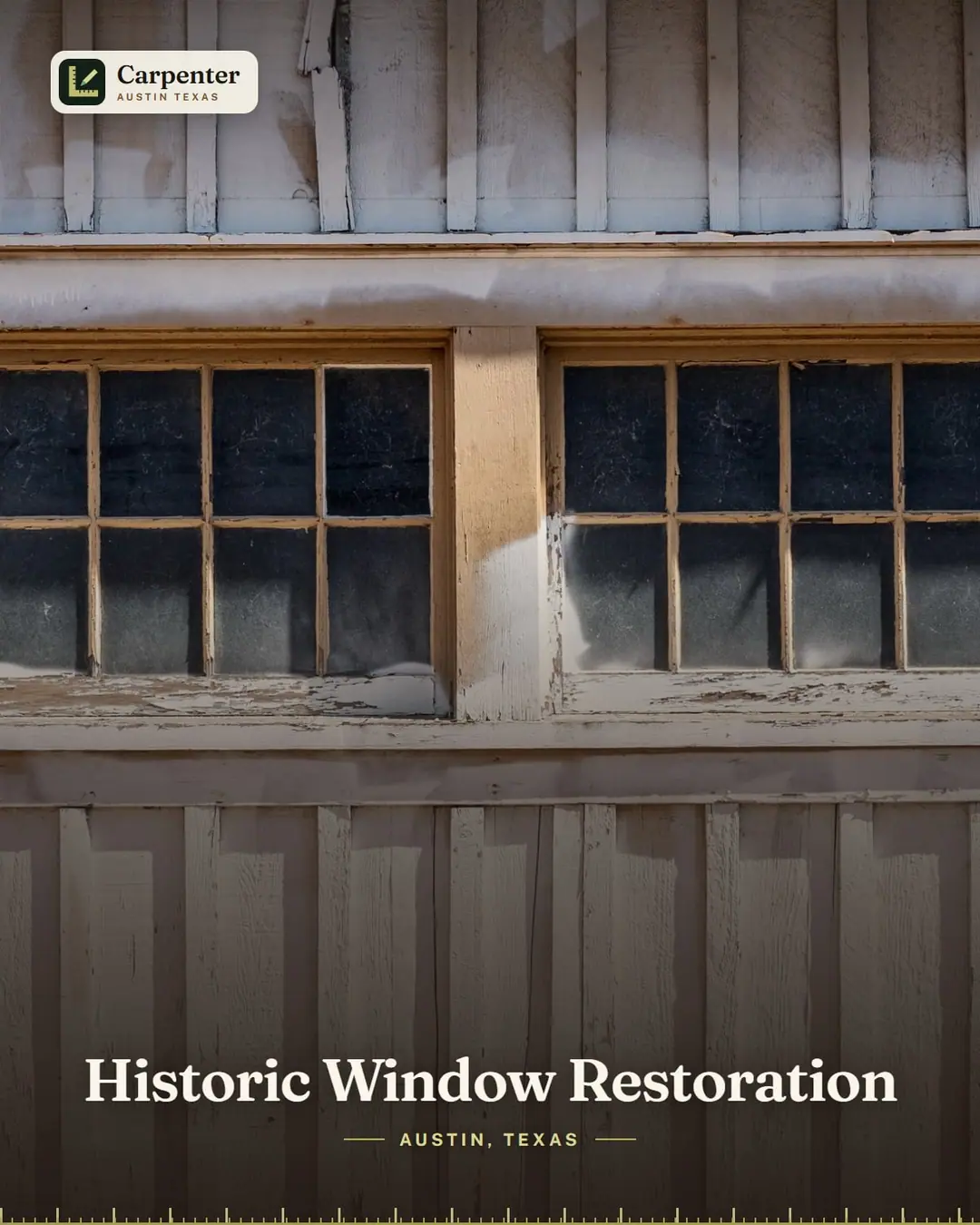
Structural, repair and remodeling · Austin, TX
The tall wood windows in your house have been painted shut for years. Two of the sash cords are broken, glazing putty is falling out in chunks, and a replacement salesman just told you the whole set is "shot."
Usually it isn't. Carpenter Austin Texas restores original wood windows in Austin homes. We free and rebalance the sashes, reglaze the glass, and repair rotted sills and rails. Weatherstripping and storm windows come next, so the windows open smoothly and seal better while the house keeps its original look.
Historic window restoration in an older house means working with old paint, and in homes built before 1978 that paint likely contains lead. Federal rules require lead-safe practices for paid work that disturbs it. Wood window restoration is one part of our historic home restoration in Austin work. Every estimate is free and written.
We'll check each window and tell you honestly what can be restored, with a written price per window. We show up on time, keep the work area tidy, and clean up every day.
01Good to know
There are four practical reasons to restore rather than replace.

Many original windows were made from dense, slow-grown lumber that resists rot better than much of the lumber sold today. Once a sash made from it is gone, the same wood is hard to buy.
Every part of an old wood window, from the glass and putty to the cords, sash and sill, can be fixed or replaced on its own. Most modern windows can't be taken apart that way.
Original windows are usually a character-defining feature. In the City's local historic districts, in-kind repair is exempt from historic review, while replacing original windows on a contributing property is an exterior change that goes through review.
Weatherstripping and storm windows deal with most drafts and add an insulating layer of air. Replacement windows have their place, and some houses need them. But "old" alone isn't a reason to replace a window that can be repaired.
Putty, paint and cords wear out first, while the sash and frame can last far longer if those small parts are kept up. Restoration renews the worn parts and keeps the durable ones.
The slight distortion in old panes catches light differently from modern glass, and a row of restored windows keeps that look across the front of the house. Replacing a whole set erases it at once.
Because each window works on its own, you can restore the worst exposures first and the rest later. Replacement projects are usually priced and installed as a set, so restoration gives more room to plan around a budget.
02Warning signs
Most window problems start small, with paint or putty, and the earlier you catch them the less original wood needs repair.
layers of paint seal the sash to the stops, or moisture has swollen the wood.
a cord has broken, or a pulley has seized.
worn parting beads and no weatherstripping.
sun and age have dried it out.
putty failure, settling, or an old impact.
the wood has been left bare to the weather.
water has been sitting where those parts meet.
condensation has run down the glass and soaked the wood.
Start outside on the south and west sides. Press a fingernail into the glazing putty: it should be firm, not rock-hard and cracked. Look where the bottom rail meets the sill for open joints or grey, bare wood.
Inside, try raising and lowering each sash. A sash that drops when you let go has a broken cord or a detached weight, and one that will not move at all is usually painted or swollen shut. Note which windows have which problem.
Probe soft-looking spots on sills and bottom rails with a small screwdriver. If the tip goes in easily, mark the spot so the extent of rot can be checked properly. Avoid forcing a painted-shut sash with a hammer or pry bar, which cracks glass and splits rails.
Most of these are repairable, often without replacing any original wood at all.

Wood should be cut, fitted, and finished like it’s meant to last a lifetime.
03What we do
Wood window restoration in Austin covers seven kinds of work. A single window may need one or all of them.
Reglazing is the heart of window restoration, because the putty is what seals the glass to the sash. Once it fails, water gets into the joints and the wood starts to rot from inside.
The sash comes out of the frame. Failed paint and old putty are removed using lead-safe methods, and loose joints are repaired. Cracked panes are replaced. Then the glass is bedded and glazed with fresh glazing compound, which has to cure before paint goes on.
The final coat of paint laps slightly onto the glass. That thin overlap seals the edge of the putty against rain.
Glazing compound works best tooled into a smooth bevel that sheds water away from the glass. Painting it before it has skinned over traps solvents in the putty and can make the paint wrinkle or fail early.
Most old double-hung windows run on a counterweight system. A cord attached to each side of the sash runs over a pulley at the top of the frame and down to a weight hidden in a pocket inside the wall. When it's working, the sash glides and stays wherever you leave it.
Restoration means opening the weight pockets, replacing broken or rotten cords, and freeing and cleaning the pulleys. Then each sash is rebalanced, so it moves smoothly and doesn't creep up or slide down.
Weights were matched to the sash when the house was built. Heavier glass or a thicker panel in a sash can upset that balance, so any change to the sash is checked against its weights before the window goes back together.
Bottom rails and sills rot first, because that's where water sits. Small areas of decay can be consolidated and filled with epoxy. Larger damage gets a dutchman: the rotted wood is cut out and a fitted piece of new wood is glued in. When a sill is too far gone, it's replaced in a matching species, as part of restoring the whole window.
If the rot continues past the window into the wall framing around the opening, it becomes a structural job. See wood rot repair in Austin.
Rot repairs last longest when the cause is fixed with them. A sill that has lost its slope, a missing drip cap over the head casing or an open joint at the bottom rail lets water back in, so those details belong in the same repair.
Ask about thisRead the wood rot & termite damage repair page
Weatherstripping an old window doesn't have to change how it looks. Low-profile strips fit into the jambs where the sash slides, and seals go on the meeting rails where the two sashes overlap. New parting beads and stops are set snug against the sash.
Together, those details stop most of the rattling and much of the air that leaks around an old sash, and from the street the window looks the same.
Good weatherstripping still lets the sash slide. A seal that makes a window hard to lift tends to get left closed or torn out, so the fit is adjusted until the sash moves smoothly and still closes snug.
A storm window, inside or outside the original, protects the restored sash from weather. It also adds an insulating layer of air. Slim modern storms are hard to see from the street, which matters in a historic district. Storm windows are also sold with low-e glass, which cuts down the heat coming through the glass.
Wood screens can be rebuilt, or new ones made to match the originals.
Interior storms stay clean and out of the weather, while exterior storms also shield the old sash and sill from rain. Either way, the storm needs a path for trapped moisture to escape so condensation does not sit against the old wood.
Old glass has slight waves and ripples in it, and we save it wherever we can. When a pane is broken, it can be replaced with salvaged old glass, or with restoration glass made to look like it. Plain clear glass works too, if you prefer.
In some spots, such as glass close to a door or near the floor, the building code can require safety glass. We check the code before choosing replacement glass for those spots.
Old glass is thinner and more brittle than modern glass, so it is cut and set with care. Salvaged panes are best chosen to match the waviness of their neighbors, so a replacement pane does not stand out in the same sash.
Many of the same skills apply to original wood doors. Loose panels get re-glued. Rot at the bottom rail is repaired with a dutchman or a splice. Glass lites in the door, and the transom above it, are reglazed. Then the door is re-hung so it swings and latches, and weatherstripped.
That overlap is why a carpenter who can restore doors and windows usually takes on both in the same house. When a door is past saving, or you want a new front door, see Austin entry door installation.
A door's bottom rail and threshold take the same punishment as a window sill: standing water and sun. Keeping the threshold sloped and the bottom edge of the door painted, underside included, protects the repaired wood.
Not every window needs the same work. A window with sound putty and a broken cord may only need its cords replaced and its sash freed, while one with failed putty, loose joints and a soft bottom rail needs full restoration. Matching the work to the window puts money where it does the most good.
Decide early which windows need to open. Some rooms only need a few working windows for airflow, while bedroom windows that serve as an emergency escape have to open. That choice affects how much cord and pulley work each window gets.
Think about the inside finish too. Interior sash and trim are sometimes stained and varnished rather than painted, and keeping that finish means extra care around it during repairs.
04Rules & permits
Windows are one of the main sources of lead dust in older homes. EPA warns that old lead paint can produce hazardous chips and dust, "especially on surfaces subject to constant friction like doors or window sills." Every time a painted sash slides in its frame, it wears a little paint into dust.

EPA's Renovation, Repair and Painting (RRP) rule requires anyone paid to disturb painted surfaces in homes built before 1978 to be certified and trained in lead-safe work practices. EPA estimates that about three-quarters of US homes built before 1978 still contain some lead-based paint. Small jobs can be exempt, but EPA says window replacement is always covered, whatever its size.
EPA still urges them to follow lead-safe practices.
Much of the paint removal can happen away from the house, where dust is easier to control.
A sash that rubs painted jambs grinds a little paint into dust every time it moves. Restoring the window with sound paint and smooth-running parts cuts down that wear.
Wipe sills and the trough between the sash and the storm with a damp cloth rather than a dry duster or broom, which lifts dust into the air. If you have concerns about young children, ask your doctor about a blood lead test.
The rule generally does not cover homeowners on their own homes, but the dust is just as harmful. Mist before scraping, contain the area, and clean up with a HEPA vacuum and damp wiping.
05How it works
Eight stages take each window from a numbered survey to a balanced, tested sash, and every window keeps its own number throughout.
each window is numbered and rated in a written window schedule.
The survey gives every window a number, usually marked on a simple plan of the house, and a written rating for its condition. Each one is checked for putty, paint, glass, cords, sash joints, sill and frame, and for whether it opens, stays where it is left and locks.
The schedule turns a house full of windows into a list you can act on. It shows which windows need only a tune-up, which need full restoration and which have rot reaching into the frame. You can see where the worst exposures are, usually south and west, and decide which windows matter most to you, such as those on the street front.
What to expect You see each window numbered and rated, and point out the ones that bother you most or matter most to the house.
a basic tune-up, full restoration, or storm windows.
Pricing each window separately makes the choices clear. A tune-up suits a window whose sash and putty are mostly sound but which sticks or has a broken cord. Full restoration suits a window with failed putty, loose joints or decay. Storm windows add a further layer against weather and heat.
You can mix options across the house: full restoration on the street front, tune-ups on sheltered sides and storms on the hottest exposures. You can also phase the work, starting with windows where water is getting in. Ask what each option leaves undone so you know what to keep an eye on later.
What to expect You review a price for each window and choose a tune-up, full restoration or storm windows for each one, or a mix.
Before any paint is disturbed, the floor and wall area inside each window are covered with plastic sheeting, and furniture is moved back or wrapped. Outside, sheeting on the ground catches paint chips and old putty, and the area is marked so nobody walks through it.
Lead-safe setup treats old paint as if it may contain lead unless testing shows otherwise. Keep children, pregnant family members and pets out of the marked rooms until the work there has been cleaned and checked. Move delicate items off nearby sills and shelves, and mention any vegetable garden or play area under the windows.
What to expect You clear the area around each window, keep family and pets out of marked rooms, and see containment set up first.
Removing a sash starts with the interior stop, which is often painted over and has to come off without splitting. The lower sash comes out, its cords are detached and tied off, then the parting bead is removed so the upper sash can come out. Each sash and its parts are labelled with the window number so they return to the same opening.
Stops and beads are often original and fragile, so they are eased off gradually along their length rather than pried hard at one point. While the sash is out, the opening is secured. Ask how the opening will be covered so you can plan for security, weather and cooling in that room.
What to expect You see each sash labelled and removed, and you know how its opening is secured while the sash is out.
paint and putty removal, repairs, reglazing and priming.
Old putty and failed paint are taken off using lead-safe methods. Glass is removed where needed and kept with its own sash. Loose joints are reglued and tightened, and decay in the rails is consolidated and filled, or cut out and patched with new wood.
The bare wood is primed so the new glazing compound bonds and does not dry out too fast. The glass is bedded, held with glazing points and glazed, and the compound is left to cure before paint. You decide here on glass for any cracked panes: salvaged old glass, restoration glass or plain clear glass.
What to expect You choose replacement glass for any cracked panes and see each sash primed and glazed before it is painted.
sills, pulleys, cords, parting beads and weatherstripping.
With the sashes out, the frame is open for repair. Sills are checked for rot and slope, and damaged sections are patched or replaced in a matching species. Pulleys are freed and cleaned, the weight pockets are opened and the cords are replaced.
The parting beads and stops are refitted snug, and weatherstripping goes in at the jambs and meeting rails. It is also the moment to look into the pocket for water damage in the wall. If rot runs into the wall framing, it becomes a separate structural repair, and you see the damage before any extra work is agreed.
What to expect You see frames repaired, cords replaced and weatherstripping fitted, and you are shown any rot that runs into the wall.
Each sash goes back into its own numbered opening. Cords are cut to length so the sash travels fully up and down without the weights hitting the bottom of the pocket or the pulley. The upper sash goes in first, then the parting bead, then the lower sash and the interior stop.
Balance is tested by raising each sash and letting go part way: it should stay put, not creep up or drop. Locks are checked so the meeting rails pull tight together. Try each window yourself before the job is closed out, and if a sash feels stiff or loose, say so then.
What to expect You raise and lower each sash yourself, check that it stays put and locks tight, and point out any that feel wrong.
Paint is coordinated so the final coat laps slightly onto the glass and seals the edge of the putty. Sashes are opened and closed once the paint is dry to the touch so they do not stick, and the work area is cleaned with HEPA vacuuming and wet wiping, then checked.
The care instructions cover what to watch: putty and paint each spring, condensation on interior stools and the drain holes in storm windows. Ask for a copy of the window schedule and keep it with your house records, since it tells future owners which windows were restored and what was done to each.
What to expect You walk the finished windows with us, get care instructions, and see the rooms cleaned before you use them again.
How long it takes depends on the number of windows and on glazing cure time. Your estimate gives a schedule.
06What we do
Two things shape how original windows should be treated in Austin: the Central Texas weather, and the City's historic review rules.
Austin's long, hot summers and strong sun dry out glazing putty and paint fastest on south- and west-facing windows. Then a sudden storm blows water into every open joint and onto the sills. That's the cycle that rots bottom rails.
The fix is maintenance more than anything. Keep the putty and paint in good shape, and keep sills sloped so water runs off them. On the worst exposures, add exterior storm windows.
Put south and west windows on a closer watch than the rest. Checking those sides first each year catches the putty and paint failures that lead to rot before they spread into the rails.
Austin's summers are long and hot, and winters are short. That puts the focus on two things: air leaking in and out around the sashes, and the sun's heat coming through the glass.
Restored windows with weatherstripping deal with the leaks. Storm windows add a layer of air, and low-e storm glass cuts the heat coming through. Shades and awnings help on the sunny sides too. We don't promise a savings figure, because that depends on the house.
Interior shades and exterior awnings work alongside storms. Closing shades on west windows on summer afternoons keeps a good share of the heat out of the room without changing the original window at all.
In the City of Austin's local historic districts, exterior changes to contributing properties need review by the Historic Preservation Office or the Historic Landmark Commission. Routine maintenance and in-kind repairs are the exception. So restoring your original windows usually avoids review, while replacing them doesn't.
City landmarks follow similar rules, and the Commission reviews certificates of appropriateness for them. Approval decisions rest with the City, so check before you plan a replacement.
If you plan to add storm windows on a contributing property, ask the Historic Preservation Office early whether your choice needs review, since storms change how the window looks from the street.
The bottom of the window does the hardest work. A sill needs a clear slope away from the house and a drip groove underneath so water falls off instead of running back to the wall. Unbroken paint on the sill's end grain matters as much as the paint on its face.
The head casing at the top needs a drip cap or flashing so water running down the wall is kicked out past the window. On many old houses that piece has rotted away or been lost under later siding work.
Caulk has a role, but not everywhere. Sealing the joint between exterior casing and siding helps, while caulking a sash shut or blocking drain paths traps water inside instead of keeping it out.
07Pricing
Window restoration is priced window by window, so condition, size and the number of windows matter more than any published average.
Angi's Austin window repair cost page shows an average of about $558, with most jobs between roughly $258 and $857, and notes that historic homes can cost more.
HomeGuide's national guide (February 2026) puts typical window repair at $175 to $600 per window and sash or track repair at $200 to $500. It puts full window replacement at $400 to $2,000 per window.
Full restoration of a badly deteriorated sash sits above simple repair, because every part gets work. These are published figures, not our prices. Your written estimate prices each window.
Restoring the south and west windows first, where weather damage moves fastest, protects the most vulnerable wood. Sheltered windows on the north and east can often wait for a later phase.
Containment, sash removal and paint removal all take setup, so restoring every window in a room or along one side of the house together usually costs less per window than doing them one at a time.
A storm shields the restored sash from rain and sun, which stretches the gap between paint and putty jobs. Count that in when you compare restoration with replacement.
08Side by side
Restoration isn't always the answer. Here is when each makes sense.
| Restoration makes sense when... | Replacement may make sense when... |
|---|---|
| The windows are original on a historic or character home | The windows are already non-original and failing |
| The frames are sound | Rot runs through both frames and sashes |
| You value the original look | Lowest maintenance is your top priority |
| The house is in a historic district | The windows are in a non-historic addition |
How many windows are actually failing? A verdict on a whole house often rests on the worst few windows. A window-by-window survey may show that most are sound, with problems concentrated on one or two sides.
What will replacement change on the outside? New units often have thicker frames and less glass, and they may need new trim or a different sill. Look at a sample installed in a similar house before deciding, especially for the street front.
What happens when the new windows wear out? Replacement units are not made to be taken apart, so when seals or parts fail, the whole unit is often replaced again. Weigh that against restored wood that can keep being repaired.
Some houses end up with a mix: original windows restored on the street side, and newer units on a later addition. When replacement is the right call, see our window replacement options.
09Why us
If you're looking for a master craftsman who restores doors and windows in Austin, TX, ask how each window will be repaired. Here is how we work.
Original glass, sash and frame stay wherever they can.
We clean up, and your written estimate is priced per window.
Ask whether you will get a written survey and a price for each window. A single lump sum makes it hard to see what each window needs or to phase the work over time.
Ask how glass is removed and stored and how old panes are protected. Old glass breaks easily, and a careful answer tells you the restorer values it as much as you do.
Ask how lead paint is handled, how openings are secured while sashes are out, and what a finished sash should do: travel smoothly, stay put when you let go and lock tight.
Wood should be cut, fitted, and finished like it’s meant to last a lifetime.
10Care & upkeep
A few minutes per window each year keeps restored sashes sealed, painted and running smoothly.

Small cracks in glazing putty can be dealt with before they open up. Remove loose bits by hand with lead-safe care, prime any bare wood, then fill with fresh glazing compound and paint once it has skinned over. Larger failures are better left for a full reglaze.
A sash that starts to stick usually needs its tracks cleaned and a little paraffin wax rubbed on the jambs, not force. If it still binds, the stops may need resetting.
Before storm season, check that storm windows are closed and latched and that sills drain freely. After a hailstorm, look for cracked panes and chipped paint on the exposed sides and get them repaired before rain gets in.
11Service area
We restore windows across Austin, and the older central, east and south-central neighborhoods hold most of the original wood windows.
older bungalows and cottages, historic districts like Hyde Park, and renovations on tight lots.
(737) 415-9388Central Austin, TX
mid-century ranch homes in established neighborhoods.
(737) 415-9388North Austin, TX
mid-century houses, many due for new trim or decks.
(737) 415-9388North Central Austin, TX
newer subdivisions sitting on the clay east of I-35.
(737) 415-9388Northeast Austin, TX
Hill Country lots on sloped limestone, with decks built for the view.
(737) 415-9388Northwest Austin, TX
newer subdivisions where builder-grade trim and fences often need upgrades.
(737) 415-9388Far North Austin, TX
older homes east of I-35 on clay soil, with plenty of infill and renovation.
(737) 415-9388East Austin, TX
hillside homes on limestone, where decks and stairs follow the slope.
(737) 415-9388West Austin, TX
established neighborhoods with a mix of older and newer homes.
(737) 415-9388South Austin, TX
older houses around neighborhoods like Travis Heights, many with porches and original trim.
(737) 415-9388South Central Austin, TX
older homes, rentals and newer infill south of Lady Bird Lake.
(737) 415-9388Riverside, Austin, TX
growing neighborhoods on clay soils, where doors and trim feel the ground move.
(737) 415-9388Southeast Austin, TX
hillside lots with decks and views toward the Hill Country.
(737) 415-9388Southwest Austin, TX
In older central neighborhoods, many houses keep tall double-hung windows on weights and pulleys, and street-facing windows on contributing properties fall under historic review if they are replaced.
East of I-35, foundation movement on clay can rack window frames out of square, so sashes bind or gaps open at the meeting rails. Adjusting the frame often matters as much as the sash work there.
Across the city, south and west exposures and storm-facing sides take the most wear, so a survey usually starts with those windows and works around the house from there.
Most original wood windows are in the older central, east and south-central neighborhoods.
12Questions
It depends on the windows' condition and on what you'd replace them with. Restoration often compares well against quality wood replacement windows, though against basic vinyl units it usually costs more up front. Your estimate shows what restoring each window would cost, so you can compare.
It varies with size and condition. HomeGuide's national guide puts general window repair at $175 to $600 per window, and full restoration of a badly worn sash costs more. Your written estimate prices each window separately.
Original windows in working order matter to buyers of historic homes. We don't quote a resale percentage, because we haven't seen a reliable Austin figure for it.
Yes. Start with the worst windows, or the most visible ones, or work one side of the house at a time.
They're a separate line item for each window. Storms protect the restored sash from weather and add an insulating layer of air, so they're worth pricing for the south and west walls even if you skip them elsewhere.
Possibly. If your home is a contributing property in a local historic district, the work may qualify for the City's rehabilitation tax abatement, which applies to City taxes on the value the work adds. Ask the City about eligibility before you start.
It depends on how many windows there are and on how long the glazing compound takes to cure. Your estimate gives a schedule for the whole house.
No. Each opening is secured while its sash is out, so the house stays closed against weather and intruders.
Usually, yes. The paint seal is cut, the stops are removed, and the sash is freed and rebalanced.
Yes, for common types. Casements and transoms use the same glazing, joinery and rot repair methods as double-hung sashes.
Sashes are primed and the glazing is sealed before they go back in. Whether finish painting is included is spelled out in your estimate.
Single glass on its own isn't. But most of the comfort problem with old windows is air leaking around the sash, and weatherstripping plus storm windows deal with most of it.
Yes. They cut air leakage around the old sash. With low-e glass, they also cut the sun's heat coming through. We don't promise a savings figure, because it varies from house to house.
Some sashes can be modified to take insulated glass, but it adds weight, needs new balancing and changes the historic look. Storm windows are the usual answer.
Mostly. Weatherstripping and snug parting beads stop most drafts, and storms help further.
Yes, noticeably, once the gaps are sealed and storm windows added. We don't quote decibel figures.
With paint and putty kept up, they can keep working for decades more. That's how the originals lasted this long in the first place.
Likely, if the home was built before 1978. Only testing confirms it, either by a certified professional or with an EPA-recognized test kit.
Yes, when lead-safe practices, containment and cleaning verification are followed. Keep children and pets out of the work areas until cleanup is done.
Yes, for paid work that disturbs paint in homes built before 1978. Small jobs can be exempt by size, but EPA says window replacement is always covered.
Not the way it used to be. Under the RRP rule, open-flame burning of painted surfaces is prohibited, heat guns must stay below 1,100 degrees Fahrenheit, and power sanders need shrouds and HEPA vacuum attachments.
Handy owners can, following EPA's lead-safe practices for do-it-yourself work. It's slow, careful work, one sash at a time.
Where the building code requires safety glass, yes, for example in some glass close to a door or near the floor. Elsewhere, you can choose old, restoration or clear glass.
Not without review, if the house is a contributing property in a local historic district. Restoration and in-kind repair generally don't need review.
Restoration is repair work, done in kind. For anything beyond that, such as changing window sizes, we check with Austin Development Services first.
Usually, if they're slim and can be removed later without damage. Check your district's design standards first.
Mostly wood double-hung windows. Casements and transoms are common too, and some later homes have steel windows.
Yes. Original wood doors and transoms get the same repairs: rot repair, reglazing, re-hanging and weatherstripping. For a new door, see our entry door installation page.
13Keep exploring
Historic window restoration is one part of what we do. The same crew handles the services below, so one call covers the whole job.

Historic home restoration carpentry in Austin: millwork matching, porch restoration and in-kind repairs that suit historic review. Free written estimates.
See the service
Rough carpentry in Austin: wall and roof framing, beams, attic conversions and pier-and-beam repair, built to engineer plans. Free written estimates.
See the service
Carpentry repair in Austin for loose trim, rotted posts, stairs, and water, storm or fire damage. Small jobs welcome, with a free written estimate.
See the service
Kitchens, baths, open layouts, garage conversions and aging-in-place work from Austin carpenters who frame and finish it. Free, clear written estimates.
See the service
Commercial carpentry in Austin for tenant finish-outs, office build-outs, retail fixtures, millwork and property repairs. Clear written bids, on time.
See the serviceFree written estimate
Keep your original windows working for another hundred years. You get a written per-window estimate, we show up on time, and we leave a clean site.
From a single rotted porch post in a 1920s bungalow to a custom cedar deck overlooking the Hill Country.
Original trim, porches and windows repaired with lumber, fasteners and finishes chosen for Central Texas.
Tenant improvements, commercial millwork and ongoing repairs for rental homes.


